Japan Detonator Market Size & Growth Rate
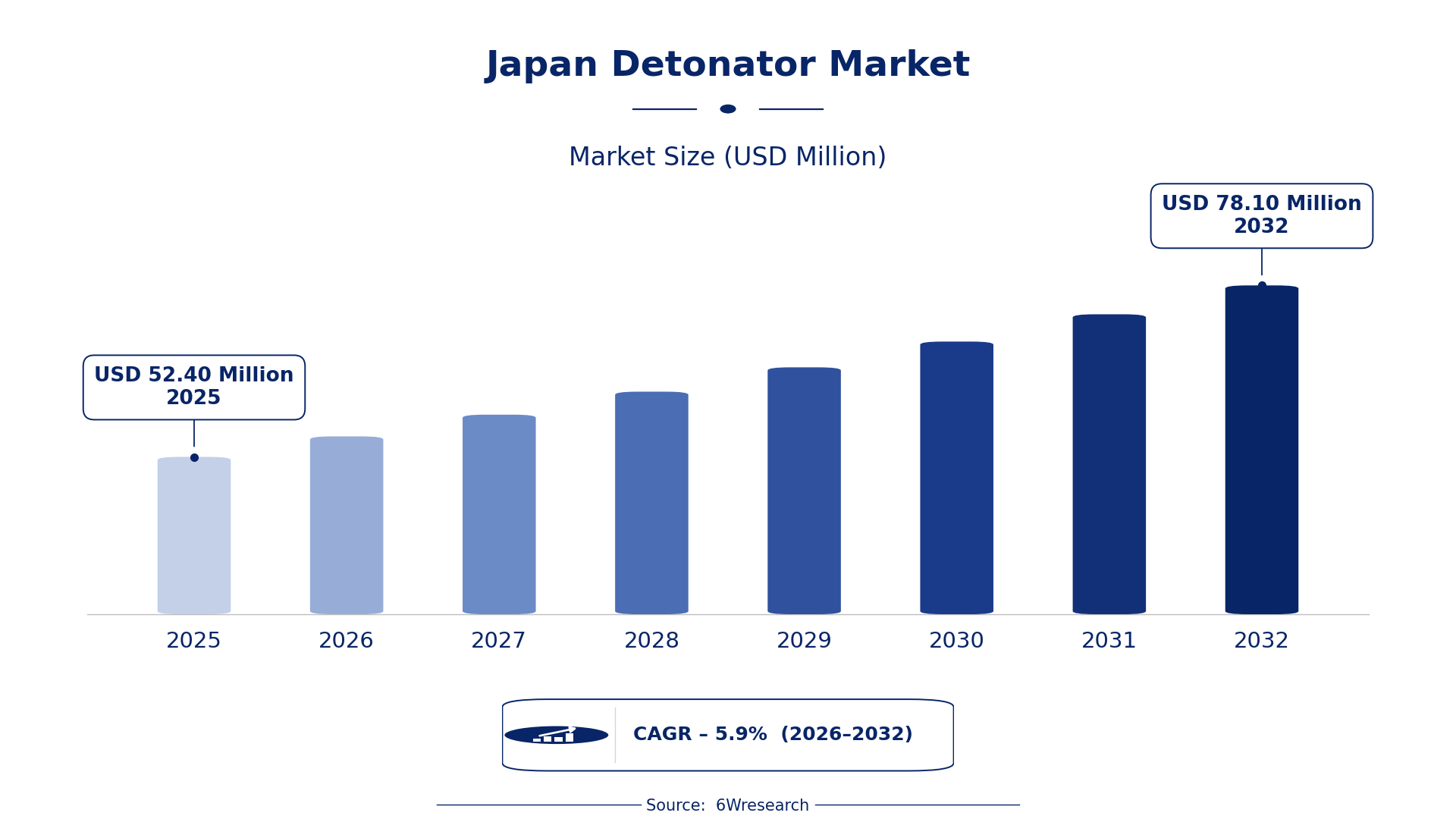
According to 6Wresearch internal database and industry insights, the Japan Detonator Market was valued at USD 52.40 Million in 2025 and is projected to reach USD 78.10 Million by 2032, growing at a CAGR of approximately 5.9% during 2026–2032.
Japan Detonator Market Highlights
| Report Metric | Details |
| Report Name | Japan Detonator Market (2026-2032) |
| Market Size 2025 | USD 52.40 Million |
| Market Size 2032 | USD 78.10 Million |
| Absolute Growth 2025–2032 | USD 25.70 Million |
| CAGR 2026–2032 | 5.9% |
| Peak Annual Growth | 7.5% in 2032 |
| Forecast Period | 2026–2032 |
| Historical Data | 2022–2025 |
| Base Year | 2025 |
| Leading Type, 2025 | Industrial electric detonators (57% share) |
| Leading Application, 2025 | Coal Mines (39% share) |
| Fastest-Growing Type | Shock Tube Detonators (8.3% CAGR) |
| Fastest-Growing Application | Metal Mines (8.4% CAGR) |
| Growing Sector | Metal Mines |
| Key End Users | Coal Mines, Metal Mines, Non-metal Mines, Railway/road |
Japan Detonator Market Year-wise Growth Rate and Key Drivers (2022–2032)
This graph illustrates the annual growth rates of the market from 2022 to 2032, highlighting a steady upward trajectory and projected market expansion over the forecast period.
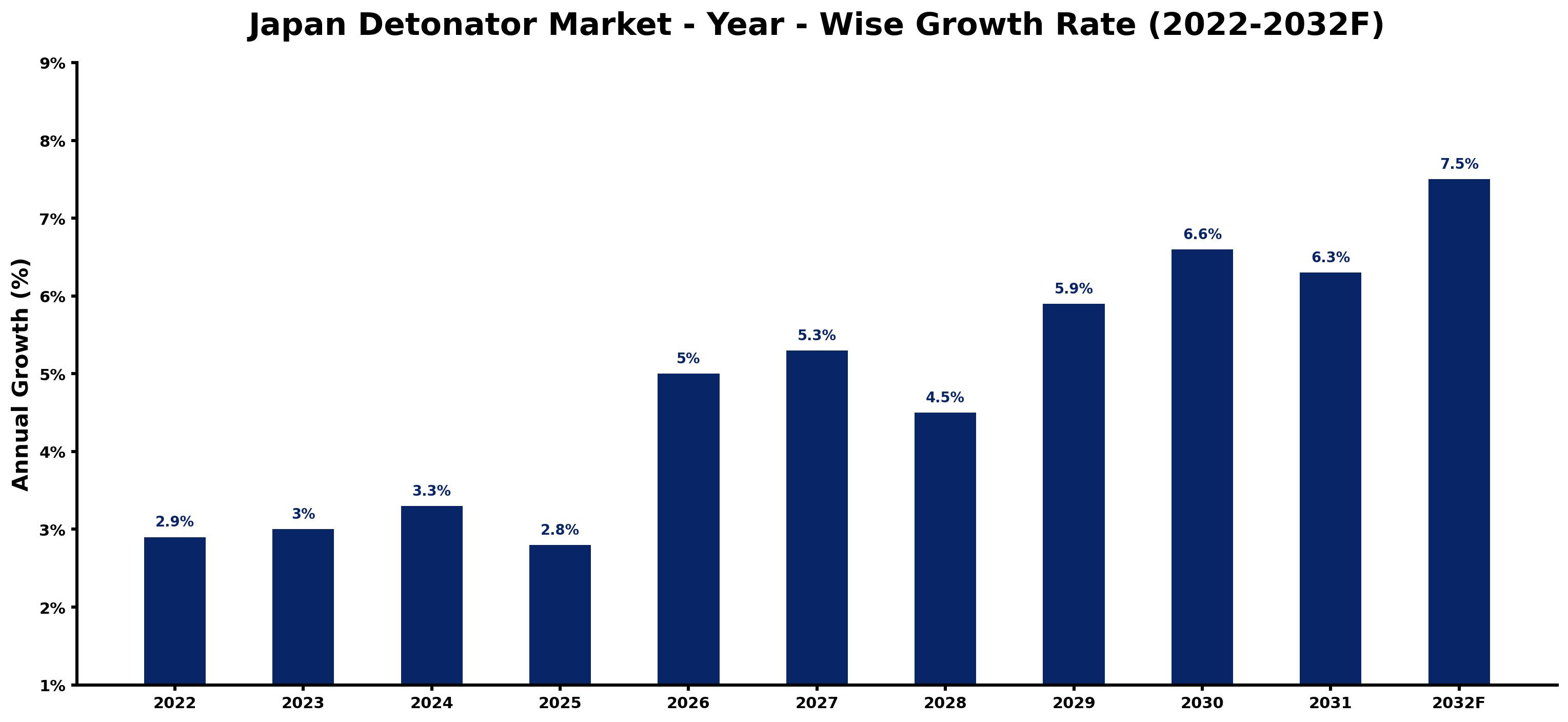
Year by year, the estimates below pair each growth rate with the development that shaped it.
| Year | Estimated Annual Growth (%) | Market Rationale |
| 2022 | 2.9 | The market experienced stable growth with consistent demand from domestic mining operations. |
| 2023 | 3.0 | Increased investments in mining infrastructure contributed to a rise in demand for detonators. |
| 2024 | 3.3 | The market saw a boost as coal production remained steady, leading to higher detonator usage. |
| 2025 | 2.8 | Growth slowed slightly due to market saturation in certain mining applications. |
| 2026 | 5.0 | New projects in the metal mining sector are expected to drive demand for detonators. |
| 2027 | 5.3 | Continued investments in coal and metal mines are likely to sustain market growth. |
| 2028 | 4.5 | Growth is projected to slow as the market adjusts to previous high demand levels. |
| 2029 | 5.9 | Increased focus on safety standards in construction is expected to boost detonator sales. |
| 2030 | 6.6 | The anticipated rise in hydropower projects will further increase detonator demand. |
| 2031 | 6.3 | Growth will moderate as the market stabilises after several years of rapid expansion. |
| 2032 | 7.5 | The peak growth rate reflects heightened demand from both mining and construction sectors. |
Note: Market size estimations and growth projections presented in this report are based on 6Wresearch's proprietary forecasting methodology, utilizing the latest available industry data, government publications, and primary research inputs.
Japan Detonator Market Synopsis
Detonators are explosive devices designed to initiate explosives in various applications, primarily in mining, construction, and demolition. The Japan Detonator Market is growing due to investments in the mining sector, which reached ¥50 billion in 2023. The coal mining industry, employing around 5,000 workers, continues to be a major demand source, while the emphasis on safety standards in construction is creating further opportunities. As new technologies develop, the market is set to expand, benefiting both suppliers and buyers.
Market Dynamics Impact Analysis (2026–2032)
| Factor | Type | Impact | Primary Segment Affected |
| Growing investments in coal mining operations | Driver | High | Coal Mines |
| Increased safety regulations in construction | Driver | High | Shock Tube Detonators |
| Rising demand for metal extraction | Opportunity | High | Metal Mines |
| Expansion of hydropower projects | Opportunity | Medium | Hydraulic & Hydropower |
| Strict regulations on explosive materials | Restraint | High | Industrial electric detonators |
| Market saturation in certain applications | Restraint | Medium | Shock Tube Detonators |
| High production costs for compliant detonators | Challenge | High | Industrial electric detonators |
| Limited workforce in the mining sector | Challenge | Medium | Coal Mines |
Evaluation of Drivers in Japan Detonator Market (2026–2032)
These are the developments adding the most demand over the forecast period.
| Drivers | Primary Segment Affected | Why It Matters (Evidence) |
| Increased coal production | Coal Mines | The average annual production of coal in Japan is around 1 million tons, leading to higher detonator demand. |
| Safety regulations in construction | Shock Tube Detonators | The widespread use of shock tube detonators in construction projects improves safety and reliability. |
| Investment in metal mining | Metal Mines | Recent investments in metal mines concentrated in the Tohoku region are increasing detonator needs. |
| Hydropower project expansions | Hydraulic & Hydropower | Recent hydropower projects have increased by 10%, driving demand for detonators in construction. |
| Technological advancements in detonators | Industrial electric detonators | Japan produces industrial electric detonators with JIS standards, ensuring quality and reliability. |
Much of the new demand traces back to the average annual production of coal in Japan, which is around 1 million tons, prompting increased purchases for coal extraction. The focus on safety in construction projects has led to a higher reliance on shock tube detonators, which are essential for various applications. Investments in metal mining, particularly in the Tohoku region, are driving demand as these projects require precise blasting. The recent increase in hydropower projects has created new opportunities for detonator suppliers, as these constructions necessitate reliable explosive initiation. Technological advancements ensure that industrial electric detonators meet stringent JIS standards, boosting buyer confidence in their performance.
Evaluation of Restraints in Japan Detonator Market
These are the pressures that could keep growth below its potential.
| Market Restraint | Primary Segment Affected | Why It Matters (Evidence) |
| Rising costs due to ISO standards | Industrial electric detonators | Producers face rising costs from stringent ISO standards for explosive materials, increasing production expenses by 15%. |
| Regulatory compliance delays | Shock Tube Detonators | Regulatory oversight from the Ministry of Economy, Trade and Industry complicates compliance, causing delays that can extend project timelines by three months. |
| Supply limitations in coal production | Coal Mines | Buyers in the mining sector encounter challenges as the average annual production of coal remains around 1 million tons, limiting supply. |
| Outdated technology adoption | Metal Mines | Technology adoption lags, with many projects still relying on outdated methods, resulting in inefficiencies that can inflate operational costs by 20%. |
| Market saturation in mining applications | Non-metal Mines | Increased competition and market saturation in certain mining applications are constraining growth opportunities. |
Japan Detonator Market Challenges
Producers face rising production costs due to strict ISO standards for explosive materials, increasing expenses by 15%. Regulatory requirements from the Ministry of Economy, Trade and Industry complicate operations, causing project delays that can extend timelines by three months for construction buyers. Buyers in the mining sector encounter supply constraints, as the average annual coal production remains around 1 million tons, driving up prices. Many operations depend on outdated technology, leading to inefficiencies that inflate operational costs by 20% for producers.
Trends in the Japan Detonator Market
Buyers and suppliers in the Japan Detonator Market are adjusting to the following trends.
- Shift from Traditional to Advanced Detonators: The Japan Detonator Market is shifting towards advanced detonator technologies, particularly in the mining sector. With an average annual production of coal at 1 million tons, the demand for reliable detonators is increasing, enhancing operational efficiency.
- Growth in Hydropower Projects: Recent hydropower projects in Japan have increased by 10%, driving demand for detonators in construction. This trend is important for suppliers as it opens new avenues for business in the energy sector.
- Increased Focus on Safety Standards in Construction: Construction companies are prioritising safety standards, resulting in a higher reliance on shock tube detonators. This shift is evident in various construction projects across Japan, enhancing demand for reliable explosive initiation.
- Rising Investment in Metal Mining: Investment in metal mining is growing, particularly in the Tohoku region, which is attracting new projects. This trend will increase the demand for detonators, creating opportunities for suppliers.
Investment Opportunities in the Japan Detonator Market
The following areas offer the clearest openings for investors and suppliers in the Japan Detonator Market.
- Timing for Investment in Coal Mining: With the coal mining industry employing around 5,000 workers, now is an opportune moment to invest in coal extraction technologies. Suppliers can enter the market by collaborating with local mining companies to meet rising demand.
- Growing Demand from Construction Sector: The construction sector is increasingly adopting shock tube detonators for safety, presenting a market opportunity. Suppliers can focus on this segment by ensuring compliance with safety standards and regulations.
- Growth in Metal Mining: The Tohoku region is experiencing a surge in metal mining investments, projected to increase detonator needs. Suppliers can seize this opportunity by forming partnerships with mining operators.
- Expanding Hydropower Projects: The recent growth in hydropower projects offers suppliers a chance to provide reliable detonators. Partnering with construction firms involved in these projects can facilitate market entry.
Government Initiatives in the Japan Detonator Market
The Economic Security Promotion Act (2022) is vital for buyers in the detonator market, as it supports supply-chain resilience for critical products. This measure ensures that producers adhere to safety and quality standards, which is important for maintaining market stability. The act also promotes investments in domestic production, boosting the availability of detonators for various applications.
The Ministry of Economy, Trade and Industry oversees the implementation of regulations affecting detonator production and usage. This agency funds initiatives aimed at improving safety standards in the mining and construction sectors, ensuring that buyers have access to reliable and compliant products.
Future Insight of the Japan Detonator Market
New hydropower projects will drive demand for detonators, as construction activities are expected to rise. By 2032, the government's push for renewable energy sources will reshape the market, promoting advanced detonator technologies. Investment in the mining sector reached ¥50 billion in 2023, enhancing operational capabilities for producers. As safety standards evolve, buyers will benefit from improved reliability and efficiency in detonator performance.
Market Segmentation Analysis
Japan Detonator Market report covers a detailed analysis of the following market segments:
By Type – Industrial electric detonators Lead, Shock Tube Detonators Expected to Grow Fastest
According to Vasudha, AM at 6Wresearch, with 57% of type revenue in 2025, Industrial electric detonators was the largest category. Industrial electric detonators dominate the market because they are crucial for precise blasting in mining operations, ensuring safety and efficiency. Their compliance with JIS standards further solidifies their position as the preferred choice among domestic users in Japan's mining sector. Shock Tube Detonators are projected to grow fastest, at a CAGR of 8.3% during 2026–2032. Shock tube detonators are growing rapidly due to their reliability and safety features, which are increasingly important in construction applications. As safety regulations tighten, their adoption is likely to expand across various sectors, reinforcing their market presence. Suppliers should focus on enhancing safety features in their products to meet the rising demand for shock tube detonators.
By Application – Coal Mines Lead, Metal Mines Expected to Grow Fastest
In 2025, Coal Mines led the application split with a 39% share. Coal mines represent the largest application segment as they are vital for coal extraction processes, which remain active in Japan despite overall production declines. The employment of around 5,000 workers in this sector highlights its importance to the local economy and the demand for detonators. Metal Mines are set to record the highest CAGR in this split, 8.4% over 2026–2032. Metal mines are experiencing rapid growth, driven by increased investments in ore extraction and processing, especially in the Tohoku region. The mining sector's investment of ¥50 billion in 2023 indicates a strong demand for detonators in this area, leading to accelerated growth. Buyers in the metal mining sector can expect an expanded selection of advanced detonator options as investments continue to rise.
Key Attractiveness of the Report
- 10 Years of Market Numbers
- Historical Data Starting from 2022 to 2025
- Base Year 2025
- Forecast Data until 2032
- Key Performance Indicators Impacting the Market
- Major Upcoming Developments and Projects
Key Highlights of the Report:
- Japan Detonator Market Outlook
- Market Size of Japan Detonator Market, 2025
- Forecast of Japan Detonator Market, 2032
- Historical Data and Forecast of Japan Detonator Revenues & Volume for the Period 2022-2032
- Japan Detonator Market Trend Evolution
- Japan Detonator Market Drivers and Challenges
- Japan Detonator Price Trends
- Japan Detonator Porter's Five Forces
- Japan Detonator Industry Life Cycle
- Historical Data and Forecast of Japan Detonator Market Revenues & Volume By Type for the Period 2022-2032
- Historical Data and Forecast of Japan Detonator Market Revenues & Volume By Industrial electric detonators for the Period 2022-2032
- Historical Data and Forecast of Japan Detonator Market Revenues & Volume By Shock Tube Detonators for the Period 2022-2032
- Historical Data and Forecast of Japan Detonator Market Revenues & Volume By Application for the Period 2022-2032
- Historical Data and Forecast of Japan Detonator Market Revenues & Volume By Coal Mines for the Period 2022-2032
- Historical Data and Forecast of Japan Detonator Market Revenues & Volume By Metal Mines for the Period 2022-2032
- Historical Data and Forecast of Japan Detonator Market Revenues & Volume By Non-metal Mines for the Period 2022-2032
- Historical Data and Forecast of Japan Detonator Market Revenues & Volume By Railway/road for the Period 2022-2032
- Historical Data and Forecast of Japan Detonator Market Revenues & Volume By Hydraulic & Hydropower for the Period 2022-2032
- Japan Detonator Import Export Trade Statistics
- Market Opportunity Assessment By Type
- Market Opportunity Assessment By Application
- Japan Detonator Top Companies Market Share
- Japan Detonator Competitive Benchmarking By Technical and Operational Parameters
- Japan Detonator Company Profiles
- Japan Detonator Key Strategic Recommendations
Market Covered
The following segment groups are covered in the report.
By Type
- Industrial electric detonators
- Shock Tube Detonators
By Application
- Coal Mines
- Metal Mines
- Non-metal Mines
- Railway/road
- Hydraulic & Hydropower































