Japan Edtech Market Size & Growth Rate
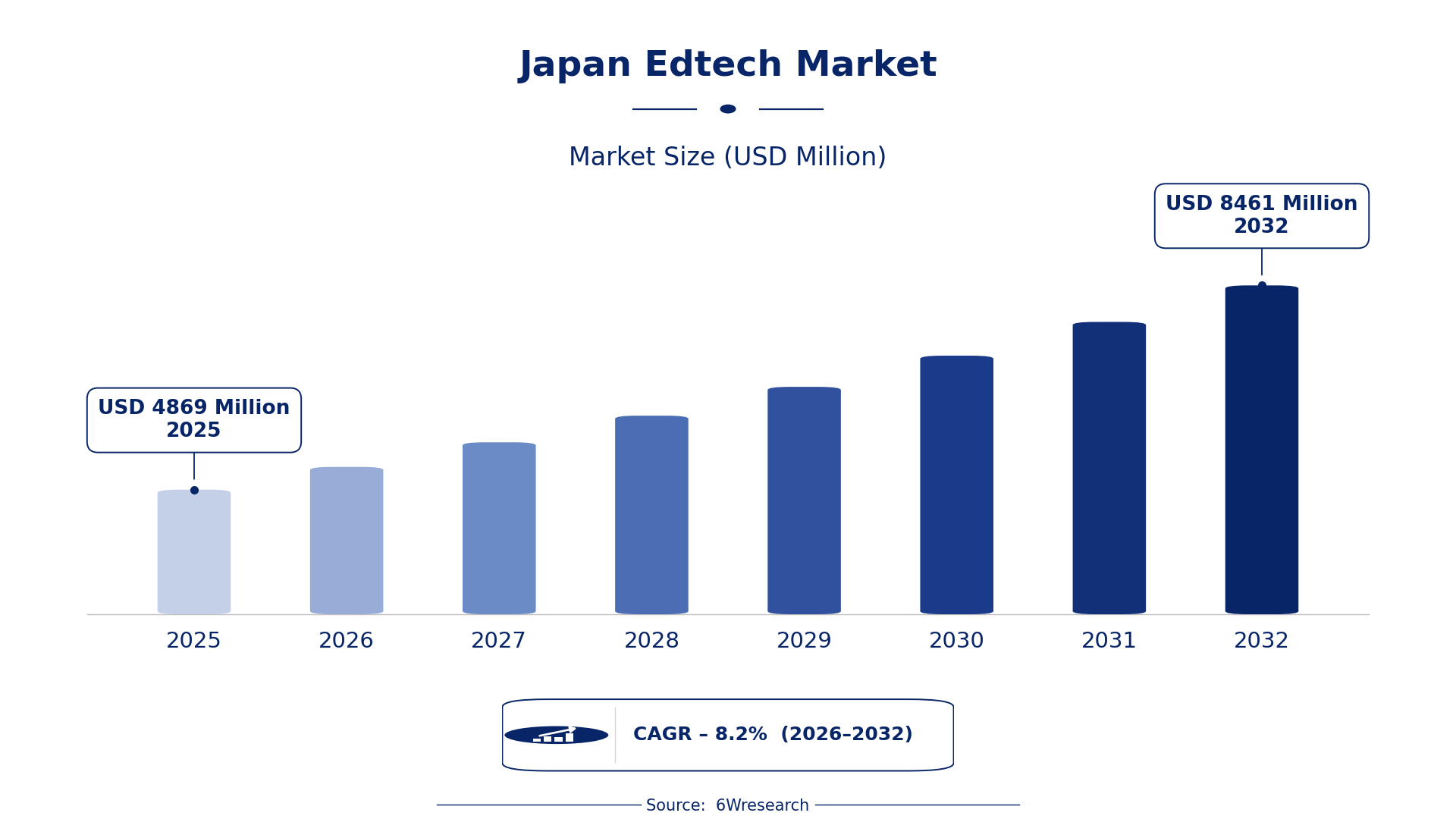
According to 6Wresearch internal database and industry insights, the Japan Edtech Market was valued at USD 4,869 Million in 2025 and is projected to reach USD 8,461 Million by 2032, growing at a CAGR of approximately 8.2% during 2026–2032.
Japan Edtech Market Highlights
| Report Metric | Details |
| Report Name | Japan Edtech Market (2026-2032) |
| Market Size 2025 | USD 4,869 Million |
| Market Size 2032 | USD 8,461 Million |
| Absolute Growth 2025–2032 | USD 3,592 Million |
| CAGR 2026–2032 | 8.2% |
| Peak Annual Growth | 9.6% in 2028 |
| Forecast Period | 2026–2032 |
| Historical Data | 2022–2025 |
| Base Year | 2025 |
| Leading Sector, 2025 | Preschool (46% share) |
| Leading Type, 2025 | Hardware (50% share) |
| Leading Deployment Mode, 2025 | Cloud-based (62% share) |
| Leading End User, 2025 | Individual Learners (46% share) |
| Fastest-Growing Sector | K-12 (10.2% CAGR) |
| Fastest-Growing Type | Software (11.6% CAGR) |
| Fastest-Growing Deployment Mode | On-premises (11.3% CAGR) |
| Fastest-Growing End User | Institutes (10.3% CAGR) |
| Growing Sector | K-12 Education |
| Key End Users | K-12 institutions, higher education institutions, individual learners |
Japan Edtech Market Year-wise Growth Rate and Key Drivers (2022–2032)
This graph illustrates the annual growth rates of the market from 2022 to 2032, highlighting a steady upward trajectory and projected market expansion over the forecast period.
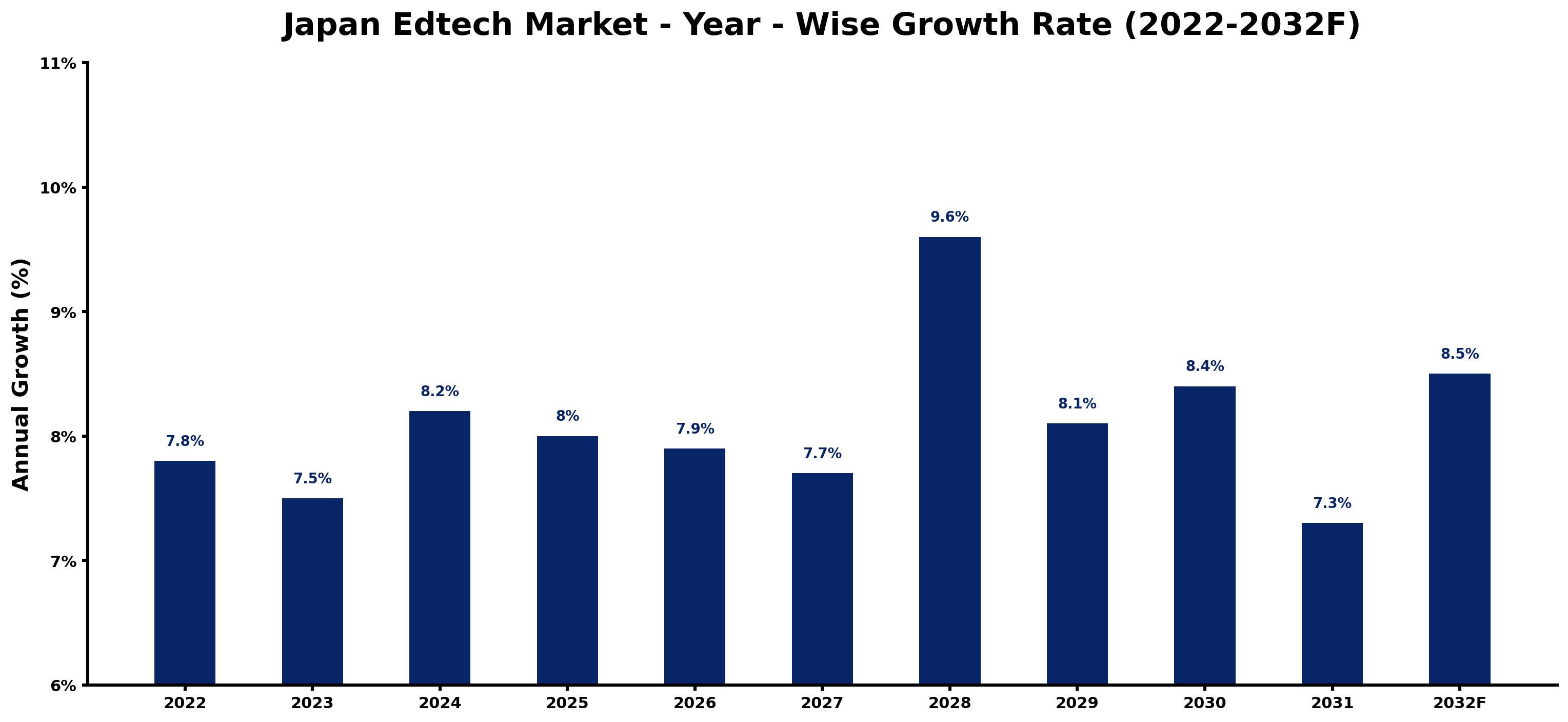
For each year, the table pairs the estimated growth rate with the leading influence on demand, showing how the drivers changed across the period.
| Year | Estimated Annual Growth (%) | Market Rationale |
| 2022 | 7.8 | The market experienced steady growth as educational institutions began integrating technology into their curricula. |
| 2023 | 7.5 | Growth slowed slightly as K-12 institutions focused on refining existing Edtech implementations. |
| 2024 | 8.2 | Demand increased as more higher education institutions adopted Edtech solutions for online learning. |
| 2025 | 8.0 | Growth decelerated as the market stabilised after a surge in digital learning initiatives. |
| 2026 | 7.9 | The market is expected to continue growing as institutions adjust to new technologies. |
| 2027 | 7.7 | A further slowdown is projected as educational institutions prioritise budget allocation for essential resources. |
| 2028 | 9.6 | Demand is expected to surge as new digital learning programmes are introduced, improving educational delivery. |
| 2029 | 8.1 | Growth is projected to slow as the market adjusts to the saturation of certain Edtech solutions in schools. |
| 2030 | 8.4 | An increase in demand is expected as institutions expand their digital offerings and resources. |
| 2031 | 7.3 | The market will experience a slowdown as institutions focus on optimising existing Edtech solutions. |
| 2032 | 8.5 | Growth is projected to accelerate again as new educational technologies gain traction among individual learners. |
Note: Market size estimations and growth projections presented in this report are based on 6Wresearch's proprietary forecasting methodology, utilizing the latest available industry data, government publications, and primary research inputs.
Japan Edtech Market Synopsis
Edtech encompasses technology and digital tools designed to improve education, including software, hardware, and content for K-12 and higher education. In Japan, over 3 million K-12 students are using Edtech solutions, supported by government initiatives and a focus on digital literacy. The Japan Edtech Market is expanding due to investments in educational technology, with a projected size of USD 8,461 million by 2032, driven by efforts to integrate Edtech in all schools by 2025 and the allocation of ¥10 billion for Edtech initiatives in 2023.
Market Dynamics Impact Analysis (2026–2032)
| Factor | Type | Impact | Primary Segment Affected |
| Increasing adoption of digital learning tools | Driver | High | K-12 |
| Growing demand for online courses | Driver | High | Higher Education |
| Expansion of digital literacy programs | Opportunity | High | Individual Learners |
| Rising interest in personalised learning solutions | Opportunity | Medium | Institutes |
| Budget constraints in educational institutions | Restraint | High | K-12 |
| Limited infrastructure for Edtech integration | Restraint | Medium | Higher Education |
| Competition from traditional educational methods | Challenge | High | K-12 |
| Slow adaptation to new technologies by educators | Challenge | Medium | Institutes |
Evaluation of Drivers in Japan Edtech Market (2026–2032)
The following drivers explain most of the expected growth.
| Drivers | Primary Segment Affected | Why It Matters (Evidence) |
| In 2022, over 70% of higher education institutions adopted Edtech solutions, increasing demand for digital tools. | Higher Education | This adoption leads to more online courses, driving purchases of learning management systems. |
| The Ministry of Education promotes digital learning initiatives, supporting the market's growth. | K-12 | These initiatives encourage schools to invest in Edtech, resulting in increased purchases of educational software. |
| In 2023, Japan's population of 126 million includes a growing number of digital learners, boosting demand. | Individual Learners | As more individuals seek online resources, demand for educational content and apps rises. |
| The establishment of the Digital Agency in 2021 supports Edtech development, encouraging innovation. | Institutes | This support encourages educational institutions to invest in new technologies, increasing overall purchases. |
| The government allocated ¥10 billion for Edtech initiatives in 2023, stimulating market activity. | K-12 | This funding drives schools to adopt and integrate Edtech solutions, improving learning experiences. |
Volumes grow on the back of over 3 million K-12 students using Edtech solutions, prompting schools to invest in digital tools. Japan's population of 126 million includes a rising number of digital learners, increasing the need for educational content. Increased focus on digital literacy among educators is further promoting the integration of technology in classrooms.
Evaluation of Restraints in Japan Edtech Market
These restraints slow adoption and weigh on supplier margins.
| Market Restraint | Primary Segment Affected | Why It Matters (Evidence) |
| Budget constraints limit investment in new Edtech solutions, affecting K-12 institutions' purchasing power. | K-12 | Many schools face financial limitations, leading to reduced spending on technology. |
| Limited infrastructure hampers effective Edtech integration in higher education institutions. | Higher Education | Some universities lack the necessary resources to fully implement digital tools. |
| Competition from traditional educational methods slows Edtech adoption in K-12 settings. | K-12 | Many educators prefer conventional teaching methods, hindering the transition to digital solutions. |
| Slow adaptation to new technologies by educators affects Edtech implementation in institutes. | Institutes | Resistance to change among educators can delay the adoption of new solutions. |
| Inadequate training for teachers on Edtech tools limits effective usage in classrooms. | K-12 | Without proper training, teachers struggle to integrate technology into their teaching. |
Japan Edtech Market Challenges
K-12 students struggle with limited access to diverse Edtech solutions, as many schools lack the budget for new technologies, delaying educational progress for over 3 million learners. Teachers experience difficulties due to insufficient training in Edtech integration, as the 2023 digital literacy programme has not reached all educators, which compromises instructional quality. Higher education institutions face technology gaps, with outdated infrastructure hindering the adoption of advanced tools, affecting 70% of these institutions. Meeting data privacy standards like JIS Q 15001:2017 incurs additional costs for Edtech providers, delaying product deployment for suppliers.
Trends in the Japan Edtech Market
Four trends stand out in the Japan Edtech Market.
- Shift from Traditional to Digital Learning: The transition to digital learning accelerated in 2022, with Tokyo leading the way in Edtech adoption. Over 70% of higher education institutions now use Edtech, indicating a change in educational delivery.
- Transition from On-premises to Cloud-based Solutions: Since 2021, educational institutions have increasingly favoured cloud-based solutions, with 62% of K-12 schools adopting this model. This transition improves accessibility and scalability for students and educators.
- Emergence of Personalised Learning Platforms: In 2023, personalised learning platforms gained traction among individual learners, with over 60% of universities offering tailored online courses. This trend reflects the growing demand for customised educational experiences.
- Focus on Digital Literacy Initiatives: The launch of digital literacy programs by the Ministry of Education in 2023 has sparked interest in Edtech solutions. With a government allocation of ¥10 billion, schools are increasingly investing in technology to improve teacher training.
Investment Opportunities in the Japan Edtech Market
Investors looking at the Japan Edtech Market should consider the following areas.
- Collaborate with Educational Institutions: With a projected market size of USD 8,461 million by 2032, there is an opportunity to partner with K-12 schools. Collaborating with local educational authorities can facilitate the introduction of effective Edtech solutions.
- Develop Learning Management Systems: The demand for learning management systems is rising, especially in higher education. By focusing on software development, suppliers can meet the needs of over 70% of institutions adopting Edtech solutions.
- Create Digital Content Resources: In 2023, over 3 million K-12 students are using Edtech solutions, indicating a gap in quality educational content. Suppliers can enter the market by providing engaging digital resources for students.
- Obtain Approval for Educational Tools: With the government's aim to integrate Edtech in all schools by 2025, there is a need for certified educational tools. Suppliers can seek approval from relevant authorities to ensure their products meet educational standards.
Government Initiatives in the Japan Edtech Market
The Industrial Standardization Act of 1949, amended in 2019, governs product and test standards in Edtech. This law ensures that educational tools meet quality benchmarks, benefiting both producers and buyers. The Act against Unjustifiable Premiums and Misleading Representations, established in 1962, prohibits misleading labelling and advertising of goods, ensuring that educational products are accurately represented to consumers.
The Digital Agency, established in 2021, leads the government's digital transformation efforts. It funds various Edtech initiatives, including teacher training programs, improving the overall effectiveness of digital learning. In 2023, the agency allocated ¥10 billion for Edtech projects, benefiting educational institutions and enhancing digital literacy.
Future Insight of the Japan Edtech Market
The 2025 initiative to integrate digital learning tools in all schools will drive changes in educational practices. By 2032, online course offerings will expand, with over 60% of universities expected to provide various online learning options. Enhanced training programmes for teachers will improve classroom engagement and learning outcomes. The establishment of the Digital Agency in 2021 will facilitate support for Edtech initiatives, enabling suppliers to effectively respond to the demands of educational institutions.
Market Segmentation Analysis
Japan Edtech Market report covers a detailed analysis of the following market segments:
By Sector – Preschool Leads, K-12 Expected to Grow Fastest
According to Vasudha, AM at 6Wresearch, with 46% of sector revenue in 2025, Preschool was the largest category. Preschool holds the largest share as it benefits from strong support from parents and local governments, facilitating early childhood education initiatives. Local government programmes frequently provide funding for technology integration in preschools, which enhances its adoption. The quickest growth will come from K-12, forecast to expand at a CAGR of 10.2% between 2026 and 2032. K-12 is experiencing rapid growth as educational institutions increasingly incorporate technology into their curricula, with over 3 million K-12 students using Edtech solutions in 2023. This momentum is likely to continue as the government aims for comprehensive Edtech integration by 2025. Suppliers should focus on developing tailored solutions for K-12 to capitalise on this growing demand.
By Type – Hardware Leads, Software Expected to Grow Fastest
Hardware took 50% of type revenue in 2025, more than any other category. Hardware leads the market as it serves as a vital supplementary tool in classrooms, enhancing the learning experience through physical devices. Schools consistently invest in hardware to support various educational activities, making it a fundamental component of educational settings. Software is projected to grow fastest, at a CAGR of 11.6% during 2026–2032. Software is growing quickly as it becomes essential for learning management systems and educational applications, with institutions increasingly adopting these tools to streamline operations. The shift towards digital learning necessitates robust software solutions, further accelerating this segment's growth. Buyers should prioritise software investments to ensure effective learning management and engagement.
By Deployment Mode – Cloud-based Leads, On-premises Expected to Grow Fastest
The largest deployment mode category in 2025 was Cloud-based, at 62% of revenue. Cloud-based solutions dominate due to their accessibility and scalability, allowing institutions to easily implement and manage Edtech resources. This mode is particularly favoured by schools looking to provide remote access to educational materials. Over 2026–2032, On-premises are expected to post the fastest growth, at a CAGR of 11.3%. On-premises deployment is growing as some institutions prioritise data security, opting for local installations to safeguard sensitive information. This trend reflects a broader concern for privacy and data management in educational environments. Suppliers must offer flexible deployment options to meet the diverse needs of educational institutions.
By End User – Individual Learners Lead, Institutes Expected to Grow Fastest
In 2025, Individual Learners led the end user split with a 46% share. Individual learners represent the largest user group, utilising Edtech for personal study and skill development, which is increasingly important in today's digital age. The growing number of digital learners in Japan underscores the demand for tailored educational solutions. Institutes are set to record the highest CAGR in this split, 10.3% over 2026–2032. Institutes are rapidly adopting Edtech for course delivery, driven by the need to enhance educational offerings and engage students effectively. With over 60% of universities offering online courses, this segment is poised for significant growth. Suppliers should focus on developing solutions that cater specifically to the needs of educational institutions.
Key Attractiveness of the Report
- 10 Years of Market Numbers
- Historical Data Starting from 2022 to 2025
- Base Year 2025
- Forecast Data until 2032
- Key Performance Indicators Impacting the Market
- Major Upcoming Developments and Projects
Key Highlights of the Report:
- Japan Edtech Market Outlook
- Market Size of Japan Edtech Market, 2025
- Forecast of Japan Edtech Market, 2032
- Historical Data and Forecast of Japan Edtech Revenues & Volume for the Period 2022-2032
- Japan Edtech Market Trend Evolution
- Japan Edtech Market Drivers and Challenges
- Japan Edtech Price Trends
- Japan Edtech Porter's Five Forces
- Japan Edtech Industry Life Cycle
- Historical Data and Forecast of Japan Edtech Market Revenues & Volume By Sector for the Period 2022-2032
- Historical Data and Forecast of Japan Edtech Market Revenues & Volume By Preschool for the Period 2022-2032
- Historical Data and Forecast of Japan Edtech Market Revenues & Volume By K-12 for the Period 2022-2032
- Historical Data and Forecast of Japan Edtech Market Revenues & Volume By Higher Education for the Period 2022-2032
- Historical Data and Forecast of Japan Edtech Market Revenues & Volume By Type for the Period 2022-2032
- Historical Data and Forecast of Japan Edtech Market Revenues & Volume By Hardware for the Period 2022-2032
- Historical Data and Forecast of Japan Edtech Market Revenues & Volume By Software for the Period 2022-2032
- Historical Data and Forecast of Japan Edtech Market Revenues & Volume By Content for the Period 2022-2032
- Historical Data and Forecast of Japan Edtech Market Revenues & Volume By Deployment Mode for the Period 2022-2032
- Historical Data and Forecast of Japan Edtech Market Revenues & Volume By Cloud-based for the Period 2022-2032
- Historical Data and Forecast of Japan Edtech Market Revenues & Volume By On-premises for the Period 2022-2032
- Historical Data and Forecast of Japan Edtech Market Revenues & Volume By End User for the Period 2022-2032
- Historical Data and Forecast of Japan Edtech Market Revenues & Volume By Individual Learners for the Period 2022-2032
- Historical Data and Forecast of Japan Edtech Market Revenues & Volume By Institutes for the Period 2022-2032
- Historical Data and Forecast of Japan Edtech Market Revenues & Volume By Enterprises for the Period 2022-2032
- Japan Edtech Import Export Trade Statistics
- Market Opportunity Assessment By Sector
- Market Opportunity Assessment By Type
- Market Opportunity Assessment By Deployment Mode
- Market Opportunity Assessment By End User
- Japan Edtech Top Companies Market Share
- Japan Edtech Competitive Benchmarking By Technical and Operational Parameters
- Japan Edtech Company Profiles
- Japan Edtech Key Strategic Recommendations
Market Covered
The study includes the following segmentation.
By Sector
- Preschool
- K-12
- Higher Education
By Type
- Hardware
- Software
- Content
By Deployment Mode
- Cloud-based
- On-premises
By End User
- Individual Learners
- Institutes
- Enterprises































