Japan Emerging Insulation Materials Market Size & Growth Rate
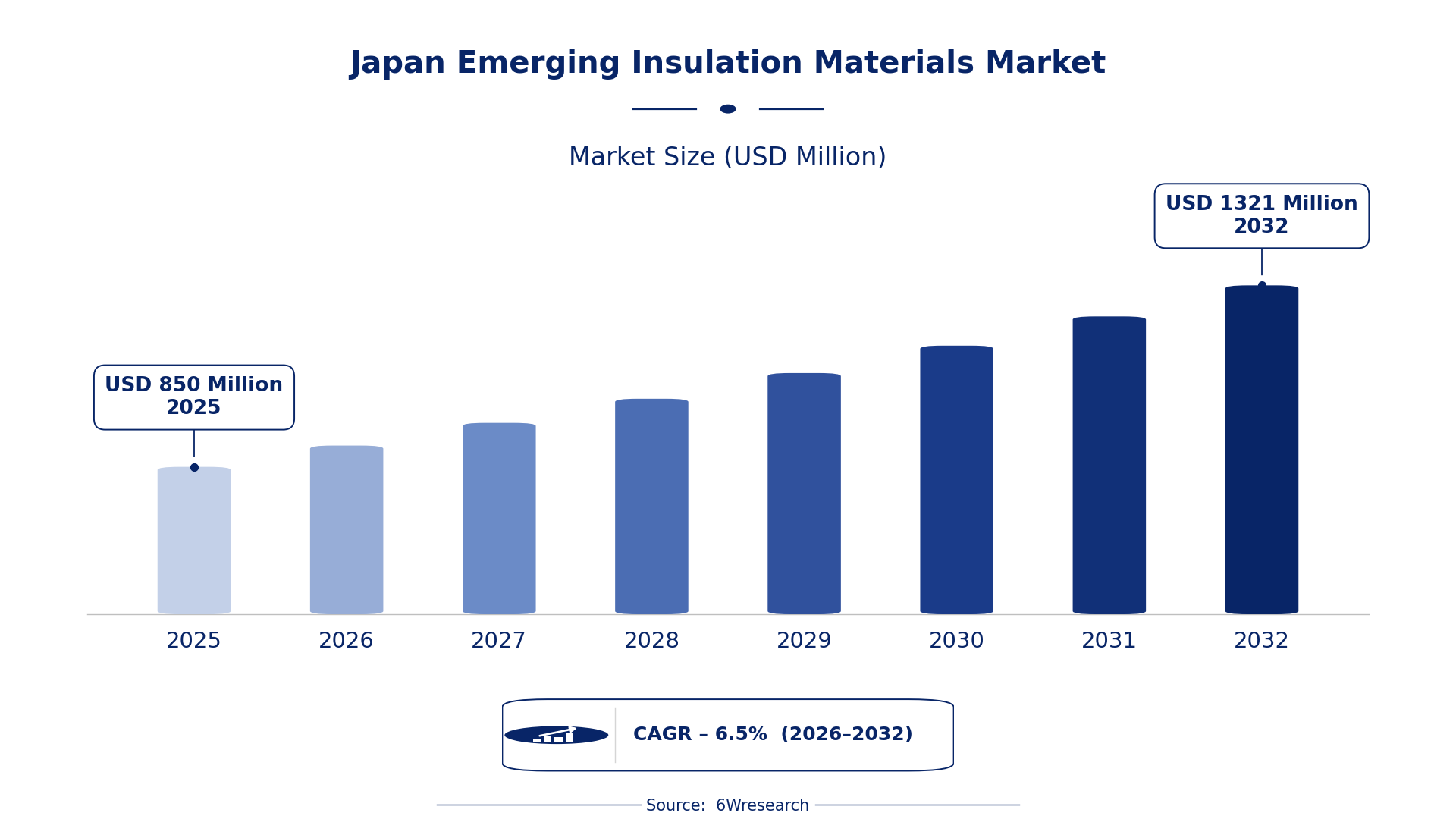
According to 6Wresearch internal database and industry insights, the Japan Emerging Insulation Materials Market was valued at USD 850 Million in 2025 and is projected to reach USD 1,321 Million by 2032, growing at a CAGR of approximately 6.5% during 2026–2032.
Japan Emerging Insulation Materials Market Highlights
| Report Metric | Details |
| Report Name | Japan Emerging Insulation Materials Market (2026-2032) |
| Market Size 2025 | USD 850 Million |
| Market Size 2032 | USD 1,321 Million |
| Absolute Growth 2025–2032 | USD 471 Million |
| CAGR 2026–2032 | 6.5% |
| Peak Annual Growth | 7.4% in 2026 |
| Forecast Period | 2026–2032 |
| Historical Data | 2022–2025 |
| Base Year | 2025 |
| Leading Types, 2025 | Fibrous (45% share) |
| Leading Applications, 2025 | Infrastructure (34% share) |
| Fastest-Growing Types | Granular (9.5% CAGR) |
| Fastest-Growing Applications | Industrial (9.1% CAGR) |
| Growing Sector | Construction |
| Key End Users | Construction firms, HVAC manufacturers, appliance producers, automotive manufacturers |
Japan Emerging Insulation Materials Market Year-wise Growth Rate and Key Drivers (2022–2032)
This graph illustrates the annual growth rates of the market from 2022 to 2032, highlighting a steady upward trajectory and projected market expansion over the forecast period.
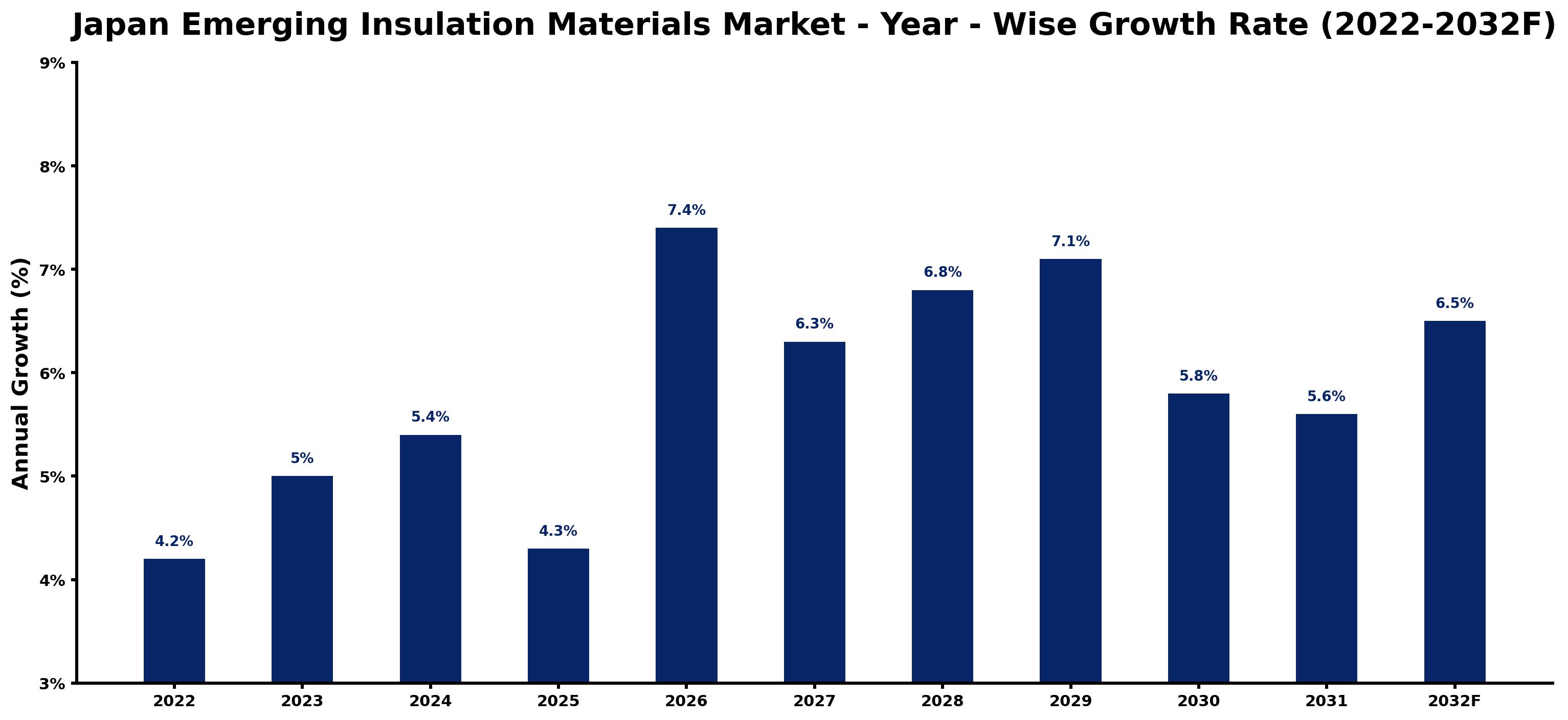
The following figures match every annual growth estimate with the main market development of that year, giving the reasoning behind each rise or slowdown.
| Year | Estimated Annual Growth (%) | Market Rationale |
| 2022 | 4.2 | The market showed steady demand from the construction sector, maintaining growth. |
| 2023 | 5.0 | Demand for energy-efficient materials increased as construction projects expanded across urban areas. |
| 2024 | 5.4 | The construction sector continued to thrive, with rising investments in energy-efficient building technologies. |
| 2025 | 4.3 | Growth slowed as market saturation began in some insulation applications, yet demand remained strong. |
| 2026 | 7.4 | The market is expected to surge due to heightened investments in decarbonisation initiatives and energy-efficient solutions. |
| 2027 | 6.3 | A slight slowdown is projected as the market adjusts to previous rapid growth rates while still expanding. |
| 2028 | 6.8 | Demand is expected to increase again as new insulation technologies gain traction in various sectors. |
| 2029 | 7.1 | The market will continue to grow, driven by ongoing construction projects and energy efficiency mandates. |
| 2030 | 5.8 | Growth is projected to moderate as the market stabilises, influenced by regulatory adjustments and market maturity. |
| 2031 | 5.6 | A further slowdown is anticipated as the market reaches a more balanced growth phase. |
| 2032 | 6.5 | Demand is expected to rise again due to new construction standards and sustainability initiatives. |
Note: Market size estimations and growth projections presented in this report are based on 6Wresearch's proprietary forecasting methodology, utilizing the latest available industry data, government publications, and primary research inputs.
Japan Emerging Insulation Materials Market Synopsis
Emerging insulation materials are advanced substances designed to minimise heat transfer, improving energy efficiency in applications such as buildings and appliances. The Japan Emerging Insulation Materials Market is expanding due to substantial investments in decarbonisation, with approximately JPY 150 trillion targeted for public and private initiatives over the next decade. The construction sector, employing over 5 million workers, is a primary driver of demand, alongside the HVAC industry valued at around $10 billion.
Market Dynamics Impact Analysis (2026–2032)
| Factor | Type | Impact | Primary Segment Affected |
| Increased investments in energy-efficient construction | Driver | High | Infrastructure |
| Growing demand for sustainable building materials | Driver | High | HVAC & OEM |
| Rising urbanisation leading to more construction projects | Opportunity | High | Industrial |
| Need for advanced insulation in the automotive sector | Opportunity | Medium | Transportation |
| High costs of advanced materials limiting adoption | Restraint | High | Cellular |
| Market saturation in some insulation applications | Restraint | Medium | Fibrous |
| Challenges in sourcing innovative materials | Challenge | High | Granular |
| Regulatory compliance costs for manufacturers | Challenge | Medium | Enabling High-performance Reflective Insulation |
Evaluation of Drivers in Japan Emerging Insulation Materials Market (2026–2032)
These are the developments adding the most demand over the forecast period.
| Drivers | Primary Segment Affected | Why It Matters (Evidence) |
| Investment in decarbonisation initiatives | Infrastructure | Japan targets a 46% reduction in greenhouse gas emissions by 2030, driving demand for insulation materials. |
| Expansion of the HVAC industry | HVAC & OEM | The HVAC sector's valuation at approximately $10 billion stimulates demand for advanced insulation solutions. |
| Government incentives for energy-efficient materials | Industrial | The 2023 Energy Efficiency Program promotes energy-saving technologies, increasing insulation material purchases. |
| Rising construction activity in urban areas | Transportation | The Tokyo metropolitan area accounts for 30% of insulation demand, boosting material requirements. |
| Growing awareness of energy conservation | Appliances | The average household uses 200 kg of insulation materials annually, reflecting increased consumer demand. |
Several shifts outside the market lift sales. The target to cut greenhouse gas emissions by 46% by 2030 drives investments in insulation technologies, particularly in the construction sector. Urban construction activity, especially in the Tokyo metropolitan area, accounts for 30% of insulation demand, stimulating purchases from suppliers. Households consume an average of 200 kg of insulation materials annually, highlighting consumer interest in energy conservation. The HVAC industry is expanding, leading to increased demand for energy-efficient materials.
Evaluation of Restraints in Japan Emerging Insulation Materials Market
The following restraints limit how fast demand can grow.
| Market Restraint | Primary Segment Affected | Why It Matters (Evidence) |
| High costs of advanced insulation materials | Cellular | The cost of materials like aerogels can deter widespread adoption, limiting market growth. |
| Market saturation in insulation applications | Fibrous | As the market matures, some segments face saturation, reducing growth potential. |
| Challenges in sourcing quality materials | Granular | Limited availability of high-quality granular materials can hinder production capabilities. |
| Regulatory compliance costs for manufacturers | Enabling High-performance Reflective Insulation | Compliance with laws such as the Building Energy Efficiency Act increases operational costs. |
| Dependence on construction sector performance | Infrastructure | Fluctuations in construction activity directly impact insulation material demand. |
Japan Emerging Insulation Materials Market Challenges
Japan's building regulations enforce JIS A 9501, compelling producers to allocate substantial resources for certification, which can delay projects by up to six months. Buyers face escalating costs as the scarcity of advanced insulation materials can inflate budgets by 15%, limiting their purchasing power. Frequent natural disasters disrupt supply chains, forcing producers to hold excess inventory, which increases operational costs by 10%. Rapid technological advancements require continuous investment, straining smaller producers who lack financial resources and hindering their competitive edge in the market.
Trends in the Japan Emerging Insulation Materials Market
The following changes are redrawing the Japan Emerging Insulation Materials Market.
- Shift in Focus to Energy-Efficient Building Materials: Since 2023, the construction sector has increasingly prioritised energy-efficient materials, driven by government initiatives. Approximately JPY 150 trillion is targeted for decarbonisation investments, encouraging suppliers to innovate.
- Emergence of Advanced Insulation Technologies: In 2023, the adoption of aerogel and other advanced materials has increased, with demand rising by 20%. This shift is reshaping the insulation market in Japan.
- Increased Demand from the HVAC Sector: The HVAC industry has seen a rise in insulation material use, valued at $10 billion. This growth is prompting suppliers to improve their product offerings.
- Growing Urbanisation Driving Insulation Needs: The Tokyo metropolitan area accounts for 30% of insulation demand, highlighting the impact of urbanisation on the market. This trend is expected to continue as cities expand.
Investment Opportunities in the Japan Emerging Insulation Materials Market
Several openings in the Japan Emerging Insulation Materials Market merit attention from investors.
- Gap in Sustainable Insulation Solutions: With Japan targeting a 46% reduction in greenhouse gas emissions, there is an opportunity for suppliers of sustainable insulation materials. The construction sector is actively seeking these solutions.
- Rising Demand from the Industrial Sector: The industrial sector is increasingly adopting advanced insulation materials, driven by efficiency needs. Suppliers can target this market by showcasing effective products.
- Investment in Energy-Efficient Building Projects: The Japanese government is investing heavily in energy-efficient building projects, creating opportunities for insulation material suppliers. Partnerships with construction firms can facilitate market entry.
- Need for Advanced Insulation in Transportation: As the automotive industry adopts advanced insulation materials, suppliers can meet this demand by providing effective solutions. Collaborating with manufacturers can enhance market presence.
Government Initiatives in the Japan Emerging Insulation Materials Market
The Building Energy Efficiency Act, amended in 2022, mandates that all new buildings meet energy standards starting April 2025. This law compels producers to ensure their insulation materials comply with these standards, driving innovation in energy-efficient solutions. Additionally, the Chemical Substances Control Law requires evaluation of new materials, ensuring safety and compliance in production.
The 2023 Energy Efficiency Program allocated JPY 50 billion to promote energy-efficient building materials, administered by the Ministry of the Environment. This funding supports manufacturers in developing compliant products, improving their market competitiveness.
Future Insight of the Japan Emerging Insulation Materials Market
New energy-efficient building projects will emerge, driven by the government's 2023 initiative to promote advanced insulation materials. The integration of aerogels will enhance thermal performance, appealing to buyers aiming to lower energy expenses. Public and private investments, projected at JPY 150 trillion over the next decade, will stimulate innovation in insulation technologies. The construction sector's workforce of over 5 million will support the growing demand for these materials, fostering a shift towards more sustainable building practices.
Market Segmentation Analysis
Japan Emerging Insulation Materials Market report covers a detailed analysis of the following market segments:
By Types – Fibrous Leads, Granular Expected to Grow Fastest
According to Ravi Bhandari, Research Head at 6Wresearch, with 45% of types revenue in 2025, Fibrous was the largest category. Fibrous insulation materials dominate the market due to their lightweight and flexible properties, making them ideal for thermal insulation in various applications. The construction sector, employing over 5 million workers, relies heavily on these materials to meet insulation needs. Granular is projected to grow fastest, at a CAGR of 9.5% during 2026–2032. Granular insulation materials are experiencing rapid growth as they are increasingly used as fillers in insulation products, driven by the demand for energy-efficient solutions. The government's 2023 initiative to promote energy-efficient building materials will likely accelerate this segment's growth. Suppliers should enhance the availability of fibrous materials while also exploring opportunities in granular products to meet the rising demand.
By Applications – Infrastructure Leads, Industrial Expected to Grow Fastest
In 2025, Infrastructure led the applications split with a 34% share. Infrastructure applications hold the largest share as they are vital for thermal insulation in construction projects across Japan, particularly in urban areas like Tokyo. The Tokyo metropolitan area accounts for 30% of the country's insulation demand, necessitating robust infrastructure solutions. Industrial is set to record the highest CAGR in this split, 9.1% over 2026–2032. Industrial applications are witnessing the fastest growth due to the increasing use of insulation materials in manufacturing processes for effective temperature control. This trend aligns with Japan's commitment to reducing energy consumption in buildings by 20% by 2030, including industrial facilities. Buyers in the industrial sector should prioritise sourcing advanced insulation materials to improve energy efficiency and comply with upcoming regulations.
Key Attractiveness of the Report
- 10 Years of Market Numbers
- Historical Data Starting from 2022 to 2025
- Base Year 2025
- Forecast Data until 2032
- Key Performance Indicators Impacting the Market
- Major Upcoming Developments and Projects
Key Highlights of the Report:
- Japan Emerging Insulation Materials Market Outlook
- Market Size of Japan Emerging Insulation Materials Market, 2025
- Forecast of Japan Emerging Insulation Materials Market, 2032
- Historical Data and Forecast of Japan Emerging Insulation Materials Revenues & Volume for the Period 2022-2032
- Japan Emerging Insulation Materials Market Trend Evolution
- Japan Emerging Insulation Materials Market Drivers and Challenges
- Japan Emerging Insulation Materials Price Trends
- Japan Emerging Insulation Materials Porter's Five Forces
- Japan Emerging Insulation Materials Industry Life Cycle
- Historical Data and Forecast of Japan Emerging Insulation Materials Market Revenues & Volume By Types for the Period 2022-2032
- Historical Data and Forecast of Japan Emerging Insulation Materials Market Revenues & Volume By Fibrous for the Period 2022-2032
- Historical Data and Forecast of Japan Emerging Insulation Materials Market Revenues & Volume By Granular for the Period 2022-2032
- Historical Data and Forecast of Japan Emerging Insulation Materials Market Revenues & Volume By Gas for the Period 2022-2032
- Historical Data and Forecast of Japan Emerging Insulation Materials Market Revenues & Volume By Cellular for the Period 2022-2032
- Historical Data and Forecast of Japan Emerging Insulation Materials Market Revenues & Volume By Enabling High-performance Reflective Insulation for the Period 2022-2032
- Historical Data and Forecast of Japan Emerging Insulation Materials Market Revenues & Volume By Applications for the Period 2022-2032
- Historical Data and Forecast of Japan Emerging Insulation Materials Market Revenues & Volume By Infrastructure for the Period 2022-2032
- Historical Data and Forecast of Japan Emerging Insulation Materials Market Revenues & Volume By Industrial for the Period 2022-2032
- Historical Data and Forecast of Japan Emerging Insulation Materials Market Revenues & Volume By HVAC & OEM for the Period 2022-2032
- Historical Data and Forecast of Japan Emerging Insulation Materials Market Revenues & Volume By Transportation for the Period 2022-2032
- Historical Data and Forecast of Japan Emerging Insulation Materials Market Revenues & Volume By Appliances for the Period 2022-2032
- Historical Data and Forecast of Japan Emerging Insulation Materials Market Revenues & Volume By Furniture for the Period 2022-2032
- Historical Data and Forecast of Japan Emerging Insulation Materials Market Revenues & Volume By Packaging for the Period 2022-2032
- Japan Emerging Insulation Materials Import Export Trade Statistics
- Market Opportunity Assessment By Types
- Market Opportunity Assessment By Applications
- Japan Emerging Insulation Materials Top Companies Market Share
- Japan Emerging Insulation Materials Competitive Benchmarking By Technical and Operational Parameters
- Japan Emerging Insulation Materials Company Profiles
- Japan Emerging Insulation Materials Key Strategic Recommendations
Market Covered
The study includes the following segmentation.
By Types
- Fibrous
- Granular
- Gas
- Cellular
- Enabling High-performance Reflective Insulation
By Applications
- Infrastructure
- Industrial
- HVAC & OEM
- Transportation
- Appliances
- Furniture
- Packaging






































