Japan Engine Components Market Size & Growth Rate
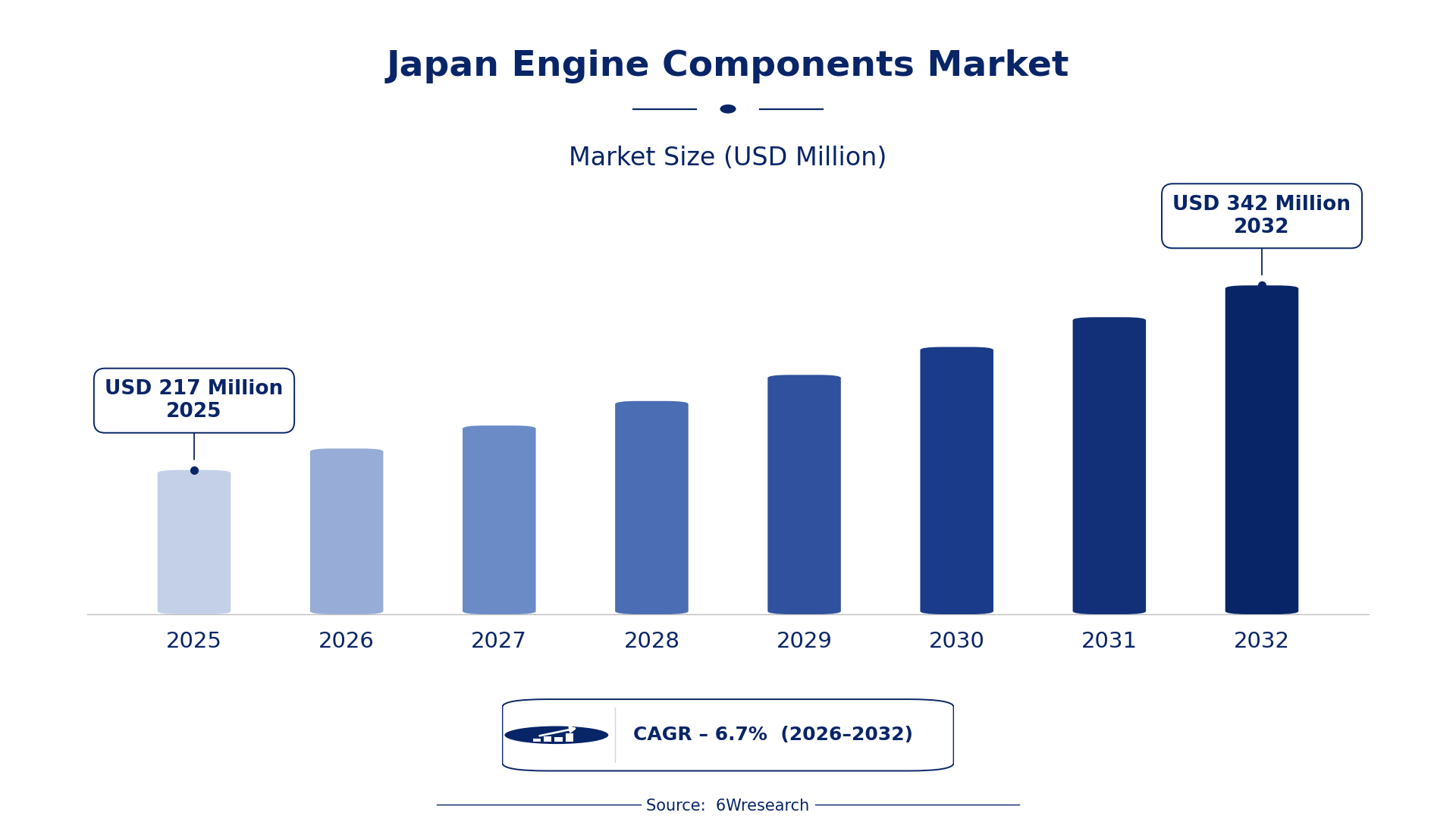
According to 6Wresearch internal database and industry insights, the Japan Engine Components Market was valued at USD 217 Million in 2025 and is projected to reach USD 342 Million by 2032, growing at a CAGR of approximately 6.7% during 2026–2032.
Japan Engine Components Market Highlights
| Report Metric | Details |
| Report Name | Japan Engine Components Market (2026-2032) |
| Market Size 2025 | USD 217 Million |
| Market Size 2032 | USD 342 Million |
| Absolute Growth 2025–2032 | USD 125 Million |
| CAGR 2026–2032 | 6.7% |
| Peak Annual Growth | 7.7% in 2032 |
| Forecast Period | 2026–2032 |
| Historical Data | 2022–2025 |
| Base Year | 2025 |
| Leading Components, 2025 | Valve tappet/ Roller tappet (50% share) |
| Leading Application, 2025 | Automotive (39% share) |
| Fastest-Growing Components | Screw Cap Assembly (9.7% CAGR) |
| Fastest-Growing Application | Two-wheelers (9.6% CAGR) |
| Growing Sector | Automotive |
| Key End Users | Automotive manufacturers, vehicle assemblers, aftermarket suppliers |
Japan Engine Components Market Year-wise Growth Rate and Key Drivers (2022–2032)
This graph illustrates the annual growth rates of the market from 2022 to 2032, highlighting a steady upward trajectory and projected market expansion over the forecast period.
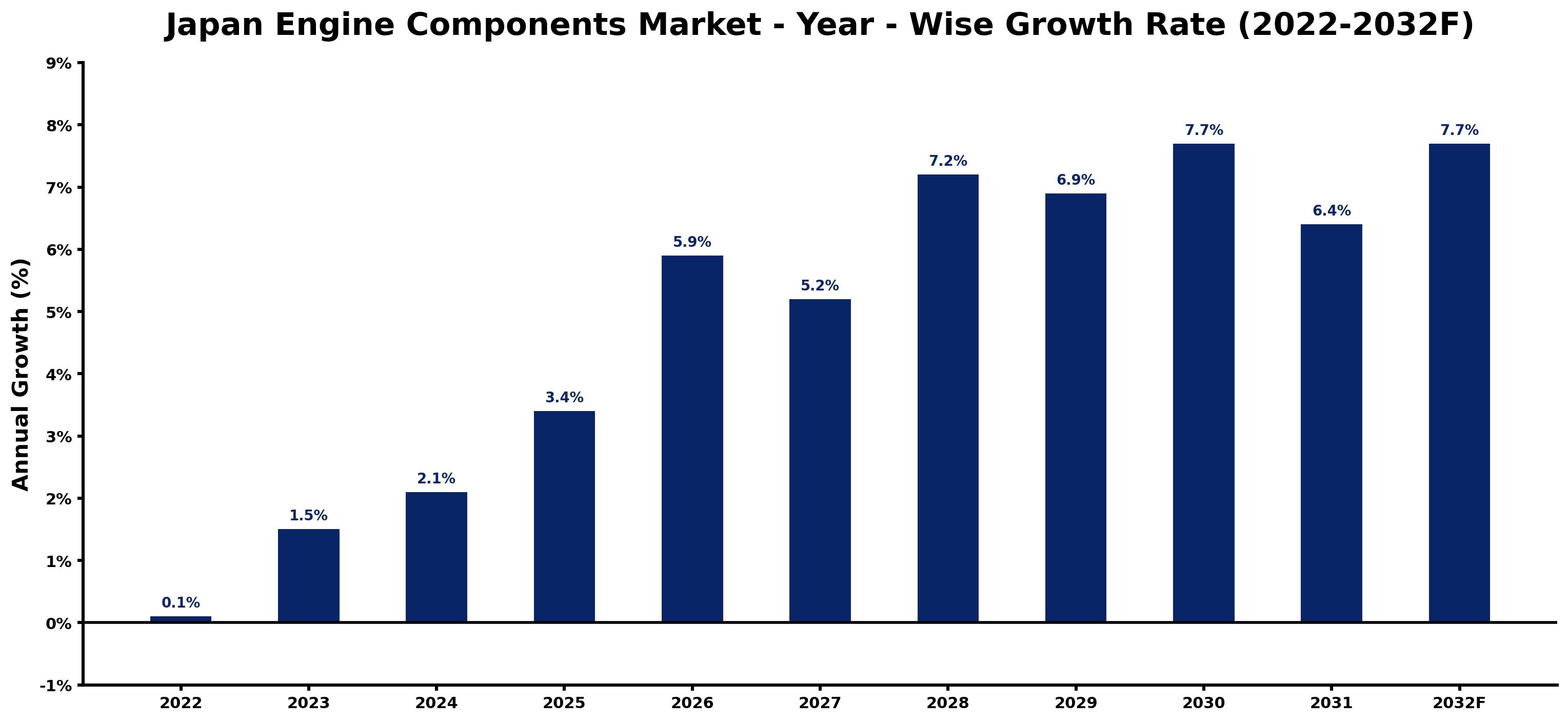
Below, each year's estimated growth is shown next to the factor that most influenced it.
| Year | Estimated Annual Growth (%) | Market Rationale |
| 2022 | 0.1 | The market experienced minimal growth due to stabilising demand from automotive manufacturers. |
| 2023 | 1.5 | Growth accelerated as domestic vehicle production increased, reflecting stronger market conditions. |
| 2024 | 2.1 | The upward trend continued with rising demand for replacement engine components from aging vehicles. |
| 2025 | 3.4 | Demand surged as the automotive sector expanded, reaching its historical peak growth rate. |
| 2026 | 5.9 | Growth is expected to rise with investments in eco-friendly engine technologies enhancing production. |
| 2027 | 5.2 | Growth will slow slightly as the market adjusts to previous high levels of demand. |
| 2028 | 7.2 | A resurgence in demand is projected as new vehicle models are introduced to the market. |
| 2029 | 6.9 | The market will continue to grow, but at a slower pace as production stabilises. |
| 2030 | 7.7 | Demand is projected to peak with the introduction of advanced engine technologies and increased vehicle sales. |
| 2031 | 6.4 | Growth will moderate as the market begins to stabilise after several years of rapid expansion. |
| 2032 | 7.7 | The market is expected to maintain its peak growth rate, driven by ongoing innovation in engine components. |
Note: Market size estimations and growth projections presented in this report are based on 6Wresearch's proprietary forecasting methodology, utilizing the latest available industry data, government publications, and primary research inputs.
Japan Engine Components Market Synopsis
Engine components are critical mechanical parts in internal combustion engines, crafted from metals and alloys through casting and machining. The Japan Engine Components Market is growing due to increasing demand from domestic manufacturers and exports, with the automotive industry expected to reach 5 trillion yen by 2025. This expansion is driven by the introduction of new eco-friendly technologies and the rising average age of vehicles, currently at 13.5 years, resulting in heightened demand for replacement parts.
Market Dynamics Impact Analysis (2026–2032)
| Factor | Type | Impact | Primary Segment Affected |
| Growing demand for replacement parts due to the average vehicle age of 13.5 years. | Driver | High | Automotive |
| Investment in eco-friendly engine technologies is increasing production capabilities. | Driver | High | Automotive |
| Expansion of automotive manufacturing clusters in the Tohoku region presents opportunities. | Opportunity | High | Automotive |
| The rising popularity of two-wheelers in urban areas opens new market segments. | Opportunity | Medium | Two-wheelers |
| Regulatory compliance costs for eco-friendly technologies can burden manufacturers. | Restraint | High | Automotive |
| Supply chain disruptions can delay the production of engine components. | Restraint | Medium | Automotive |
| Competition from alternative powertrains poses a risk to traditional engine component sales. | Challenge | High | Automotive |
| Fluctuating raw material prices can affect production costs for manufacturers. | Challenge | Medium | Automotive |
Evaluation of Drivers in Japan Engine Components Market (2026–2032)
Key forces behind demand, with the segment each one moves most, are listed below.
| Drivers | Primary Segment Affected | Why It Matters (Evidence) |
| Increased vehicle production | Automotive | Japan's automotive industry produced 8.3 million vehicles in 2022, driving demand for engine components. |
| Aging vehicle fleet | Automotive | The average age of vehicles in Japan is 13.5 years, increasing the need for replacement parts. |
| Investment in eco-friendly technologies | Automotive | The 2023 initiative promotes eco-friendly engine technologies, boosting demand for advanced components. |
| Rising popularity of two-wheelers | Two-wheelers | The growing urban population increases demand for two-wheelers, which require engine components. |
| Manufacturing clusters in Tohoku | Automotive | The Tohoku region is known for its automotive component manufacturing, strengthening supply capabilities. |
A wider customer base explains much of the growth, as the aging vehicle fleet in Japan creates demand for replacement engine components. The average vehicle age of 13.5 years leads to increased purchases from automotive manufacturers, who produced 8.3 million vehicles in 2022. The rising popularity of two-wheelers in urban areas is driving purchases, as these vehicles require specific engine components. Manufacturing clusters in regions like Tohoku improve supply capabilities, allowing producers to meet this growing demand effectively.
Evaluation of Restraints in Japan Engine Components Market
The main factors holding the market back are set out below.
| Market Restraint | Primary Segment Affected | Why It Matters (Evidence) |
| Regulatory compliance costs for eco-friendly technologies | Automotive | Compliance with new regulations can increase production costs for manufacturers, affecting pricing. |
| Supply chain disruptions | Automotive | Delays in the supply chain can hinder timely production of engine components, impacting sales. |
| Competition from alternative powertrains | Automotive | The rise of electric vehicles poses a challenge to traditional engine component sales, reducing demand. |
| Fluctuating raw material prices | Automotive | Increased costs of raw materials can impact the profitability of engine component manufacturers. |
| Limited use of certain components in specific applications | Collet/Cotter | The minor application of collet/cotter components restricts their market potential and growth. |
Japan Engine Components Market Challenges
A key challenge in the engine components market is the shortage of skilled automotive engineers, which delays production timelines and affects output for component suppliers. Limited integration of advanced manufacturing technologies results in inefficiencies, leading to longer lead times that hinder suppliers' ability to satisfy automotive sector demands. Heightened competition among local producers drives down prices, squeezing profit margins for component manufacturers. Supply chain disruptions, particularly in the Tohoku region, can cause component shortages, forcing manufacturers to extend delivery timelines and impacting overall production schedules.
Trends in the Japan Engine Components Market
The shifts below are changing how Japan Engine Components Market products are bought and supplied.
- Shift towards Eco-Friendly Engine Technologies: In 2023, Japan launched a new initiative promoting eco-friendly engine technologies, resulting in increased demand for advanced engine components.
- Rising Popularity of Two-Wheelers: The demand for two-wheelers surged in 2022, reflecting changing urban transport preferences and increasing engine component needs.
- Focus on Advanced Engine Performance: The introduction of new automotive standards, such as JIS B 1001, has heightened the focus on engine performance, driving component innovation.
- Growth of Automotive Manufacturing Clusters: The Tohoku region's automotive manufacturing clusters expanded in 2022, boosting local component production capabilities.
Investment Opportunities in the Japan Engine Components Market
The following areas offer the clearest openings for investors and suppliers in the Japan Engine Components Market.
- Urban Two-Wheeler Market Expansion: Urban areas are increasingly adopting two-wheelers, creating investment opportunities for suppliers of engine components.
- Investment in Eco-Friendly Technologies: Manufacturers can invest in eco-friendly engine components to capture the growing market for sustainable vehicles.
- Partnerships in Tohoku Region: Forming partnerships with local manufacturers in the Tohoku region can improve production capabilities and market reach for engine components.
- Supply Chain Innovations: Investing in supply chain innovations can streamline production processes, particularly for components like valve tappets, essential for engine performance.
Government Initiatives in the Japan Engine Components Market
The GX Promotion Act, introduced in 2023, creates a legal framework for advancing green technologies in the automotive sector. This act aligns with the Green Growth Strategy, which aims for carbon neutrality by 2050, thus encouraging manufacturers to innovate in engine components.
The Battery Industry Strategy, overseen by the Ministry of Economy, Trade and Industry (METI), assists buyers in the automotive sector by ensuring a reliable supply of eco-friendly technologies, targeting 150 GWh of domestic battery manufacturing capacity by 2030.
Future Insight of the Japan Engine Components Market
The investment pipeline for eco-friendly engine technologies will stimulate demand for engine components, creating opportunities for suppliers who adopt these advancements. By 2032, the automotive market is projected to reach 5 trillion yen, reflecting a shift towards high-performance vehicles. The adoption of JIS B 1001 standards will improve product consistency, ensuring reliability for buyers. Government initiatives aimed at reducing vehicle emissions by 50% by 2030 will drive innovation in engine technologies, paving the way for market expansion.
Market Segmentation Analysis
Japan Engine Components Market report covers a detailed analysis of the following market segments:
By Components – Valve tappet/ Roller tappet Leads, Screw Cap Assembly Expected to Grow Fastest
According to Vasudha, AM at 6Wresearch, Valve tappet/ Roller tappet took 50% of components revenue in 2025, more than any other category. Valve tappet and roller tappet hold the largest share due to their crucial role in engine operation, essential for performance and reliability. The high concentration of automotive manufacturers in the Tokyo metropolitan area drives the demand for these components. Screw Cap Assembly is set to record the highest CAGR in this split, 9.7% over 2026–2032. Screw cap assembly is experiencing rapid growth as manufacturers aim to optimise assembly processes, coinciding with increased production rates in Japan's automotive sector. The government's focus on automotive innovation programmes further accelerates this trend. This indicates that suppliers should invest in production capacity to meet the increasing demand for both critical and assembly components.
By Application – Automotive Leads, Two-wheelers Expected to Grow Fastest
Automotive held 39% of the Japan Engine Components Market by application in 2025. The automotive sector leads the market as it serves as the primary application for engine components, supported by Japan's production of 8.3 million vehicles in 2022. This strong automotive foundation guarantees a steady demand for essential engine parts. Over 2026–2032, Two-wheelers are expected to post the fastest growth, at a CAGR of 9.6%. Two-wheelers represent the fastest-growing segment, especially in urban regions where the need for efficient transportation is on the rise. Additionally, the increasing average age of vehicles in Japan necessitates more replacement parts in this category. Buyers should diversify their sourcing strategies to incorporate components for emerging applications such as two-wheelers.
Key Attractiveness of the Report
- 10 Years of Market Numbers
- Historical Data Starting from 2022 to 2025
- Base Year 2025
- Forecast Data until 2032
- Key Performance Indicators Impacting the Market
- Major Upcoming Developments and Projects
Key Highlights of the Report:
- Japan Engine Components Market Outlook
- Market Size of Japan Engine Components Market, 2025
- Forecast of Japan Engine Components Market, 2032
- Historical Data and Forecast of Japan Engine Components Revenues & Volume for the Period 2022-2032
- Japan Engine Components Market Trend Evolution
- Japan Engine Components Market Drivers and Challenges
- Japan Engine Components Price Trends
- Japan Engine Components Porter's Five Forces
- Japan Engine Components Industry Life Cycle
- Historical Data and Forecast of Japan Engine Components Market Revenues & Volume By Components for the Period 2022-2032
- Historical Data and Forecast of Japan Engine Components Market Revenues & Volume By Valve tappet/ Roller tappet for the Period 2022-2032
- Historical Data and Forecast of Japan Engine Components Market Revenues & Volume By Screw Cap Assembly for the Period 2022-2032
- Historical Data and Forecast of Japan Engine Components Market Revenues & Volume By Collet/Cotter for the Period 2022-2032
- Historical Data and Forecast of Japan Engine Components Market Revenues & Volume By Retiner for the Period 2022-2032
- Historical Data and Forecast of Japan Engine Components Market Revenues & Volume By Application for the Period 2022-2032
- Historical Data and Forecast of Japan Engine Components Market Revenues & Volume By Automotive for the Period 2022-2032
- Historical Data and Forecast of Japan Engine Components Market Revenues & Volume By Passenger Vehicle for the Period 2022-2032
- Historical Data and Forecast of Japan Engine Components Market Revenues & Volume By Ligjht Duty Vehicle for the Period 2022-2032
- Historical Data and Forecast of Japan Engine Components Market Revenues & Volume By Medium & Heavy Duty Trucks for the Period 2022-2032
- Historical Data and Forecast of Japan Engine Components Market Revenues & Volume By Buses & Coaches for the Period 2022-2032
- Historical Data and Forecast of Japan Engine Components Market Revenues & Volume By Two-wheelers for the Period 2022-2032
- Historical Data and Forecast of Japan Engine Components Market Revenues & Volume By Agriculture for the Period 2022-2032
- Historical Data and Forecast of Japan Engine Components Market Revenues & Volume By Tractors for the Period 2022-2032
- Japan Engine Components Import Export Trade Statistics
- Market Opportunity Assessment By Components
- Market Opportunity Assessment By Application
- Japan Engine Components Top Companies Market Share
- Japan Engine Components Competitive Benchmarking By Technical and Operational Parameters
- Japan Engine Components Company Profiles
- Japan Engine Components Key Strategic Recommendations
Market Covered
The following segment groups are covered in the report.
By Components
- Valve tappet/ Roller tappet
- Screw Cap Assembly
- Collet/Cotter
- Retiner
By Application
- Automotive
- Passenger Vehicle
- Ligjht Duty Vehicle
- Medium & Heavy Duty Trucks
- Buses & Coaches
- Two-wheelers
- Agriculture
- Tractors































