Japan In-Vitro Diagnostics Market Size & Growth Rate
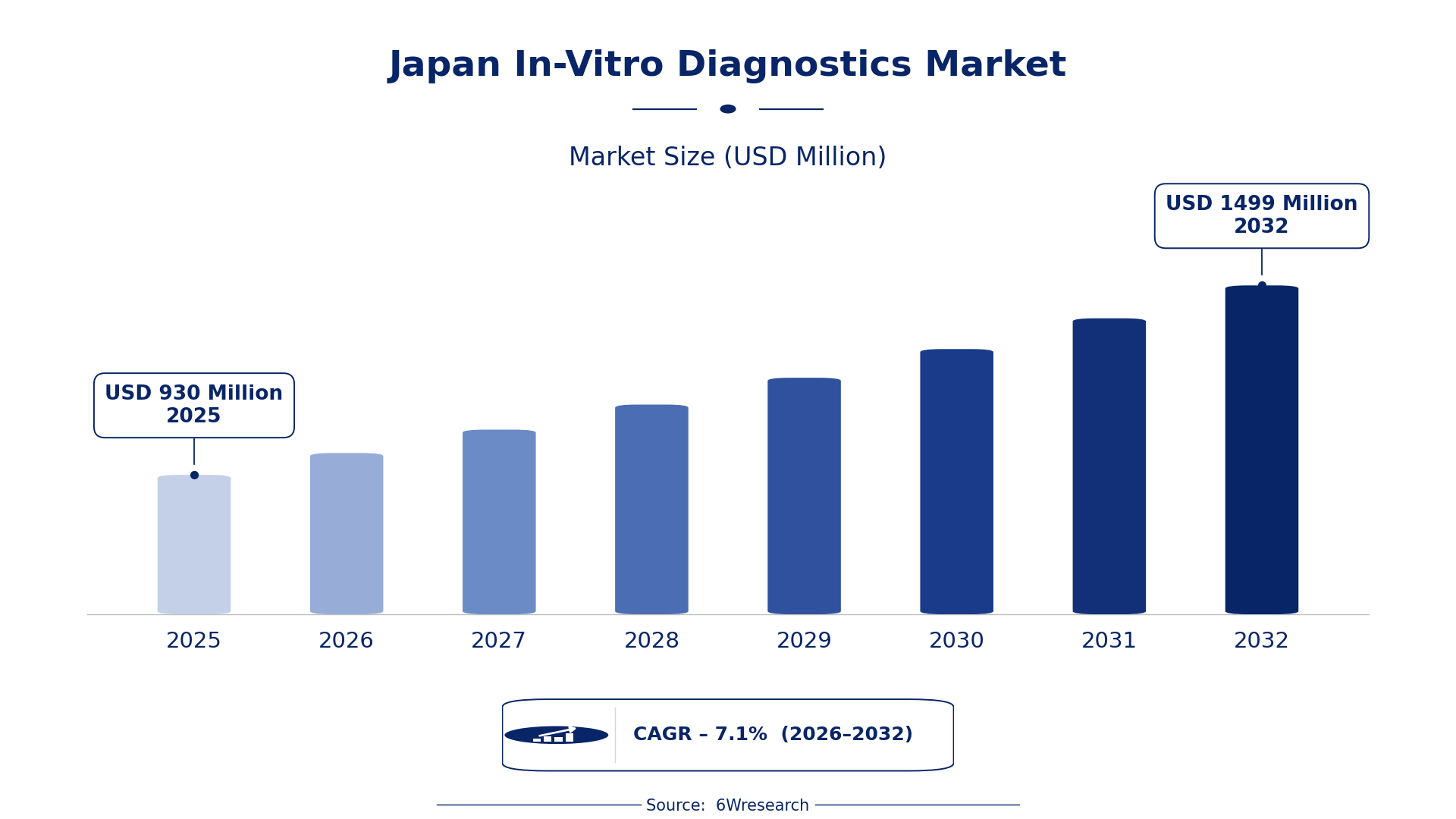
According to 6Wresearch internal database and industry insights, the Japan In-Vitro Diagnostics Market was valued at USD 930 Million in 2025 and is projected to reach USD 1,499 Million by 2032, growing at a CAGR of approximately 7.1% during 2026–2032.
Japan In-Vitro Diagnostics Market Highlights
| Report Metric | Details |
| Report Name | Japan In-Vitro Diagnostics Market (2026-2032) |
| Market Size 2025 | USD 930 Million |
| Market Size 2032 | USD 1,499 Million |
| Absolute Growth 2025–2032 | USD 569 Million |
| CAGR 2026–2032 | 7.1% |
| Peak Annual Growth | 9.5% in 2026 |
| Forecast Period | 2026–2032 |
| Historical Data | 2022–2025 |
| Base Year | 2025 |
| Leading Type, 2025 | Laboratory Testing (43% share) |
| Leading Test Type, 2025 | Molecular Diagnostics (47% share) |
| Leading Application, 2025 | Disease Screening (47% share) |
| Leading End User, 2025 | Hospitals (44% share) |
| Leading End Use, 2025 | Professional Tattooing (61% share) |
| Fastest-Growing Type | Self-Testing Kits (9.4% CAGR) |
| Fastest-Growing Test Type | Home-Based ELISA (10.2% CAGR) |
| Fastest-Growing Application | Personalized Medicine (9.1% CAGR) |
| Fastest-Growing End User | Consumers (8.7% CAGR) |
| Growing Sector | Disease Screening |
| Key End Users | Hospitals, Clinics, Research Labs, Consumers |
Japan In-Vitro Diagnostics Market Year-wise Growth Rate and Key Drivers (2022–2032)
This graph illustrates the annual growth rates of the market from 2022 to 2032, highlighting a steady upward trajectory and projected market expansion over the forecast period.
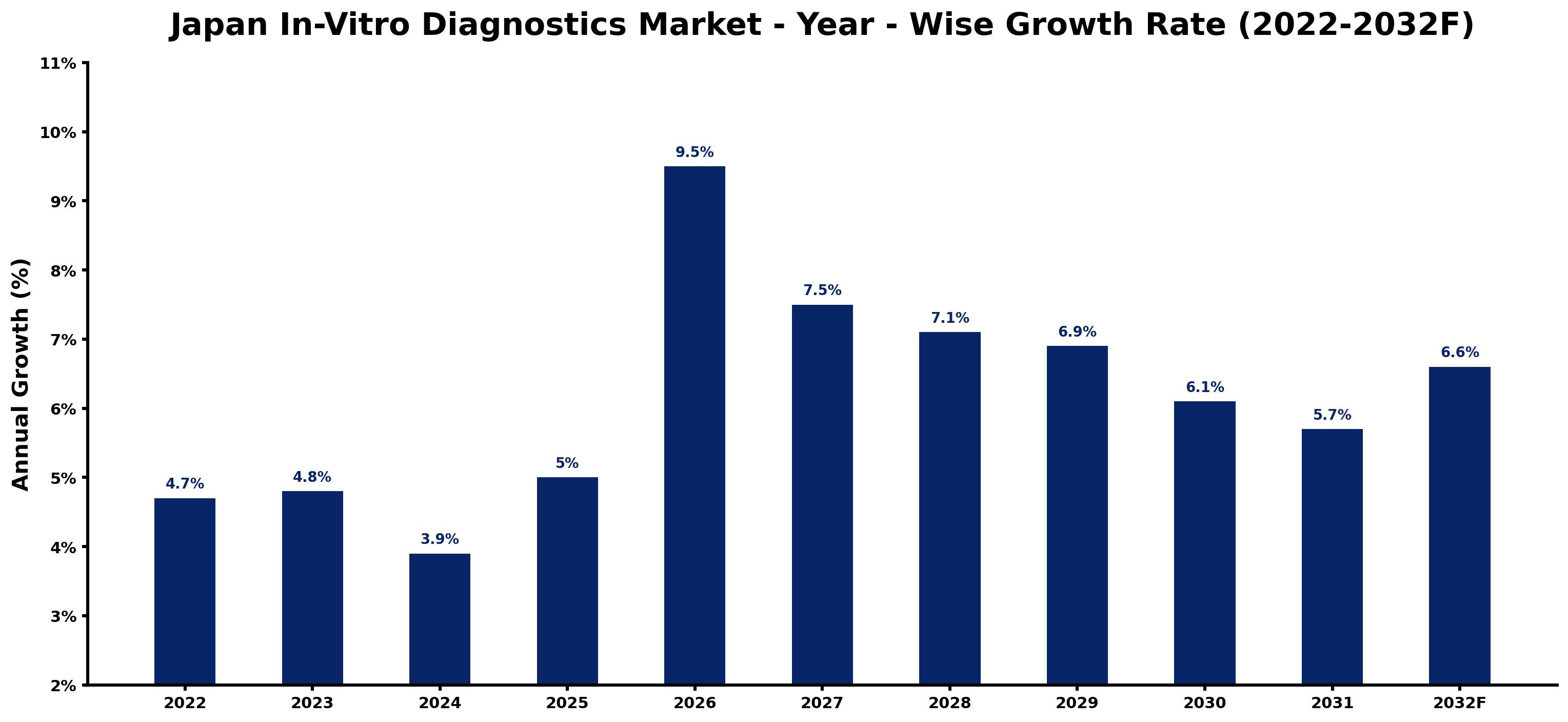
Annual growth estimates for each year appear below with the principal reason behind them, explaining the shifts that set the pace of the market.
| Year | Estimated Annual Growth (%) | Market Rationale |
| 2022 | 4.7 | The market experienced steady growth due to increased health awareness among the population. |
| 2023 | 4.8 | Demand rose as hospitals expanded their diagnostic capabilities and services. |
| 2024 | 3.9 | Growth slowed as market saturation began affecting new product introductions. |
| 2025 | 5.0 | The market rebounded with hospitals investing in advanced diagnostic technologies. |
| 2026 | 9.5 | A surge in demand for personalized medicine drove rapid market expansion. |
| 2027 | 7.5 | Growth slowed as competition intensified among diagnostic product providers. |
| 2028 | 7.1 | Market growth continued to slow as consumer adoption of self-testing kits increased. |
| 2029 | 6.9 | Demand remained strong due to the ongoing need for effective disease monitoring. |
| 2030 | 6.1 | Growth decelerated as market maturity began to stabilise purchasing patterns. |
| 2031 | 5.7 | The market continued to grow, driven by an aging population requiring more diagnostics. |
| 2032 | 6.6 | Demand increased again as new technologies and testing methods gained traction. |
Note: Market size estimations and growth projections presented in this report are based on 6Wresearch's proprietary forecasting methodology, utilizing the latest available industry data, government publications, and primary research inputs.
Japan In-Vitro Diagnostics Market Synopsis
In-Vitro Diagnostics (IVD) encompasses medical devices and reagents used for testing samples such as blood and urine. The market is expanding due to Japan's aging population, with 29.3% of individuals aged 65 or older, which is increasing the demand for health monitoring solutions. Growth is further supported by heightened hospital investments in advanced diagnostics and a growing interest in personalised medicine, bolstered by government initiatives aimed at improving healthcare infrastructure.
Market Dynamics Impact Analysis (2026–2032)
| Factor | Type | Impact | Primary Segment Affected |
| Rising health awareness and an aging population are driving demand for IVD products. | Driver | High | Laboratory Testing |
| The increasing prevalence of chronic diseases necessitates effective monitoring solutions. | Driver | High | Diabetes Monitoring |
| The growing consumer interest in self-testing kits presents a significant market opportunity. | Opportunity | High | Self-Testing Kits |
| Investment in personalized medicine is expanding the IVD market's potential. | Opportunity | High | Personalized Medicine |
| Market saturation is limiting the introduction of new products and technologies. | Restraint | Medium | Laboratory Testing |
| Regulatory complexities can delay product approvals and market entry. | Restraint | Medium | Molecular Diagnostics |
| High competition among manufacturers can lead to pricing pressures. | Challenge | High | Point-of-Care Testing |
| Technological advancements require continuous investment in R&D. | Challenge | Medium | Rapid Immunoassays |
Evaluation of Drivers in Japan In-Vitro Diagnostics Market (2026–2032)
The main growth drivers and the segments they affect most are set out below.
| Drivers | Primary Segment Affected | Why It Matters (Evidence) |
| Increased healthcare expenditure is boosting demand for advanced diagnostics. | Laboratory Testing | Japan's national medical care expenditure reached JPY 46.7 trillion in 2022, prompting hospitals to invest in IVD. |
| The rising prevalence of diabetes is driving demand for monitoring solutions. | Diabetes Monitoring | With 7.4 million diabetes patients in Japan, healthcare providers are increasing their IVD purchases. |
| The aging population necessitates more frequent health screenings. | Disease Screening | With 29.3% of the population aged 65 or older, hospitals are expanding their diagnostic capabilities. |
| Consumer interest in home health monitoring is increasing the adoption of self-testing kits. | Self-Testing Kits | Growing awareness of personal health management is leading to more purchases of these kits. |
| Advancements in molecular diagnostics are improving disease detection capabilities. | Molecular Diagnostics | Technological innovations are increasing accuracy and speed, encouraging hospitals to adopt new IVD technologies. |
Volumes grow on the back of increased healthcare spending, which reached JPY 46.7 trillion in 2022, prompting hospitals to invest in advanced IVD solutions. The prevalence of diabetes, with 7.4 million patients, drives demand for monitoring products, resulting in increased purchases by healthcare providers. An aging population necessitates more health screenings, prompting hospitals to expand their diagnostic services. Consumer interest in self-testing kits is rising, reflecting a shift towards personal health management. Technological advancements in molecular diagnostics improve disease detection capabilities, encouraging hospitals to adopt new IVD technologies.
Evaluation of Restraints in Japan In-Vitro Diagnostics Market
Several factors work against faster growth; the main ones are summarised below.
| Market Restraint | Primary Segment Affected | Why It Matters (Evidence) |
| Market saturation limits the introduction of new products. | Laboratory Testing | With over 8,000 hospitals in Japan, the market is becoming crowded, slowing down new product launches. |
| Regulatory complexities can delay product approvals and market entry. | Molecular Diagnostics | The stringent requirements set by the PMDA can prolong the time to market for new IVD products. |
| High competition among manufacturers leads to pricing pressures. | Point-of-Care Testing | As more players enter the market, pricing strategies become aggressive, affecting profit margins. |
| Technological advancements require continuous investment in R&D. | Rapid Immunoassays | Manufacturers must invest heavily to keep up with rapid technological changes, impacting budgets. |
| Limited awareness of self-testing kits may hinder market growth. | Self-Testing Kits | Despite rising interest, many consumers remain unaware of available options, affecting sales. |
Japan In-Vitro Diagnostics Market Challenges
High costs of IVD products challenge hospitals, as Japan's national medical care expenditure was approximately JPY 46.7 trillion in fiscal 2022, restricting their capacity to upgrade equipment. Supply chain issues stem from strict regulations enforced by the Ministry of Health, Labour and Welfare, resulting in delays in product availability and increased costs for suppliers. Intense competition forces producers to lower prices, which may compromise quality and reliability for buyers. Rapid technological advancements necessitate ongoing investment, making it challenging for smaller suppliers to keep up and meet the growing expectations of hospitals and clinics.
Trends in the Japan In-Vitro Diagnostics Market
Buyers and suppliers in the Japan In-Vitro Diagnostics Market are adjusting to the following trends.
- Surge in Home Testing Solutions: In 2023, consumer demand for self-testing kits surged, with a projected increase of 20% in adoption rates. This trend reflects a growing preference for at-home health monitoring, driven by convenience and privacy.
- Emergence of Personalized Medicine: A government program launched in 2023 promotes personalized medicine, with funding of JPY 5 billion. This initiative is reshaping diagnostics, encouraging tailored treatment approaches and driving demand for advanced IVD solutions.
- Increase in Molecular Diagnostics Usage: Since 2026, molecular diagnostics have gained traction in oncology, with a 15% annual growth rate. This shift highlights the importance of accurate disease detection and the need for advanced testing methods.
- Focus on Disease Screening: Disease screening has remained a priority since 2022, with hospitals increasing their budgets for IVD products by 10%. This focus is essential for early detection and effective treatment strategies.
Investment Opportunities in the Japan In-Vitro Diagnostics Market
Investors looking at the Japan In-Vitro Diagnostics Market should consider the following areas.
- Invest in Self-Testing Kits: The growing interest in self-testing kits presents an opportunity for suppliers to meet rising consumer demand. With a projected increase of 20% in adoption rates, partnerships with local distributors can facilitate market entry.
- Supply Advanced Molecular Diagnostics: Investing in advanced molecular diagnostics can cater to the increasing demand from hospitals. The Tokyo region, a major hub for IVD, offers opportunities for collaboration with healthcare providers.
- Focus on Personalized Medicine Solutions: The government’s 2023 program promoting personalised medicine creates opportunities for innovation in diagnostics. Collaborating with research institutions can improve product development and market reach.
- Expand Disease Screening Offerings: The emphasis on disease screening provides a chance to supply innovative IVD solutions. Engaging with hospitals in urban areas can lead to fruitful partnerships and increased sales.
Government Initiatives in the Japan In-Vitro Diagnostics Market
The PMDA's establishment in 2004 has strengthened the regulatory framework for IVD products, ensuring safety and efficacy. This measure complements the PMD Act, which regulates the approval and quality of medical devices, building consumer trust in diagnostics.
In 2023, the government allocated JPY 5 billion to support medical research and development through AMED, which oversees funding for IVD projects. This initiative aims to drive advancements in diagnostic technologies and improve patient outcomes.
Future Insight of the Japan In-Vitro Diagnostics Market
Hospitals will transform their health monitoring capabilities by 2032, as they embrace advanced IVD technologies tailored for an ageing population. The integration of automation in manufacturing will streamline processes and lower costs for suppliers. Urban centres like Tokyo will experience heightened demand for cutting-edge IVD products, especially with the growing elderly demographic. By 2032, the estimated 7.4 million diabetes patients will drive substantial demand for innovative monitoring solutions, prompting suppliers to enhance their offerings.
Market Segmentation Analysis
Japan In-Vitro Diagnostics Market report covers a detailed analysis of the following market segments:
By Type – Laboratory Testing Leads, Self-Testing Kits Expected to Grow Fastest
According to Bhawna Singh, Assistant Manager at 6Wresearch, with 43% of type revenue in 2025, Laboratory Testing was the largest category. Laboratory Testing holds the largest share due to its critical role in hospitals and laboratories for accurate diagnostics. With over 8,000 hospitals in Japan using IVD products, this segment is vital for patient care and effective treatment. Self-Testing Kits are projected to grow fastest, at a CAGR of 9.4% during 2026–2032. Self-Testing Kits are rapidly gaining popularity as consumer interest in personal health monitoring rises, particularly due to the convenience of at-home testing. The government's recent initiative promoting personalised medicine further fuels this growth. Suppliers should prioritise the development of self-testing products to cater to the increasing consumer demand.
By Test Type – Molecular Diagnostics Lead, Home-Based ELISA Expected to Grow Fastest
Molecular Diagnostics took 47% of test type revenue in 2025, more than any other category. Molecular Diagnostics leads the market as it is essential for detecting genetic diseases and infections, which are on the rise. This segment's significance is highlighted by the growing patient population requiring precise diagnostic solutions. Home-Based ELISA is set to record the highest CAGR in this split, 10.2% over 2026–2032. Home-Based ELISA is emerging as a convenient option for specific health monitoring, driven by consumer demand for at-home testing solutions. This trend reflects a broader shift towards personalised healthcare approaches. Buyers may find value in exploring home-based testing options to improve their health monitoring capabilities.
By Application – Disease Screening Leads, Personalized Medicine Expected to Grow Fastest
In 2025, Disease Screening led the application split with a 47% share. Disease Screening holds the largest share in the application segment due to its critical role in the early detection of various diseases, essential for timely treatment. The increasing average age of the Japanese population, which was 29.3% aged 65 or older in September 2024, further emphasises the need for regular health screenings. Over 2026–2032, Personalized Medicine is expected to post the fastest growth, at a CAGR of 9.1%. Personalized Medicine is experiencing rapid growth as it focuses on tailored treatments that cater to individual patient needs. This segment's expansion is driven by the government's recent programme promoting personalised medicine in diagnostics, highlighting a shift towards customised healthcare solutions. Suppliers should prioritise investments in personalised medicine technologies to stay relevant in the changing healthcare environment.
By End User – Hospitals Lead, Consumers Expected to Grow Fastest
Hospitals held 44% of the Japan In-Vitro Diagnostics Market by end user in 2025. Hospitals represent the largest end users of IVD products, acting as primary facilities for patient care and diagnostics. With around 8,100 hospitals in Japan utilising IVD products, they play a vital role in the widespread adoption of these technologies. The quickest growth will come from Consumers, forecast to expand at a CAGR of 8.7% between 2026 and 2032. Consumers are increasingly engaging with the IVD market through self-testing options, marking a significant shift towards personal health management. This trend is supported by the growing availability of user-friendly testing kits, encouraging more individuals to monitor their health. Suppliers must adapt to the expanding consumer market by developing accessible self-testing products to meet rising demand.
By End Use – Professional Tattooing Leads and Records the Fastest Growth
Professional Tattooing accounted for 61% of the market by end use in 2025. Professional Tattooing leads the end use segment, albeit on a smaller scale, as it is occasionally employed for skin health assessments. This niche market prioritises health and safety, making it a critical area for IVD applications. The same category is also set to grow fastest, at a CAGR of 8.4% during 2026–2032. Professional Tattooing is also the fastest-growing end use, as awareness of skin health assessments increases among tattoo professionals. This growth indicates a rising demand for health-related products within the tattooing community, reinforcing the segment's importance. Suppliers should target the professional tattooing sector with health assessment products to leverage this growth opportunity.
Key Attractiveness of the Report
- 10 Years of Market Numbers
- Historical Data Starting from 2022 to 2025
- Base Year 2025
- Forecast Data until 2032
- Key Performance Indicators Impacting the Market
- Major Upcoming Developments and Projects
Key Highlights of the Report:
- Japan In-Vitro Diagnostics Market Outlook
- Market Size of Japan In-Vitro Diagnostics Market,2025
- Forecast of Japan In-Vitro Diagnostics Market, 2032
- Historical Data and Forecast of Japan In-Vitro Diagnostics Revenues & Volume for the Period 2022-2032
- Japan In-Vitro Diagnostics Market Trend Evolution
- Japan In-Vitro Diagnostics Market Drivers and Challenges
- Japan In-Vitro Diagnostics Price Trends
- Japan In-Vitro Diagnostics Porter's Five Forces
- Japan In-Vitro Diagnostics Industry Life Cycle
- Historical Data and Forecast of Japan In-Vitro Diagnostics Market Revenues & Volume By Type for the Period 2022-2032
- Historical Data and Forecast of Japan In-Vitro Diagnostics Market Revenues & Volume By Laboratory Testing for the Period 2022-2032
- Historical Data and Forecast of Japan In-Vitro Diagnostics Market Revenues & Volume By Point-of-Care Testing for the Period 2022-2032
- Historical Data and Forecast of Japan In-Vitro Diagnostics Market Revenues & Volume By Self-Testing Kits for the Period 2022-2032
- Historical Data and Forecast of Japan In-Vitro Diagnostics Market Revenues & Volume By Others for the Period 2022-2032
- Historical Data and Forecast of Japan In-Vitro Diagnostics Market Revenues & Volume By Test Type for the Period 2022-2032
- Historical Data and Forecast of Japan In-Vitro Diagnostics Market Revenues & Volume By Molecular Diagnostics for the Period 2022-2032
- Historical Data and Forecast of Japan In-Vitro Diagnostics Market Revenues & Volume By Rapid Immunoassays for the Period 2022-2032
- Historical Data and Forecast of Japan In-Vitro Diagnostics Market Revenues & Volume By Home-Based ELISA for the Period 2022-2032
- Historical Data and Forecast of Japan In-Vitro Diagnostics Market Revenues & Volume By Application for the Period 2022-2032
- Historical Data and Forecast of Japan In-Vitro Diagnostics Market Revenues & Volume By Disease Screening for the Period 2022-2032
- Historical Data and Forecast of Japan In-Vitro Diagnostics Market Revenues & Volume By Infectious Disease Detection for the Period 2022-2032
- Historical Data and Forecast of Japan In-Vitro Diagnostics Market Revenues & Volume By Diabetes Monitoring for the Period 2022-2032
- Historical Data and Forecast of Japan In-Vitro Diagnostics Market Revenues & Volume By Personalized Medicine for the Period 2022-2032
- Historical Data and Forecast of Japan In-Vitro Diagnostics Market Revenues & Volume By End User for the Period 2022-2032
- Historical Data and Forecast of Japan In-Vitro Diagnostics Market Revenues & Volume By Hospitals for the Period 2022-2032
- Historical Data and Forecast of Japan In-Vitro Diagnostics Market Revenues & Volume By Clinics for the Period 2022-2032
- Historical Data and Forecast of Japan In-Vitro Diagnostics Market Revenues & Volume By Consumers for the Period 2022-2032
- Historical Data and Forecast of Japan In-Vitro Diagnostics Market Revenues & Volume By Research Labs for the Period 2022-2032
- Historical Data and Forecast of Japan In-Vitro Diagnostics Market Revenues & Volume By End Use for the Period 2022-2032
- Historical Data and Forecast of Japan In-Vitro Diagnostics Market Revenues & Volume By Professional Tattooing for the Period 2022-2032
- Historical Data and Forecast of Japan In-Vitro Diagnostics Market Revenues & Volume By Tattoo Studios for the Period 2022-2032
- Japan In-Vitro Diagnostics Import Export Trade Statistics
- Market Opportunity Assessment By Type
- Market Opportunity Assessment By Test Type
- Market Opportunity Assessment By Application
- Market Opportunity Assessment By End User
- Market Opportunity Assessment By End Use
- Japan In-Vitro Diagnostics Top Companies Market Share
- Japan In-Vitro Diagnostics Competitive Benchmarking By Technical and Operational Parameters
- Japan In-Vitro Diagnostics Company Profiles
- Japan In-Vitro Diagnostics Key Strategic Recommendations
Market Covered
The report covers the following segments.
By Type
- Laboratory Testing
- Point-of-Care Testing
- Self-Testing Kits
- Others
By Test Type
- Molecular Diagnostics
- Rapid Immunoassays
- Home-Based ELISA
By Application
- Disease Screening
- Infectious Disease Detection
- Diabetes Monitoring
- Personalized Medicine
By End User
- Hospitals
- Clinics
- Consumers
- Research Labs
By End Use
- Professional Tattooing
- Tattoo Studios































