Japan Low Voltage Induction Motors Market Size & Growth Rate
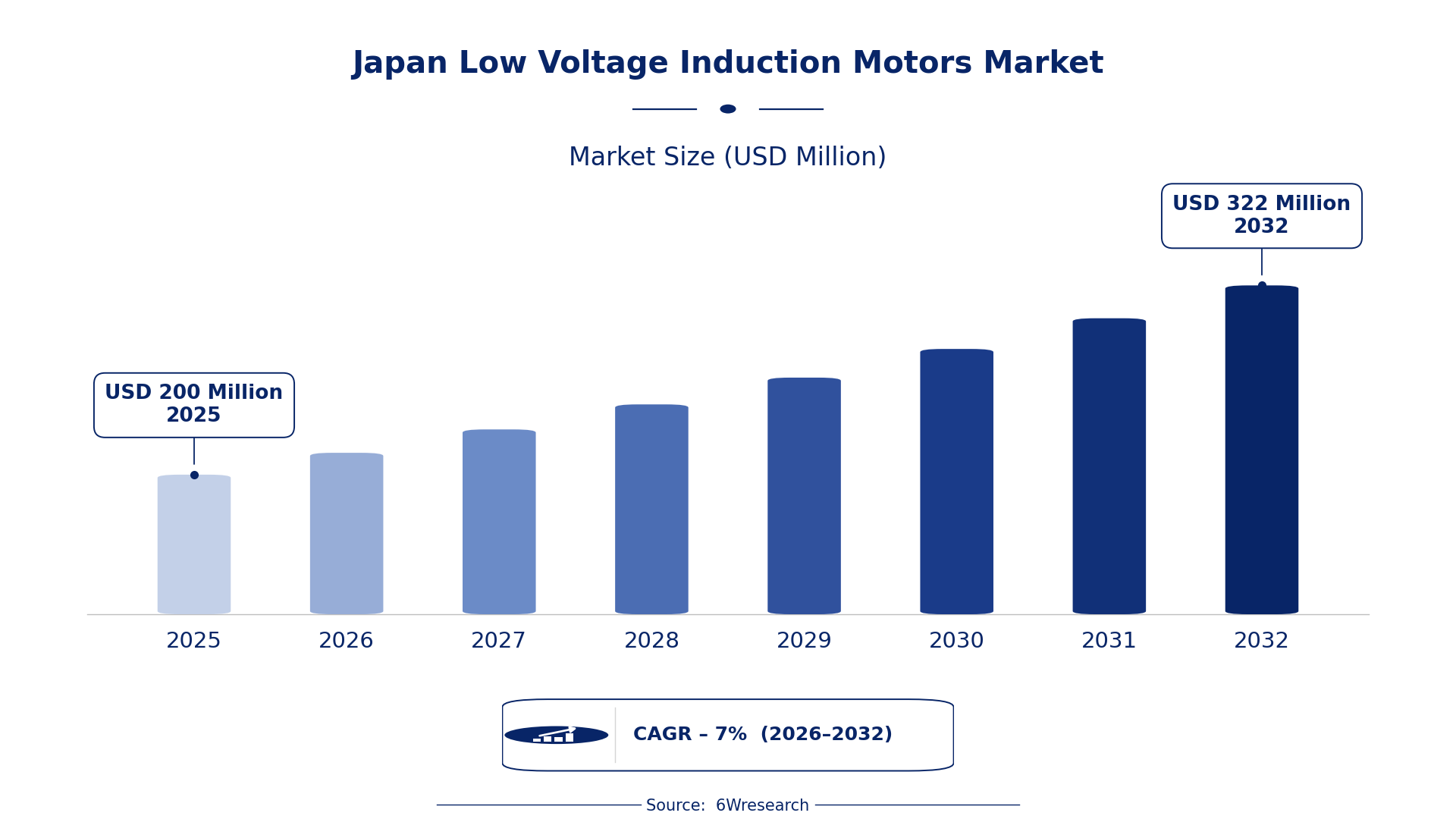
According to 6Wresearch internal database and industry insights, the Japan Low Voltage Induction Motors Market was valued at USD 200 Million in 2025 and is projected to reach USD 322 Million by 2032, growing at a CAGR of approximately 7% during 2026–2032.
Japan Low Voltage Induction Motors Market Highlights
| Report Metric | Details |
| Report Name | Japan Low Voltage Induction Motors Market (2026-2032) |
| Market Size 2025 | USD 200 Million |
| Market Size 2032 | USD 322 Million |
| Absolute Growth 2025–2032 | USD 122 Million |
| CAGR 2026–2032 | 7% |
| Peak Annual Growth | 8.4% in 2026 |
| Forecast Period | 2026–2032 |
| Historical Data | 2022–2025 |
| Base Year | 2025 |
| Leading Type, 2025 | Single Phase (61% share) |
| Leading End User Industry, 2025 | Metal and Mining (36% share) |
| Fastest-Growing Type | Poly Phase (9.3% CAGR) |
| Fastest-Growing End User Industry | Oil and Gas (9.8% CAGR) |
| Growing Sector | Power Generation |
| Key End Users | Manufacturers, industrial facilities, energy producers, processing plants |
Japan Low Voltage Induction Motors Market Year-wise Growth Rate and Key Drivers (2022–2032)
This graph illustrates the annual growth rates of the market from 2022 to 2032, highlighting a steady upward trajectory and projected market expansion over the forecast period.
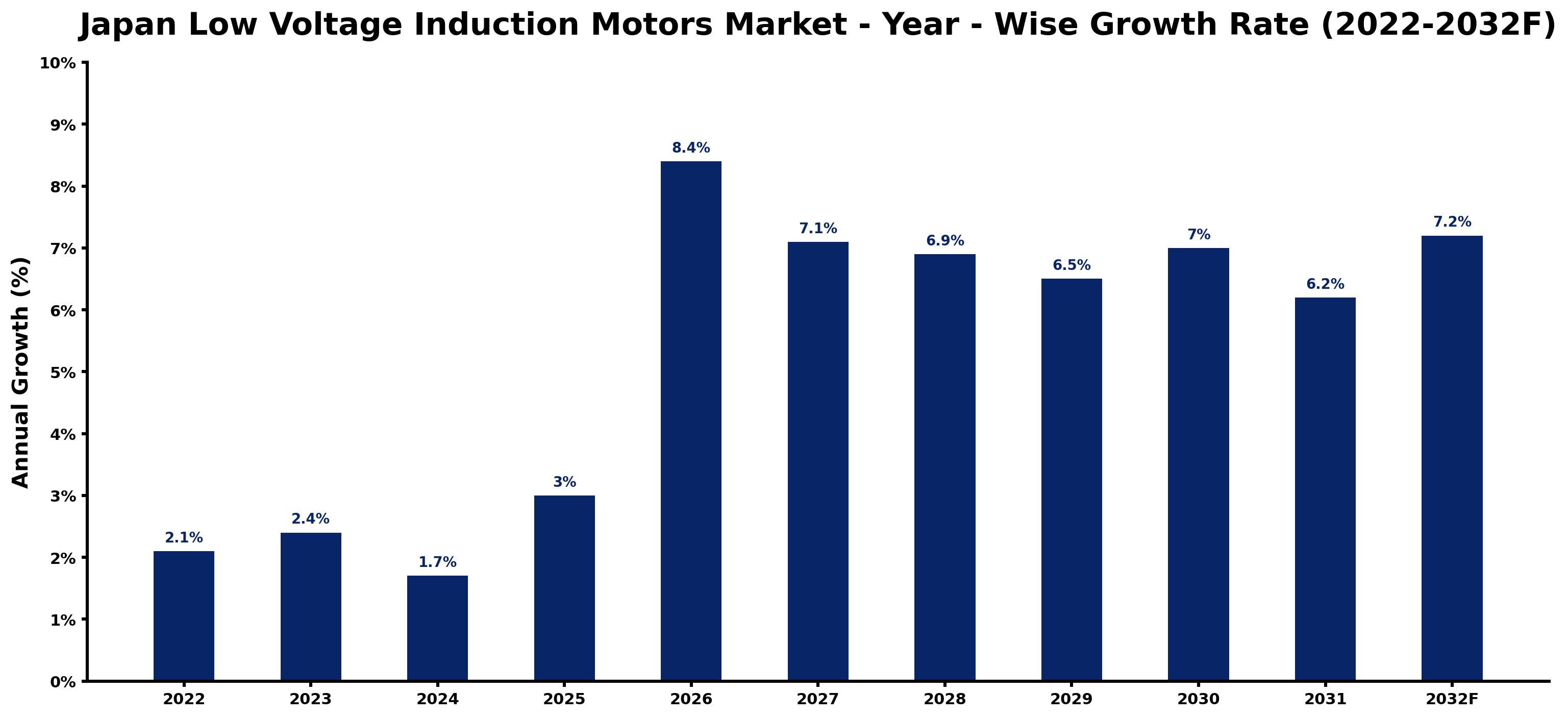
Below, each year's estimated growth is shown next to the factor that most influenced it.
| Year | Estimated Annual Growth (%) | Market Rationale |
| 2022 | 2.1 | The market showed steady performance with consistent demand from industrial sectors. |
| 2023 | 2.4 | Growth accelerated as domestic users increased their reliance on low voltage motors. |
| 2024 | 1.7 | The market experienced a slowdown due to temporary fluctuations in industrial output. |
| 2025 | 3.0 | Demand surged as manufacturing activities expanded, particularly in urban areas. |
| 2026 | 8.4 | The peak growth is expected to stem from investments in energy-efficient technologies. |
| 2027 | 7.1 | Growth is projected to slow as the market adjusts to the previous year's rapid expansion. |
| 2028 | 6.9 | The market is expected to continue growing but at a moderated pace compared to 2026. |
| 2029 | 6.5 | Demand is projected to remain strong, though growth rates will stabilise further. |
| 2030 | 7.0 | The market will see renewed interest as new industrial projects commence across regions. |
| 2031 | 6.2 | Growth is expected to slow slightly as the market reaches a more mature phase. |
| 2032 | 7.2 | The market is projected to benefit from ongoing technological advancements. |
Note: Market size estimations and growth projections presented in this report are based on 6Wresearch's proprietary forecasting methodology, utilizing the latest available industry data, government publications, and primary research inputs.
Japan Low Voltage Induction Motors Market Synopsis
Low Voltage Induction Motors convert electrical energy into mechanical energy, primarily used to drive pumps, fans, and conveyors across various industries. The Japan Low Voltage Induction Motors Market is growing due to increased demand from sectors such as Metal and Mining, concentrated in the Tohoku region, and the Chemicals and Petrochemicals industry, supported by advanced motor technology. The installed base of these motors is estimated at millions of units, while the government's focus on energy efficiency in manufacturing is driving further investments in this market.
Market Dynamics Impact Analysis (2026–2032)
| Factor | Type | Impact | Primary Segment Affected |
| Rising demand for energy-efficient solutions | Driver | High | Poly Phase |
| Increased industrial automation | Driver | High | Single Phase |
| Growing investments in renewable energy projects | Opportunity | High | Power Generation |
| Expansion of the Oil and Gas sector | Opportunity | High | Oil and Gas |
| High initial investment costs for advanced motors | Restraint | Medium | Chemicals and Petrochemicals |
| Limited awareness of energy-efficient options | Restraint | Medium | Food and Beverage |
| Competition from alternative motor technologies | Challenge | High | Discrete Industries |
| Supply chain disruptions affecting production | Challenge | High | Water and Wastewater |
Evaluation of Drivers in Japan Low Voltage Induction Motors Market (2026–2032)
These are the developments adding the most demand over the forecast period.
| Drivers | Primary Segment Affected | Why It Matters (Evidence) |
| Increased energy efficiency standards | Poly Phase | The adoption of energy-efficient motors in industrial settings is driven by regulations, leading to higher purchases from manufacturers. |
| Rising industrial automation | Single Phase | Automation in residential and light commercial applications boosts demand for reliable low voltage motors. |
| Investment in renewable energy | Power Generation | Renewable energy projects require low voltage motors for generators, increasing demand from this sector. |
| Growth in the Oil and Gas sector | Oil and Gas | The sector's expansion necessitates efficient pumps and compressors, driving motor purchases. |
| Technological advancements in motor design | Chemicals and Petrochemicals | Innovations in motor technology prompt chemical processing plants to upgrade their systems. |
Most of the extra volume comes from rising industrial automation in Japan, which is expected to increase demand for low voltage induction motors. The Metal and Mining sector, particularly in the Tohoku region, is investing heavily in automation, resulting in a notable uptick in motor purchases. In 2023, the Oil and Gas sector also saw increased investments in efficient pumps and compressors, prompting further demand for low voltage motors. The Food and Beverage industry has begun adopting energy-efficient motors, with a significant increase in uptake. These factors contribute to a strong growth outlook for low voltage induction motors in Japan.
Evaluation of Restraints in Japan Low Voltage Induction Motors Market
These restraints slow adoption and weigh on supplier margins.
| Market Restraint | Primary Segment Affected | Why It Matters (Evidence) |
| High initial investment costs for advanced motors | Chemicals and Petrochemicals | The upfront costs of energy-efficient motors deter some buyers, limiting market growth in this segment. |
| Limited awareness of energy-efficient options | Food and Beverage | Many producers are unaware of the benefits of energy-efficient motors, resulting in slower adoption rates. |
| Competition from alternative motor technologies | Discrete Industries | Emerging technologies may divert investments away from traditional low voltage motors, affecting market share. |
| Supply chain disruptions affecting production | Water and Wastewater | Disruptions can delay motor availability, impacting project timelines and buyer confidence. |
| Regulatory compliance costs | Power Generation | Compliance with stringent regulations can increase operational costs for facilities, affecting purchasing decisions. |
Japan Low Voltage Induction Motors Market Challenges
In 2023, Japan's low voltage induction motors market faces intense competition, with over 100 suppliers vying for market share, which pressures profit margins for producers. Technological advancements lag behind those in other regions, preventing buyers from accessing energy-efficient solutions that could reduce operational costs by 20%. A shortage of skilled workers hampers manufacturers' ability to innovate, leading to delayed product launches and increased costs for suppliers. Supply chain disruptions in sourcing copper wire can extend lead times, negatively impacting delivery schedules for buyers in the industrial sector.
Trends in the Japan Low Voltage Induction Motors Market
These developments are changing demand patterns in the Japan Low Voltage Induction Motors Market.
- Shift towards Energy-Efficient Motors: The Food and Beverage industry began adopting energy-efficient motors in 2023, with an estimated increase of 25% in uptake. This trend is driven by the need to reduce operational costs and comply with environmental standards.
- Transition from Single Phase to Poly Phase Motors: Since 2022, Poly Phase motors have gained popularity in industrial applications, particularly in the Tohoku region, with a growth rate of 9.3%. This shift reflects the push for higher efficiency in manufacturing processes.
- Emergence of Smart Motor Technologies: The introduction of smart motor technologies in 2024 has transformed operations in the Chemicals and Petrochemicals sector, with a 30% increase in efficiency reported. This advancement supports better monitoring and control of motor performance.
- Prioritisation of Renewable Energy Applications: The Power Generation sector has seen a focus on low voltage motors for renewable energy applications since 2023, with investments increasing significantly. This trend aligns with Japan's commitment to enhancing energy efficiency.
Investment Opportunities in the Japan Low Voltage Induction Motors Market
Several openings in the Japan Low Voltage Induction Motors Market merit attention from investors.
- Investment in Renewable Energy Facilities: Renewable energy projects are surging in the Tokyo metropolitan area, with an estimated investment of USD 50 million. Suppliers can enter this market by partnering with local energy providers.
- Expansion of Oil and Gas Operations: With the Oil and Gas sector projected to grow by 20% in the next five years, suppliers should focus on providing efficient low voltage motors to meet rising demand. Collaboration with industry stakeholders is essential.
- Enhancing Energy Efficiency in Manufacturing: The Chemicals and Petrochemicals industry is investing heavily in energy-efficient technologies, targeting a 30% reduction in energy consumption by 2025. Suppliers can enter by obtaining JIS certification for their products.
- Development of Smart Motor Solutions: The need for smart motor technologies is growing, particularly in the Discrete Industries, with a projected market gap of USD 15 million. Suppliers should consider joint ventures with technology firms to develop advanced solutions.
Government Initiatives in the Japan Low Voltage Induction Motors Market
The Economic Security Promotion Act, launched in 2022, supports supply-chain resilience for critical products, including low voltage motors. This act enhances existing regulations by ensuring that manufacturers comply with new standards for production and reporting, ultimately improving product quality and reliability.
In 2023, the government allocated USD 10 million to support energy efficiency initiatives in manufacturing, administered by the Ministry of Economy, Trade and Industry. This funding aims to assist facilities in upgrading their motor systems to meet modern efficiency standards.
Future Insight of the Japan Low Voltage Induction Motors Market
Buyers in the industrial sector will increasingly demand energy-efficient solutions, driven by government initiatives promoting sustainability. By 2032, advancements in smart technology will enable real-time monitoring and predictive maintenance, enhancing operational efficiency. The integration of renewable energy sources will elevate demand for low voltage induction motors across various applications. As the installed base expands, suppliers will need to invest in research and development to meet evolving industry standards and maintain competitiveness.
Market Segmentation Analysis
Japan Low Voltage Induction Motors Market report covers a detailed analysis of the following market segments:
By Type – Single Phase Leads, Poly Phase Expected to Grow Fastest
According to Bhawna Singh, Assistant Manager at 6Wresearch, with 61% of type revenue in 2025, Single Phase was the largest category. Single phase motors lead the market due to their widespread application in residential and light commercial settings, meeting the needs of domestic users effectively. Their reliability in powering household appliances has established a substantial installed base across Japan. Poly Phase is projected to grow fastest, at a CAGR of 9.3% during 2026–2032. Poly phase motors are experiencing rapid growth as industries increasingly adopt them for their efficiency in manufacturing processes. The recent government initiative to enhance energy efficiency in manufacturing is likely to further boost their uptake. Suppliers must focus on developing energy-efficient solutions to meet the rising demand in industrial applications.
By End User Industry – Metal and Mining Leads, Oil and Gas Expected to Grow Fastest
Metal and Mining accounted for 36% of the market by end user industry in 2025. The Metal and Mining industry commands the largest share as low voltage induction motors are crucial for operating machinery in extraction processes, especially in the Tohoku region. This sector's reliance on these motors guarantees steady demand and a strong installed base. Oil and Gas are set to record the highest CAGR in this split, 9.8% over 2026–2032. The Oil and Gas sector is the fastest-growing end user, driven by the need for efficient pumps and compressors in extraction and processing operations. The sector's increasing emphasis on energy efficiency is expected to sustain its growth trajectory. Buyers in the Oil and Gas sector should prioritise suppliers that offer advanced motor technology to enhance operational efficiency.
Key Attractiveness of the Report
- 10 Years of Market Numbers
- Historical Data Starting from 2022 to 2025
- Base Year 2025
- Forecast Data until 2032
- Key Performance Indicators Impacting the Market
- Major Upcoming Developments and Projects
Key Highlights of the Report:
- Japan Low Voltage Induction Motors Market Outlook
- Market Size of Japan Low Voltage Induction Motors Market, 2025
- Forecast of Japan Low Voltage Induction Motors Market, 2032
- Historical Data and Forecast of Japan Low Voltage Induction Motors Revenues & Volume for the Period 2022-2032
- Japan Low Voltage Induction Motors Market Trend Evolution
- Japan Low Voltage Induction Motors Market Drivers and Challenges
- Japan Low Voltage Induction Motors Price Trends
- Japan Low Voltage Induction Motors Porter's Five Forces
- Japan Low Voltage Induction Motors Industry Life Cycle
- Historical Data and Forecast of Japan Low Voltage Induction Motors Market Revenues & Volume By Type for the Period 2022-2032
- Historical Data and Forecast of Japan Low Voltage Induction Motors Market Revenues & Volume By Single Phase for the Period 2022-2032
- Historical Data and Forecast of Japan Low Voltage Induction Motors Market Revenues & Volume By Poly Phase for the Period 2022-2032
- Historical Data and Forecast of Japan Low Voltage Induction Motors Market Revenues & Volume By End User Industry for the Period 2022-2032
- Historical Data and Forecast of Japan Low Voltage Induction Motors Market Revenues & Volume By Metal and Mining for the Period 2022-2032
- Historical Data and Forecast of Japan Low Voltage Induction Motors Market Revenues & Volume By Oil and Gas for the Period 2022-2032
- Historical Data and Forecast of Japan Low Voltage Induction Motors Market Revenues & Volume By Chemicals and Petrochemicals for the Period 2022-2032
- Historical Data and Forecast of Japan Low Voltage Induction Motors Market Revenues & Volume By Water and Wastewater for the Period 2022-2032
- Historical Data and Forecast of Japan Low Voltage Induction Motors Market Revenues & Volume By Discrete Industries for the Period 2022-2032
- Historical Data and Forecast of Japan Low Voltage Induction Motors Market Revenues & Volume By Power Generation for the Period 2022-2032
- Historical Data and Forecast of Japan Low Voltage Induction Motors Market Revenues & Volume By Food and Beverage for the Period 2022-2032
- Japan Low Voltage Induction Motors Import Export Trade Statistics
- Market Opportunity Assessment By Type
- Market Opportunity Assessment By End User Industry
- Japan Low Voltage Induction Motors Top Companies Market Share
- Japan Low Voltage Induction Motors Competitive Benchmarking By Technical and Operational Parameters
- Japan Low Voltage Induction Motors Company Profiles
- Japan Low Voltage Induction Motors Key Strategic Recommendations
Market Covered
The report covers the following segments.
By Type
- Single Phase
- Poly Phase
By End User Industry
- Metal and Mining
- Oil and Gas
- Chemicals and Petrochemicals
- Water and Wastewater
- Discrete Industries
- Power Generation
- Food and Beverage































