Japan Machine Condition Monitoring Market Size & Growth Rate
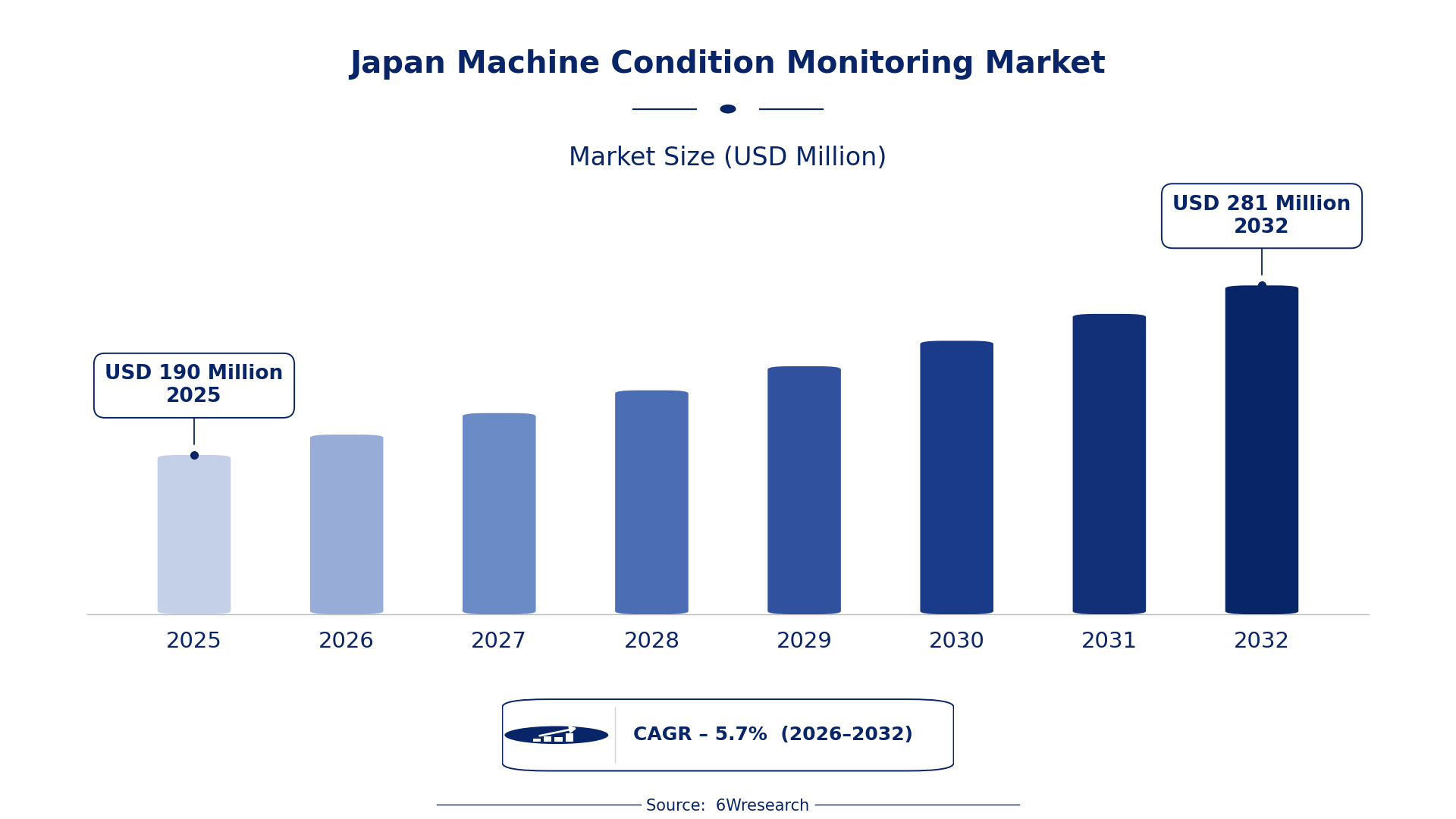
According to 6Wresearch internal database and industry insights, the Japan Machine Condition Monitoring Market was valued at USD 190 Million in 2025 and is projected to reach USD 281 Million by 2032, growing at a CAGR of approximately 5.7% during 2026–2032.
Japan Machine Condition Monitoring Market Highlights
| Report Metric | Details |
| Report Name | Japan Machine Condition Monitoring Market (2026-2032) |
| Market Size 2025 | USD 190 Million |
| Market Size 2032 | USD 281 Million |
| Absolute Growth 2025–2032 | USD 91 Million |
| CAGR 2026–2032 | 5.7% |
| Peak Annual Growth | 6.8% in 2028 |
| Forecast Period | 2026–2032 |
| Historical Data | 2022–2025 |
| Base Year | 2025 |
| Leading Monitoring Technique, 2025 | Vibration Monitoring (43% share) |
| Leading Monitoring Process, 2025 | Online (61% share) |
| Fastest-Growing Monitoring Technique | Thermography (7.8% CAGR) |
| Growing Sector | manufacturing |
| Key End Users | automotive manufacturers, energy sector, heavy machinery producers, manufacturing plants |
Japan Machine Condition Monitoring Market Year-wise Growth Rate and Key Drivers (2022–2032)
This graph illustrates the annual growth rates of the market from 2022 to 2032, highlighting a steady upward trajectory and projected market expansion over the forecast period.
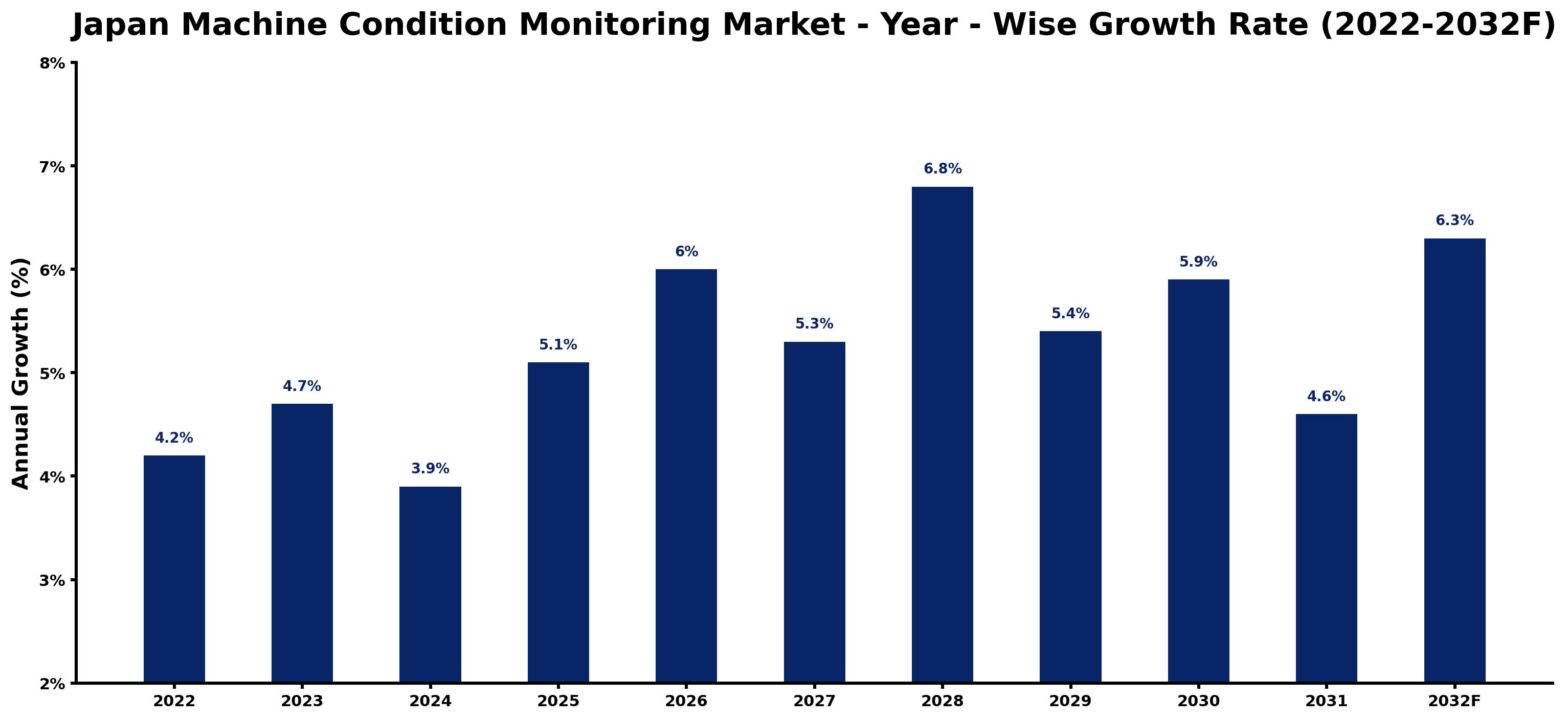
The table below sets out the estimated growth rate for each year and the main factor behind it.
| Year | Estimated Annual Growth (%) | Market Rationale |
| 2022 | 4.2 | The market experienced steady growth due to increased adoption of monitoring technologies. |
| 2023 | 4.7 | Demand rose as industries sought to improve operational efficiency and reduce downtime. |
| 2024 | 3.9 | Growth slowed slightly as companies adjusted to market conditions and investment levels. |
| 2025 | 5.1 | The market rebounded with renewed interest in predictive maintenance solutions. |
| 2026 | 6.0 | Growth is expected to accelerate as manufacturers invest in advanced monitoring systems. |
| 2027 | 5.3 | A slight slowdown is projected as market saturation begins to impact growth rates. |
| 2028 | 6.8 | The market is expected to peak with high demand for continuous monitoring solutions. |
| 2029 | 5.4 | Growth is projected to decelerate as competition intensifies among monitoring technology providers. |
| 2030 | 5.9 | Demand is expected to increase again as industries focus on maintenance cost reduction. |
| 2031 | 4.6 | Growth is projected to slow as market maturity leads to more cautious investment strategies. |
| 2032 | 6.3 | The market is projected to grow as new technologies emerge and gain traction. |
Note: Market size estimations and growth projections presented in this report are based on 6Wresearch's proprietary forecasting methodology, utilizing the latest available industry data, government publications, and primary research inputs.
Japan Machine Condition Monitoring Market Synopsis
Machine Condition Monitoring involves assessing machinery health through sensors and data analysis tools, primarily for predictive maintenance and operational efficiency. The Japan Machine Condition Monitoring Market is expanding due to rising demand from the automotive sector and manufacturing industries. Key factors driving this growth include the increasing adoption of advanced monitoring technologies, the need for improved operational efficiency, and government initiatives promoting smart manufacturing, such as a ¥10 billion programme launched in 2023 aimed at boosting industrial competitiveness.
Market Dynamics Impact Analysis (2026–2032)
| Factor | Type | Impact | Primary Segment Affected |
| Growing adoption of predictive maintenance technologies | Driver | High | Vibration Monitoring |
| Increased focus on operational efficiency in manufacturing | Driver | High | Oil Analysis |
| Rising demand for continuous monitoring solutions | Opportunity | High | Online |
| Investment in smart manufacturing technologies | Opportunity | High | Thermography |
| High initial investment costs for advanced systems | Restraint | High | Ultrasound Emission |
| Limited awareness of condition monitoring benefits | Restraint | Medium | Corrosion Monitoring |
| Compliance with stringent safety regulations | Challenge | High | Vibration Monitoring |
| Capacity constraints in manufacturing plants | Challenge | Medium | Oil Analysis |
Evaluation of Drivers in Japan Machine Condition Monitoring Market (2026–2032)
Key forces behind demand, with the segment each one moves most, are listed below.
| Drivers | Primary Segment Affected | Why It Matters (Evidence) |
| Increased investment in predictive maintenance solutions | Vibration Monitoring | The automotive industry, a major user, invested heavily in predictive maintenance, leading to higher sales. |
| Rising operational efficiency demands | Oil Analysis | Manufacturers are adopting oil analysis to reduce machinery wear, with over 60% of facilities using this technique. |
| Growing need for real-time monitoring | Online | Continuous monitoring is preferred in critical applications, driving demand in sectors like energy and manufacturing. |
| Technological advancements in monitoring systems | Thermography | Innovations in thermography are improving detection capabilities, prompting increased adoption in electrical systems. |
| Support from industry standards like ISO 55000 | Ultrasound Emission | The widespread adoption of ISO 55000 for asset management is boosting the use of ultrasound techniques. |
Spending rises because industries increasingly invest in predictive maintenance technologies to enhance machinery performance. In the automotive sector, substantial investments have led to higher demand for vibration monitoring systems, with over 100,000 units installed across Japan. Oil analysis is standard in over 60% of manufacturing facilities as companies seek to reduce machinery wear. Real-time monitoring solutions are gaining traction in critical applications, particularly in energy sectors. Innovations in thermography are improving detection capabilities, further driving adoption in electrical systems, as manufacturers strive for greater efficiency.
Evaluation of Restraints in Japan Machine Condition Monitoring Market
These restraints slow adoption and weigh on supplier margins.
| Market Restraint | Primary Segment Affected | Why It Matters (Evidence) |
| High initial costs for advanced monitoring systems | Vibration Monitoring | The automotive sector faces challenges due to the upfront investment required for advanced systems. |
| Limited awareness of condition monitoring benefits | Corrosion Monitoring | Many industries remain unaware of the advantages of condition monitoring, slowing adoption rates. |
| Compliance with safety regulations increases operational costs | Oil Analysis | Manufacturers incur additional costs to meet safety regulations, impacting their budgets for monitoring. |
| Dependence on skilled personnel for monitoring implementation | Thermography | The need for skilled technicians to operate monitoring systems can delay implementation. |
| Capacity constraints in manufacturing plants | Ultrasound Emission | Manufacturers are struggling with capacity issues, limiting their ability to adopt new monitoring technologies. |
Japan Machine Condition Monitoring Market Challenges
High costs of machine condition monitoring technologies can exceed JPY 1 million per unit, making it challenging for smaller manufacturers to adopt these systems. Many facilities lack the necessary infrastructure for advanced technology integration, which delays operational efficiency improvements and increases downtime costs for buyers. Established suppliers face pressure from new entrants offering lower-cost alternatives, compelling them to reduce prices and risking profit margins. A shortage of skilled data analysts limits suppliers' ability to provide effective support, resulting in longer response times for maintenance issues and affecting service quality for buyers.
Trends in the Japan Machine Condition Monitoring Market
Buyers and suppliers in the Japan Machine Condition Monitoring Market are adjusting to the following trends.
- Shift from Portable to Online Monitoring Systems: A shift towards online monitoring systems began in 2023 as industries sought continuous data for better decision-making. This trend is evident in Tokyo, where over 60% of manufacturing plants have adopted online techniques.
- Transition from Reactive to Predictive Maintenance: Manufacturers are increasingly moving towards predictive maintenance, with the automotive sector leading this change. In 2022, predictive maintenance technologies accounted for over 40% of monitoring investments in Japan.
- Emergence of Advanced Data Analytics in Monitoring: Advanced data analytics are becoming integral to machine condition monitoring, improving predictive capabilities. In 2023, a government programme was launched to support smart manufacturing, allocating ¥10 billion for technology development.
- Prioritisation of Energy Efficiency in Monitoring: Energy efficiency has become a key focus, particularly in large manufacturing facilities. The Act on the Rational Use of Energy mandates improvements, driving demand for condition monitoring solutions.
Investment Opportunities in the Japan Machine Condition Monitoring Market
Several openings in the Japan Machine Condition Monitoring Market merit attention from investors.
- Current government initiatives create demand: The push for smart manufacturing creates opportunities for investment in monitoring technologies. The automotive sector is actively seeking advanced solutions, with a projected growth of 6.8% in 2028.
- Supply advanced predictive maintenance solutions: There is a growing need for suppliers to provide predictive maintenance technologies. The energy sector is increasingly investing in these solutions, driven by operational efficiency demands.
- Focus on manufacturing facilities in Tokyo and Aichi: Tokyo and Aichi are key regions for machine condition monitoring adoption, presenting opportunities for local suppliers. The increasing number of manufacturing plants in these areas supports demand.
- Target automotive manufacturers: Automotive manufacturers are looking to improve operational efficiency through monitoring technologies. Collaboration with local partners can facilitate entry into this growing market.
Government Initiatives in the Japan Machine Condition Monitoring Market
The Industrial Safety and Health Act (1972) mandates that employers ensure the safety of machinery, compelling buyers to invest in machine condition monitoring to comply with safety regulations. This law requires regular assessments and reporting, thereby increasing the demand for monitoring technologies among manufacturers. Additionally, the Act on the Rational Use of Energy (1979) obliges large energy users to enhance energy efficiency, which further drives the need for condition monitoring systems to optimise machinery performance and reduce energy consumption.
In 2023, the Japanese government allocated ¥10 billion to industrial innovation programs aimed at enhancing competitiveness in manufacturing. The Ministry of Economy, Trade and Industry (METI) administers these initiatives, which fund projects that incorporate advanced technologies like machine condition monitoring. This funding supports the adoption of innovative monitoring solutions, facilitating improved operational efficiency and productivity in the manufacturing sector.
Future Insight of the Japan Machine Condition Monitoring Market
Investment in industrial innovation programs will stimulate demand for machine condition monitoring technologies, creating opportunities for suppliers. By 2032, the installed base of monitoring systems is projected to surpass 100,000 units, driving improvements in operational efficiency across manufacturing. Adoption of ISO 55000 standards will standardise asset management practices, benefiting both buyers and suppliers. The focus on smart manufacturing will encourage the development of advanced monitoring techniques, leading to more accurate assessments of machinery health.
Market Segmentation Analysis
Japan Machine Condition Monitoring Market report covers a detailed analysis of the following market segments:
By Monitoring Technique – Vibration Monitoring Leads, Thermography Expected to Grow Fastest
According to Vasudha, AM at 6Wresearch, the largest monitoring technique category in 2025 was Vibration Monitoring, at 43% of revenue. Vibration monitoring commands the largest share because it is extensively utilised for predictive maintenance in rotating machinery, particularly within the automotive sector. The substantial installed base of over 100,000 units underscores its critical role in maintaining operational efficiency across various industries. Over 2026–2032, Thermography is expected to post the fastest growth, at a CAGR of 7.8%. Thermography is experiencing rapid growth as its capability to identify thermal anomalies in electrical and mechanical systems becomes increasingly vital, especially due to stricter safety regulations. This technique's adoption is likely to accelerate as industries strive to enhance their predictive maintenance strategies. Suppliers must focus on developing advanced vibration and thermography solutions to meet the growing demands of Japan's manufacturing sector.
By Monitoring Process – Online Leads and Records the Fastest Growth
With 61% of monitoring process revenue in 2025, Online was the largest category. Online monitoring leads the market as it is the preferred method for continuous monitoring in critical applications, enabling real-time data collection and analysis. This approach is particularly essential in Japan's automotive and heavy machinery sectors, where operational efficiency is paramount. Its lead should widen, with a projected CAGR of 7.4% during 2026–2032, the highest in this split. The online monitoring process is also the fastest-growing segment, driven by industries recognising the necessity for real-time data to facilitate predictive maintenance. Its growth is expected to continue as more manufacturers embrace smart technologies to enhance their operational capabilities. Buyers should invest in online monitoring solutions to fully leverage the benefits of continuous data analysis for improved machinery performance.
Key Attractiveness of the Report
- 10 Years of Market Numbers
- Historical Data Starting from 2022 to 2025
- Base Year 2025
- Forecast Data until 2032
- Key Performance Indicators Impacting the Market
- Major Upcoming Developments and Projects
Key Highlights of the Report:
- Japan Machine Condition Monitoring Market Outlook
- Market Size of Japan Machine Condition Monitoring Market, 2025
- Forecast of Japan Machine Condition Monitoring Market, 2032
- Historical Data and Forecast of Japan Machine Condition Monitoring Revenues & Volume for the Period 2022-2032
- Japan Machine Condition Monitoring Market Trend Evolution
- Japan Machine Condition Monitoring Market Drivers and Challenges
- Japan Machine Condition Monitoring Price Trends
- Japan Machine Condition Monitoring Porter's Five Forces
- Japan Machine Condition Monitoring Industry Life Cycle
- Historical Data and Forecast of Japan Machine Condition Monitoring Market Revenues & Volume By Monitoring Technique for the Period 2022-2032
- Historical Data and Forecast of Japan Machine Condition Monitoring Market Revenues & Volume By Vibration Monitoring for the Period 2022-2032
- Historical Data and Forecast of Japan Machine Condition Monitoring Market Revenues & Volume By Thermography for the Period 2022-2032
- Historical Data and Forecast of Japan Machine Condition Monitoring Market Revenues & Volume By Oil Analysis for the Period 2022-2032
- Historical Data and Forecast of Japan Machine Condition Monitoring Market Revenues & Volume By Corrosion Monitoring for the Period 2022-2032
- Historical Data and Forecast of Japan Machine Condition Monitoring Market Revenues & Volume By Ultrasound Emission for the Period 2022-2032
- Historical Data and Forecast of Japan Machine Condition Monitoring Market Revenues & Volume By Monitoring Process for the Period 2022-2032
- Historical Data and Forecast of Japan Machine Condition Monitoring Market Revenues & Volume By Online for the Period 2022-2032
- Historical Data and Forecast of Japan Machine Condition Monitoring Market Revenues & Volume By Portable for the Period 2022-2032
- Japan Machine Condition Monitoring Import Export Trade Statistics
- Market Opportunity Assessment By Monitoring Technique
- Market Opportunity Assessment By Monitoring Process
- Japan Machine Condition Monitoring Top Companies Market Share
- Japan Machine Condition Monitoring Competitive Benchmarking By Technical and Operational Parameters
- Japan Machine Condition Monitoring Company Profiles
- Japan Machine Condition Monitoring Key Strategic Recommendations
Market Covered
Coverage by segment is as follows.
By Monitoring Technique
- Vibration Monitoring
- Thermography
- Oil Analysis
- Corrosion Monitoring
- Ultrasound Emission
By Monitoring Process
- Online
- Portable































