Japan Tracking As A Service Market Size & Growth Rate
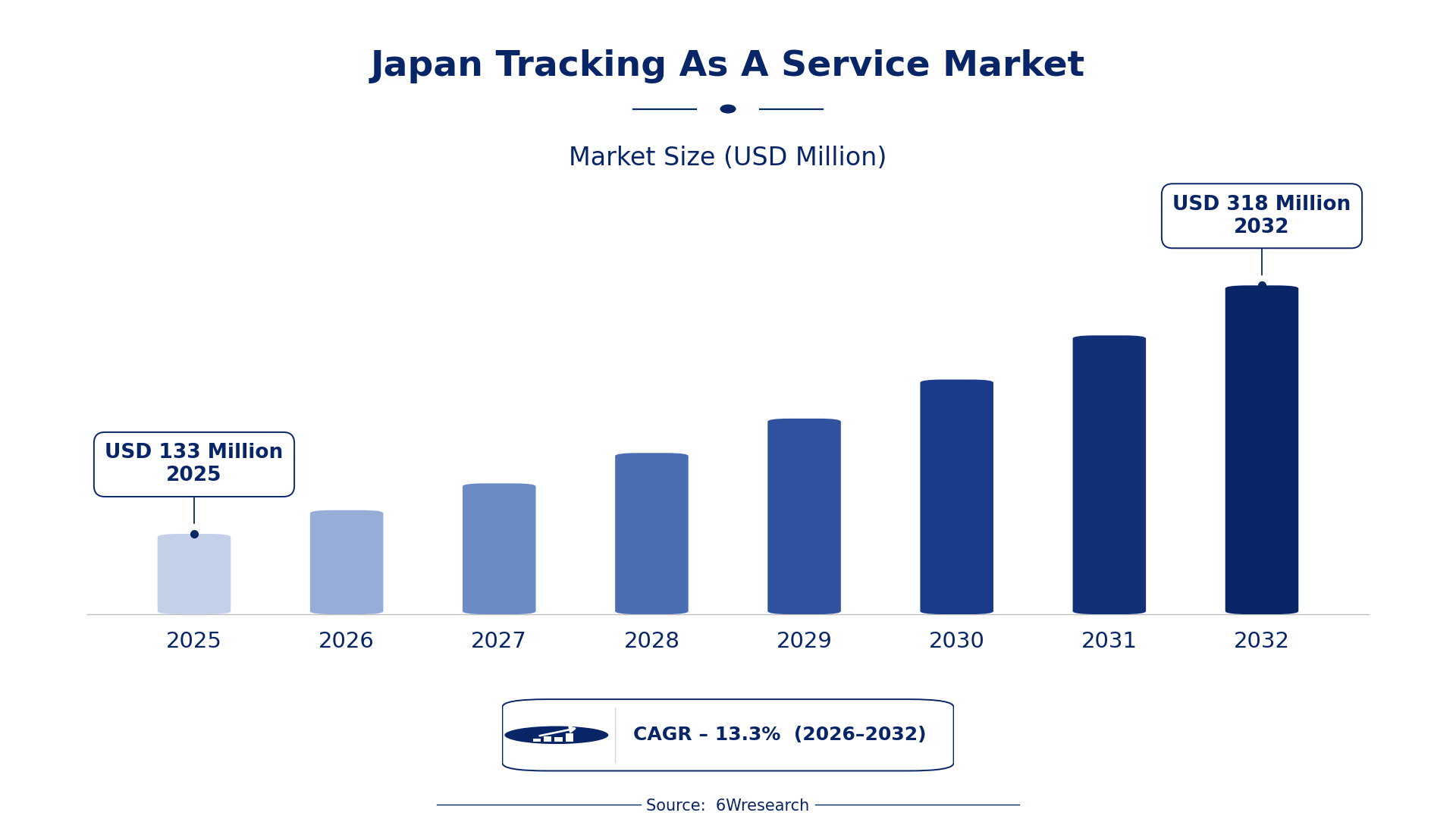
According to 6Wresearch internal database and industry insights, the Japan Tracking As A Service Market was valued at USD 133 Million in 2025 and is projected to reach USD 318 Million by 2032, growing at a CAGR of approximately 13.3% during 2026–2032.
Japan Tracking As A Service Market Highlights
| Report Metric | Details |
| Report Name | Japan Tracking As A Service Market (2026-2032) |
| Market Size 2025 | USD 133 Million |
| Market Size 2032 | USD 318 Million |
| Absolute Growth 2025–2032 | USD 185 Million |
| CAGR 2026–2032 | 13.3% |
| Peak Annual Growth | 14.1% in 2032 |
| Forecast Period | 2026–2032 |
| Historical Data | 2022–2025 |
| Base Year | 2025 |
| Leading Component, 2025 | Software (59% share) |
| Leading Enterprise Size, 2025 | Large Enterprises (57% share) |
| Leading Asset Type, 2025 | Electronics & IT Assets (46% share) |
| Leading Vertical, 2025 | Transportation & Logistic (39% share) |
| Fastest-Growing Component | Services (14.9% CAGR) |
| Fastest-Growing Enterprise Size | Small & Medium Enterprises (16.9% CAGR) |
| Fastest-Growing Asset Type | In-transit Equipment (18.7% CAGR) |
| Fastest-Growing Vertical | Manufacturing (18.1% CAGR) |
| Growing Sector | logistics |
| Key End Users | logistics companies, manufacturing firms, small and medium enterprises |
Japan Tracking As A Service Market Year-wise Growth Rate and Key Drivers (2022–2032)
This graph illustrates the annual growth rates of the market from 2022 to 2032, highlighting a steady upward trajectory and projected market expansion over the forecast period.
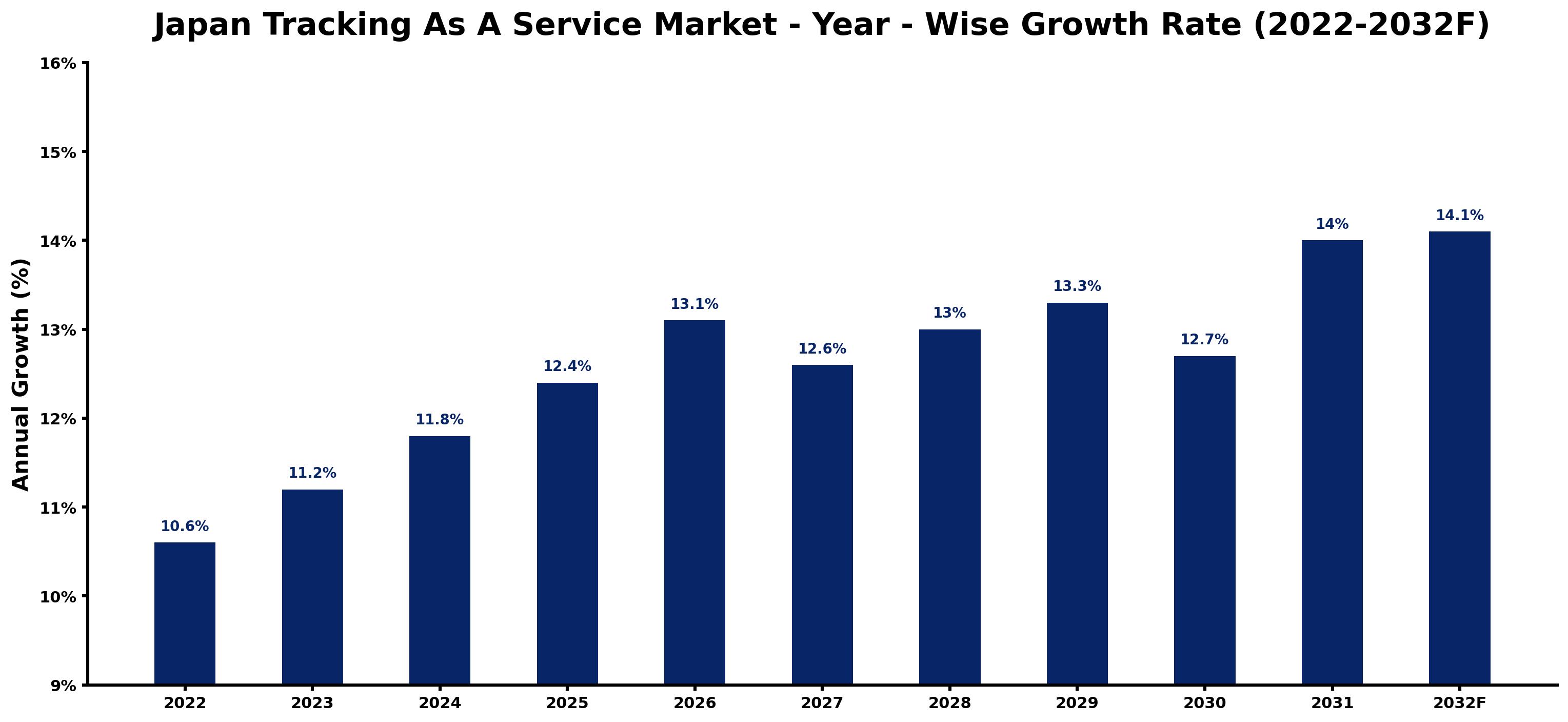
Each row of the following table gives one year's estimated growth and the event or demand shift that explains it.
| Year | Estimated Annual Growth (%) | Market Rationale |
| 2022 | 10.6 | The logistics sector showed steady demand from domestic users and technology integration. |
| 2023 | 11.2 | Growth accelerated as logistics companies adopted advanced tracking solutions. |
| 2024 | 11.8 | Increased efficiency in supply chains drove further adoption of tracking services. |
| 2025 | 12.4 | The manufacturing sector's expansion led to higher asset management needs. |
| 2026 | 13.1 | Demand rose as businesses sought to optimise logistics and asset visibility. |
| 2027 | 12.6 | Growth slowed slightly as market saturation began to affect new investments. |
| 2028 | 13.0 | Increased focus on technology integration revitalised growth in tracking services. |
| 2029 | 13.3 | The rise of e-commerce boosted demand for real-time tracking solutions. |
| 2030 | 12.7 | Growth decelerated as companies consolidated existing technologies and services. |
| 2031 | 14.0 | A surge in logistics operations led to renewed interest in tracking solutions. |
| 2032 | 14.1 | The peak growth was driven by advancements in IoT and cloud technologies. |
Note: Market size estimations and growth projections presented in this report are based on 6Wresearch's proprietary forecasting methodology, utilizing the latest available industry data, government publications, and primary research inputs.
Japan Tracking As A Service Market Synopsis
Tracking as a Service (TaaS) is a technology solution that enables real-time asset tracking through GPS, IoT devices, and cloud-based services. The Japan Tracking As A Service Market is primarily driven by the logistics and manufacturing sectors, valued at approximately 10 trillion JPY and contributing about 20% to the GDP. The government's digital transformation initiative for SMEs is stimulating demand for tracking solutions, leading to increased adoption across various industries.
Market Dynamics Impact Analysis (2026–2032)
| Factor | Type | Impact | Primary Segment Affected |
| Growing logistics sector demands real-time tracking solutions. | Driver | High | Transportation & Logistic |
| Increasing adoption of IoT technology enhances asset tracking capabilities. | Driver | High | Electronics & IT Assets |
| Investment in digital transformation creates opportunities for TaaS providers. | Opportunity | High | Small & Medium Enterprises |
| Rising e-commerce activities boost demand for efficient tracking services. | Opportunity | High | Transportation & Logistic |
| High competition among logistics companies pressures pricing strategies. | Restraint | Medium | Transportation & Logistic |
| Aging manufacturing equipment may hinder technology adoption. | Restraint | Medium | Manufacturing Assets |
| Limited awareness of TaaS benefits among SMEs affects market penetration. | Challenge | Medium | Small & Medium Enterprises |
| Integration challenges with existing systems may delay adoption. | Challenge | Medium | Manufacturing Assets |
Evaluation of Drivers in Japan Tracking As A Service Market (2026–2032)
These are the developments adding the most demand over the forecast period.
| Drivers | Primary Segment Affected | Why It Matters (Evidence) |
| Expansion of the logistics sector increases demand for tracking solutions. | Transportation & Logistic | Japan's logistics sector is valued at approximately 10 trillion JPY, creating higher asset management needs. |
| Adoption of IoT technology improves asset monitoring capabilities. | Electronics & IT Assets | The integration of IoT devices allows for real-time tracking, prompting more purchases from manufacturers. |
| Increased focus on supply chain optimisation drives TaaS adoption. | Manufacturing Assets | Manufacturers are investing in tracking solutions to enhance operational efficiency and asset utilisation. |
| Growing e-commerce activities require efficient logistics management. | Transportation & Logistic | The rise of e-commerce has led to a surge in demand for real-time tracking services. |
| Government initiatives support technology adoption in logistics. | Small & Medium Enterprises | The Japan External Trade Organization promotes technology integration, encouraging SMEs to adopt TaaS. |
A wider customer base explains much of the growth, as Japan's logistics sector, valued at approximately 10 trillion JPY, drives demand for tracking solutions. The integration of IoT technology improves asset monitoring capabilities, prompting manufacturers to invest in real-time tracking. The rise of e-commerce has led to increased demand for efficient logistics management, encouraging more purchases of tracking services.
Evaluation of Restraints in Japan Tracking As A Service Market
Several factors work against faster growth; the main ones are summarised below.
| Market Restraint | Primary Segment Affected | Why It Matters (Evidence) |
| High competition pressures pricing strategies among logistics providers. | Transportation & Logistic | With over 1,000 registered logistics companies, competition limits profit margins for tracking services. |
| Aging manufacturing equipment may hinder the adoption of new technologies. | Manufacturing Assets | The average age of manufacturing equipment in Japan is over 10 years, impacting efficiency. |
| Limited awareness of TaaS benefits among SMEs affects market penetration. | Small & Medium Enterprises | Many SMEs are unaware of how TaaS can improve operational efficiency and asset management. |
| Integration challenges with existing systems may delay adoption. | Manufacturing Assets | Companies face difficulties in integrating new tracking solutions with legacy systems. |
| Budget constraints limit investments in advanced tracking technologies. | Small & Medium Enterprises | Many SMEs operate on tight budgets, restricting their ability to invest in TaaS. |
Japan Tracking As A Service Market Challenges
Outdated manufacturing equipment, averaging over 10 years old, increases operational costs for producers, leading to higher prices for buyers in Japan's logistics sector valued at approximately 10 trillion JPY. A skills gap prevents the workforce from effectively using advanced technologies, delaying logistics companies' ability to modernise and resulting in lost market share. Intense competition among over 1,000 logistics firms pressures suppliers to cut costs, which can compromise service quality and ultimately reduce buyer satisfaction. Regulatory complexities from the Ministry of Land, Infrastructure, Transport and Tourism can lead to service delivery delays, impacting all market participants.
Trends in the Japan Tracking As A Service Market
The shifts below are changing how Japan Tracking As A Service Market products are bought and supplied.
- Shift from Traditional to Digital Tracking Solutions: Transportation and logistics companies are increasingly adopting digital tracking solutions, moving away from traditional methods. In 2023, over 60% of logistics firms reported using digital tracking systems, reflecting a shift in operational practices.
- Emergence of Real-Time Data Analytics in Logistics: Since 2022, logistics companies have begun utilising real-time data analytics to optimise supply chain processes. This trend is illustrated by the growing use of analytics platforms, with 45% of firms reporting improved efficiency.
- Increased Focus on Sustainability in Asset Tracking: As of 2023, logistics firms are prioritising sustainable practices, integrating eco-friendly tracking solutions. Approximately 30% of companies have adopted green tracking technologies to reduce their carbon footprint.
- Expansion of TaaS in Small & Medium Enterprises: Since 2023, SMEs have increasingly adopted TaaS to enhance operational efficiency. Reports indicate a 25% increase in TaaS adoption among SMEs, driven by the need for cost-effective asset management.
Investment Opportunities in the Japan Tracking As A Service Market
The following areas offer the clearest openings for investors and suppliers in the Japan Tracking As A Service Market.
- Partnership with Local Logistics Firms: Now is an ideal time to partner with local logistics firms to supply TaaS solutions, as the logistics sector is valued at approximately 10 trillion JPY, creating opportunities for growth.
- Supply of Advanced Tracking Software: The demand for advanced tracking software is rising, particularly in the manufacturing sector, which contributes about 20% to Japan's GDP. Companies can enter this market by collaborating with local software developers.
- Investment in IoT Integration Services: With the increasing adoption of IoT technology, there is a growing need for integration services. Targeting logistics companies in Tokyo and Osaka can provide opportunities for service providers.
- Focus on Digital Transformation Initiatives: The Japanese government's digital transformation initiative for SMEs presents an opportunity to supply TaaS solutions, as many SMEs seek to improve their operational efficiency through technology.
Government Initiatives in the Japan Tracking As A Service Market
The Semiconductor and Digital Industry Strategy launched in June 2021 introduces measures to secure domestic semiconductor manufacturing. This strategy supports the capabilities of tracking technologies by ensuring a reliable supply of semiconductors, which are essential for IoT devices used in TaaS. The strategy aims to strengthen the domestic semiconductor industry, which is vital for the development of advanced tracking solutions.
The Ministry of Land, Infrastructure, Transport and Tourism oversees transportation regulations, ensuring compliance with safety and operational standards. This agency supports logistics companies by facilitating the adoption of tracking technologies, promoting efficiency and transparency in operations. By providing guidelines and resources, the ministry helps businesses implement effective tracking solutions.
Future Insight of the Japan Tracking As A Service Market
The integration of GPS and IoT devices will revolutionise asset tracking, enabling logistics companies to access real-time data and optimise operations. The digital transformation initiative for SMEs will enhance efficiency, allowing buyers to benefit from reduced costs. With a goal to decrease logistics costs by 10% by 2025, suppliers will need to innovate continuously to stay competitive. Widespread adoption of ISO 9001 standards will promote consistent quality, building trust and reliability for buyers.
Market Segmentation Analysis
Japan Tracking As A Service Market report covers a detailed analysis of the following market segments:
By Component – Software Leads, Services Expected to Grow Fastest
According to Vasudha, AM at 6Wresearch, in 2025, Software led the component split with a 59% share. Software holds the largest share as it is essential for tracking and data management in logistics operations. Its role in supporting Japan's logistics sector, valued at approximately 10 trillion JPY, underscores its critical importance. Services are projected to grow fastest, at a CAGR of 14.9% during 2026–2032. Services are experiencing rapid growth due to their necessity for implementation and ongoing support of tracking solutions. The recent digital transformation initiative for SMEs is expected to further boost demand for these services. Suppliers should focus on enhancing service offerings to meet the increasing demand for implementation and support.
By Enterprise Size – Large Enterprises Lead, Small & Medium Enterprises Expected to Grow Fastest
The largest enterprise size category in 2025 was Large Enterprises, at 57% of revenue. Large Enterprises dominate the market because they have extensive asset management needs that require robust tracking solutions. Their significant contribution to Japan's GDP, especially in manufacturing, reflects their reliance on TaaS for operational efficiency. The quickest growth will come from Small & Medium Enterprises, forecast to expand at a CAGR of 16.9% between 2026 and 2032. Small & Medium Enterprises are growing quickly as they seek efficiency improvements through technology adoption. The backing from the Japan External Trade Organization for technology integration is a key factor in this growth. Buyers from small and medium enterprises should consider investing in tracking solutions to improve their operational efficiency.
By Asset Type – Electronics & IT Assets Lead, In-transit Equipment Expected to Grow Fastest
Electronics & IT Assets took 46% of asset type revenue in 2025, more than any other category. Electronics & IT Assets lead the market as they are critical for monitoring high-value items, particularly in logistics and manufacturing sectors. The average age of manufacturing equipment in Japan, over 10 years, necessitates modern tracking solutions for effective management. In-transit Equipment is set to record the highest CAGR in this split, 18.7% over 2026–2032. In-transit Equipment is the fastest-growing segment due to its importance for logistics and supply chain visibility. The Japanese government's target to reduce logistics costs by 10% by 2025 is likely to boost demand for tracking solutions in this area. Suppliers should prioritise solutions for in-transit equipment to capitalise on the increasing focus on logistics efficiency.
By Vertical – Transportation & Logistic Leads, Manufacturing Expected to Grow Fastest
Transportation & Logistic accounted for 39% of the market by vertical in 2025. Transportation & Logistics is the leading vertical as it represents the core application area for asset tracking, vital for managing logistics operations. The presence of over 1,000 registered logistics companies in Japan indicates strong demand for tracking solutions in this sector. Over 2026–2032, Manufacturing is expected to post the fastest growth, at a CAGR of 18.1%. Manufacturing is the fastest-growing vertical, primarily due to its significant need for production asset management. The ongoing digital transformation in this sector aligns with the rising adoption of tracking technologies. Suppliers should tailor their offerings to meet the specific needs of the manufacturing sector as it continues to expand.
Key Attractiveness of the Report
- 10 Years of Market Numbers
- Historical Data Starting from 2022 to 2025
- Base Year 2025
- Forecast Data until 2032
- Key Performance Indicators Impacting the Market
- Major Upcoming Developments and Projects
Key Highlights of the Report:
- Japan Tracking As A Service Market Outlook
- Market Size of Japan Tracking As A Service Market, 2025
- Forecast of Japan Tracking As A Service Market, 2032
- Historical Data and Forecast of Japan Tracking As A Service Revenues & Volume for the Period 2022-2032
- Japan Tracking As A Service Market Trend Evolution
- Japan Tracking As A Service Market Drivers and Challenges
- Japan Tracking As A Service Price Trends
- Japan Tracking As A Service Porter's Five Forces
- Japan Tracking As A Service Industry Life Cycle
- Historical Data and Forecast of Japan Tracking As A Service Market Revenues & Volume By Component for the Period 2022-2032
- Historical Data and Forecast of Japan Tracking As A Service Market Revenues & Volume By Software for the Period 2022-2032
- Historical Data and Forecast of Japan Tracking As A Service Market Revenues & Volume By Services for the Period 2022-2032
- Historical Data and Forecast of Japan Tracking As A Service Market Revenues & Volume By Enterprise Size for the Period 2022-2032
- Historical Data and Forecast of Japan Tracking As A Service Market Revenues & Volume By Large Enterprises for the Period 2022-2032
- Historical Data and Forecast of Japan Tracking As A Service Market Revenues & Volume By Small & Medium Enterprises for the Period 2022-2032
- Historical Data and Forecast of Japan Tracking As A Service Market Revenues & Volume By Asset Type for the Period 2022-2032
- Historical Data and Forecast of Japan Tracking As A Service Market Revenues & Volume By Electronics & IT Assets for the Period 2022-2032
- Historical Data and Forecast of Japan Tracking As A Service Market Revenues & Volume By In-transit Equipment for the Period 2022-2032
- Historical Data and Forecast of Japan Tracking As A Service Market Revenues & Volume By Manufacturing Assets for the Period 2022-2032
- Historical Data and Forecast of Japan Tracking As A Service Market Revenues & Volume By Others for the Period 2022-2032
- Historical Data and Forecast of Japan Tracking As A Service Market Revenues & Volume By Vertical for the Period 2022-2032
- Historical Data and Forecast of Japan Tracking As A Service Market Revenues & Volume By Transportation & Logistic for the Period 2022-2032
- Historical Data and Forecast of Japan Tracking As A Service Market Revenues & Volume By Manufacturing for the Period 2022-2032
- Historical Data and Forecast of Japan Tracking As A Service Market Revenues & Volume By Healthcare for the Period 2022-2032
- Historical Data and Forecast of Japan Tracking As A Service Market Revenues & Volume By Food & Beverage for the Period 2022-2032
- Historical Data and Forecast of Japan Tracking As A Service Market Revenues & Volume By Retail for the Period 2022-2032
- Historical Data and Forecast of Japan Tracking As A Service Market Revenues & Volume By IT & Telecom for the Period 2022-2032
- Historical Data and Forecast of Japan Tracking As A Service Market Revenues & Volume By Others for the Period 2022-2032
- Japan Tracking As A Service Import Export Trade Statistics
- Market Opportunity Assessment By Component
- Market Opportunity Assessment By Enterprise Size
- Market Opportunity Assessment By Asset Type
- Market Opportunity Assessment By Vertical
- Japan Tracking As A Service Top Companies Market Share
- Japan Tracking As A Service Competitive Benchmarking By Technical and Operational Parameters
- Japan Tracking As A Service Company Profiles
- Japan Tracking As A Service Key Strategic Recommendations
Market Covered
The study includes the following segmentation.
By Component
- Software
- Services
By Enterprise Size
- Large Enterprises
- Small & Medium Enterprises
By Asset Type
- Electronics & IT Assets
- In-transit Equipment
- Manufacturing Assets
- Others
By Vertical
- Transportation & Logistic
- Manufacturing
- Healthcare
- Food & Beverage
- Retail
- IT & Telecom
- Others































