Japan Wealth Management Market Size & Growth Rate
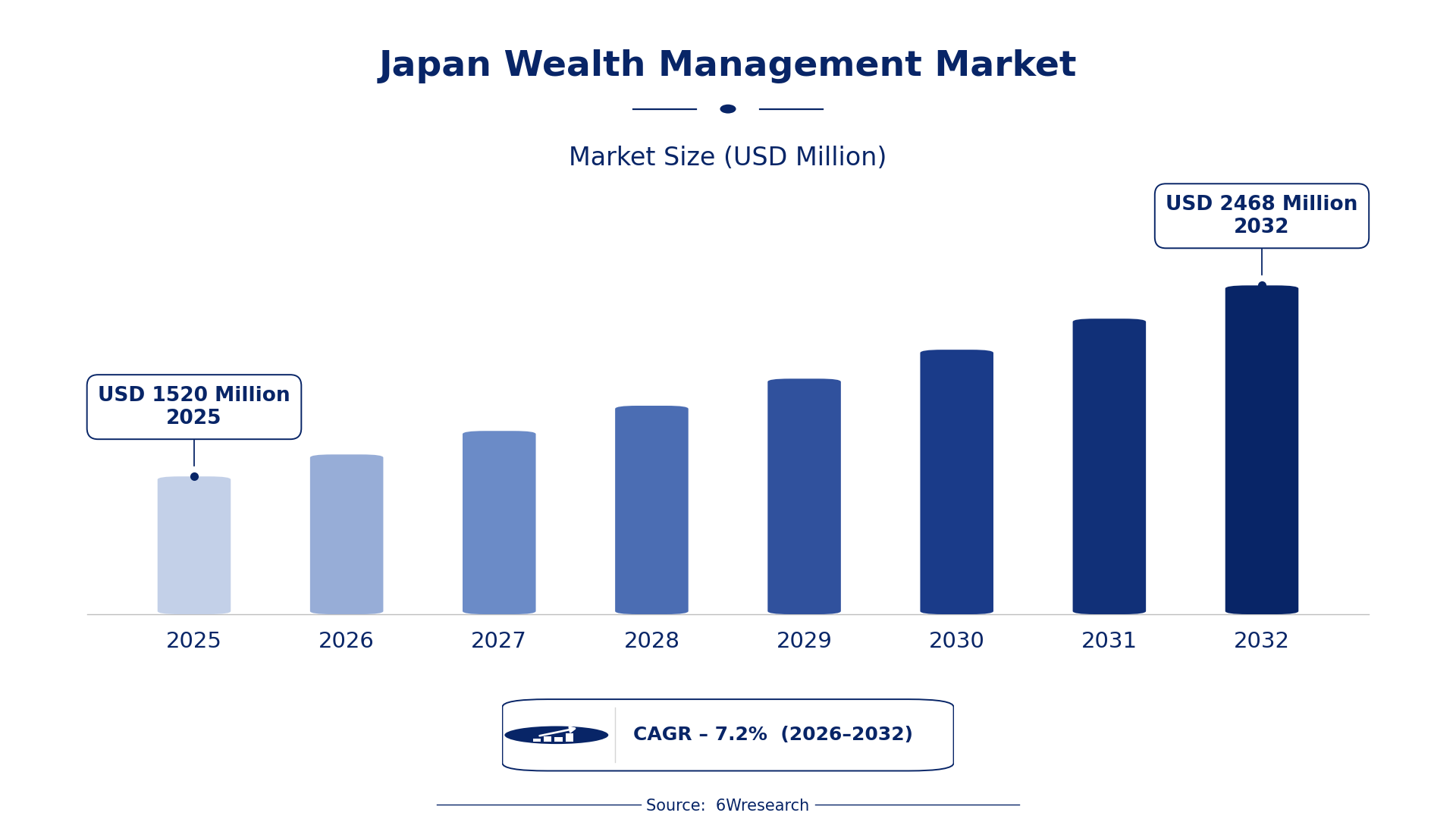
According to 6Wresearch internal database and industry insights, the Japan Wealth Management Market was valued at USD 1,520 Million in 2025 and is projected to reach USD 2,468 Million by 2032, growing at a CAGR of approximately 7.2% during 2026–2032.
Japan Wealth Management Market Highlights
| Report Metric | Details |
| Report Name | Japan Wealth Management Market (2026-2032) |
| Market Size 2025 | USD 1,520 Million |
| Market Size 2032 | USD 2,468 Million |
| Absolute Growth 2025–2032 | USD 948 Million |
| CAGR 2026–2032 | 7.2% |
| Peak Annual Growth | 8.2% in 2028 |
| Forecast Period | 2026–2032 |
| Historical Data | 2022–2025 |
| Base Year | 2025 |
| Leading Type, 2025 | Private Wealth Management (33% share) |
| Leading Service Model, 2025 | Traditional Advisory (42% share) |
| Leading Client Type, 2025 | High Net Worth Individuals (35% share) |
| Leading End Use, 2025 | Private Clients (44% share) |
| Fastest-Growing Type | Digital Wealth Management (10.5% CAGR) |
| Fastest-Growing Service Model | Robo-Advisory (10.1% CAGR) |
| Fastest-Growing Client Type | Mass Affluent (10.7% CAGR) |
| Growing Sector | Private Clients |
| Key End Users | Private Clients, Financial Institutions, Investment Firms, Family Offices |
Japan Wealth Management Market Year-wise Growth Rate and Key Drivers (2022–2032)
This graph illustrates the annual growth rates of the market from 2022 to 2032, highlighting a steady upward trajectory and projected market expansion over the forecast period.
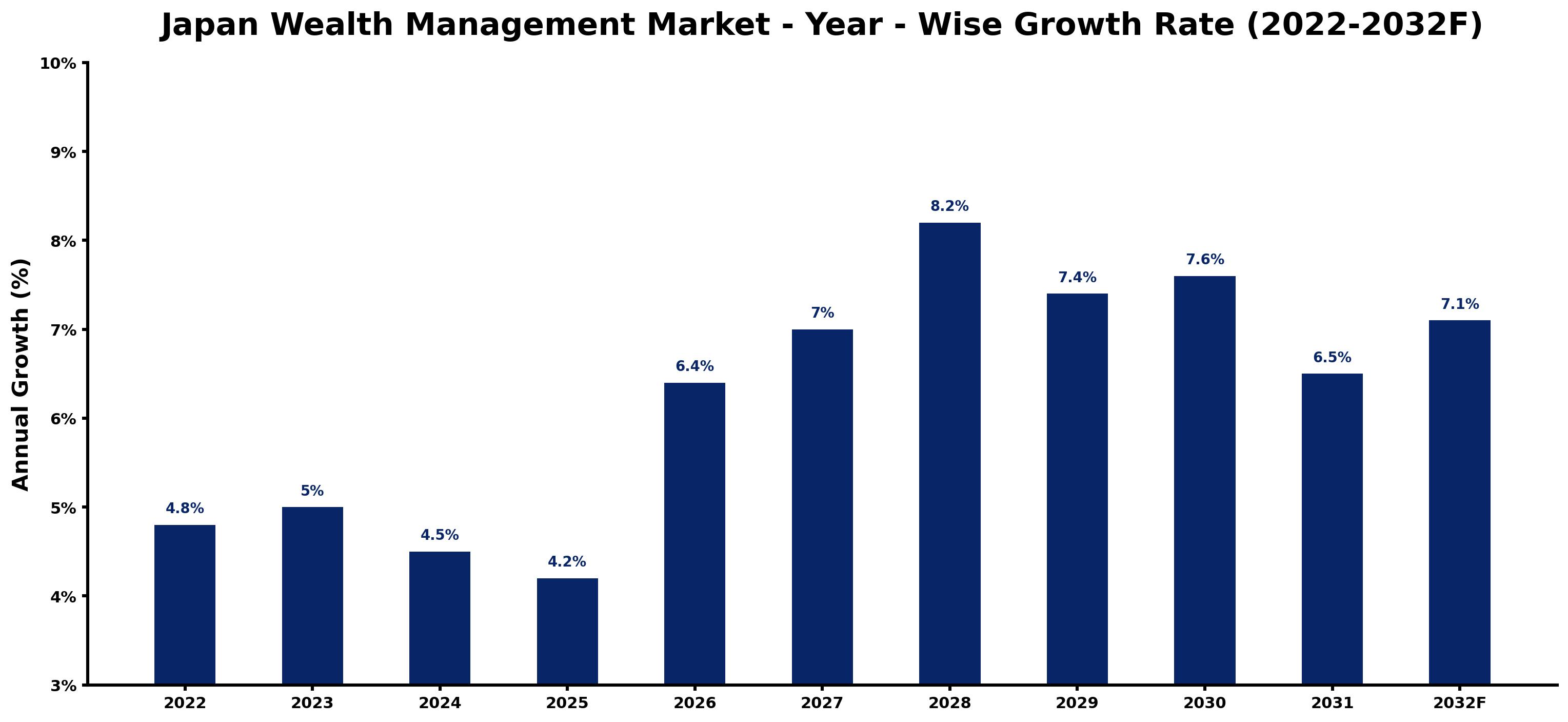
Annual growth estimates for each year appear below with the principal reason behind them, explaining the shifts that set the pace of the market.
| Year | Estimated Annual Growth (%) | Market Rationale |
| 2022 | 4.8 | Demand was steady as high net worth individuals sought tailored financial strategies. |
| 2023 | 5.0 | Growth accelerated due to increased investments from high net worth individuals and corporations. |
| 2024 | 4.5 | Market growth slowed as economic uncertainties affected investment decisions. |
| 2025 | 4.2 | Demand continued to decelerate as clients became cautious amid market fluctuations. |
| 2026 | 6.4 | Growth is expected to resume as younger investors embrace digital wealth management solutions. |
| 2027 | 7.0 | Demand is projected to rise as firms adopt AI-driven solutions for portfolio management. |
| 2028 | 8.2 | The market is expected to peak as personalized services attract more high net worth clients. |
| 2029 | 7.4 | Growth will slow slightly as competition intensifies among wealth management firms. |
| 2030 | 7.6 | Demand is projected to increase as financial literacy programs encourage more young investors. |
| 2031 | 6.5 | The market will experience a slowdown as firms adjust to evolving client needs. |
| 2032 | 7.1 | Growth is expected to pick up as digital solutions become mainstream in wealth management. |
Note: Market size estimations and growth projections presented in this report are based on 6Wresearch's proprietary forecasting methodology, utilizing the latest available industry data, government publications, and primary research inputs.
Japan Wealth Management Market Synopsis
Wealth management in Japan encompasses investment advice and portfolio management, primarily provided through financial institutions and advisors. The Japan Wealth Management Market is driven by approximately 3 million high net worth individuals seeking tailored strategies. The emergence of digital solutions and AI-driven services is generating new demand, particularly among younger investors. Private wealth management services represented 40% of total revenue, highlighting the industry's commitment to individual client needs and preferences.
Market Dynamics Impact Analysis (2026–2032)
| Factor | Type | Impact | Primary Segment Affected |
| Growing number of high net worth individuals | Driver | High | Private Wealth Management |
| Increased adoption of digital solutions | Driver | High | Digital Wealth Management |
| Rising interest in financial literacy programs | Opportunity | Medium | Retail Wealth Management |
| Expansion of robo-advisory services | Opportunity | High | Robo-Advisory |
| Regulatory pressures on investment firms | Restraint | High | Institutional Wealth Management |
| High competition among wealth management firms | Restraint | Medium | Private Wealth Management |
| Talent shortages in wealth management | Challenge | High | Traditional Advisory |
| Compliance costs associated with new regulations | Challenge | Medium | Institutional Wealth Management |
Evaluation of Drivers in Japan Wealth Management Market (2026–2032)
Demand rests on the following drivers, each shown with the segment it touches most.
| Drivers | Primary Segment Affected | Why It Matters (Evidence) |
| Increase in high net worth individuals | Private Wealth Management | As of 2023, Japan has approximately 3 million high net worth individuals seeking tailored investment strategies. |
| Growth in digital wealth management | Digital Wealth Management | The FSA's 2022 report indicated a growing trend towards digital wealth management solutions, enhancing service delivery. |
| Expansion of financial education initiatives | Retail Wealth Management | In 2023, the government allocated ¥5 billion to improve financial education initiatives targeting young investors. |
| Rising adoption of robo-advisory services | Robo-Advisory | Robo-advisory services have seen a 20% increase in adoption among millennials in Japan, expanding market reach. |
| Investment firms adopting AI solutions | Institutional Wealth Management | Investment firms in Japan are increasingly adopting AI-driven solutions for portfolio management, improving efficiency. |
Spending rises because high net worth individuals increasingly seek personalized strategies, driving demand for private wealth management services. In 2023, the average portfolio size for these individuals reached ¥100 million, prompting firms to adjust their offerings. The adoption of AI-driven solutions is rising, as investment firms aim to improve portfolio management efficiency.
Evaluation of Restraints in Japan Wealth Management Market
The key brakes on demand, and where they bite hardest, are shown below.
| Market Restraint | Primary Segment Affected | Why It Matters (Evidence) |
| Regulatory compliance costs | Institutional Wealth Management | Investment firms face increasing compliance costs due to stricter regulations set by the FSA, which can exceed ¥1 billion annually. |
| Intense competition among firms | Private Wealth Management | High competition leads to price pressures, affecting profitability for wealth management firms, which can reduce resources for client services. |
| Talent shortages in the industry | Traditional Advisory | The average age of wealth managers in Japan is 45, indicating a need for younger talent to connect with millennial clients. |
| High operational costs for digital solutions | Digital Wealth Management | Investments in technology infrastructure increase operational costs for digital wealth management providers, consuming substantial portions of their budgets. |
| Limited awareness of robo-advisory services | Robo-Advisory | Despite growth, many potential clients remain unaware of the benefits of robo-advisory services, limiting market expansion. |
Japan Wealth Management Market Challenges
A skills gap in wealth management stems from an ageing workforce, hindering firms' ability to connect with younger clients who favour digital solutions. This gap results in lost revenue opportunities as they struggle to engage the 3 million high net worth individuals in Japan. High operational costs associated with traditional advisory models can consume up to 30% of a firm's budget, restricting their capacity to invest in modern technologies. Increased competition from fintech disruptors compels traditional firms to reduce fees, potentially impacting profitability and service quality. Regulatory changes from the Financial Services Agency may introduce compliance costs exceeding ¥1 billion annually for larger firms, straining their operational budgets.
Trends in the Japan Wealth Management Market
The following changes are redrawing the Japan Wealth Management Market.
- Shift towards Digital Wealth Management: The Tokyo Metropolitan Government has initiated a program to support fintech innovations in wealth management. This shift is reflected in a reported 20% rise in robo-advisory adoption among millennials, indicating a growing preference for digital solutions.
- Increased Focus on Financial Literacy: In 2023, the government launched a financial literacy program targeting young investors. This initiative aims to educate the younger generation, leading to a more informed client base and increased engagement in wealth management.
- Growth of AI-Driven Solutions: Investment firms are increasingly adopting AI-driven solutions for portfolio management. This trend is reshaping the industry, as firms seek to improve efficiency and client satisfaction, with investments in technology exceeding ¥10 billion annually.
- Expansion of Family Offices: The number of family offices in Japan has increased by 15% since 2020. This growth reflects the rising demand for tailored wealth management services among affluent families, indicating a shift in client preferences.
Investment Opportunities in the Japan Wealth Management Market
Several openings in the Japan Wealth Management Market merit attention from investors.
- High Net Worth Individuals Seeking Tailored Solutions: High net worth individuals are increasingly pursuing personalised financial strategies, creating opportunities for wealth management firms to broaden their service offerings. The average portfolio size is ¥100 million, showcasing strong investment potential.
- Tokyo as a Global Financial Center: Tokyo's ambition to establish itself as a global financial centre offers opportunities for wealth management services. The Tokyo Financial City initiative aims to attract international clients, expanding market potential.
- Growing Demand for Robo-Advisory Services: With a 20% rise in adoption among millennials, a clear gap exists in the market for robo-advisory services. Firms can leverage this trend by investing in technology and targeted marketing.
- Investment in Financial Literacy Programs: The government's allocation of ¥5 billion for financial education initiatives presents opportunities for firms to connect with younger clients. Partnering with educational institutions can assist firms in tapping into this emerging market.
Government Initiatives in the Japan Wealth Management Market
The AI Promotion Act (2025) introduces a national framework for AI research and development, improving the regulatory environment for wealth management firms. This law complements existing regulations, promoting innovation while ensuring compliance with industry standards. It aims to facilitate the integration of AI technologies into wealth management practices, improving service delivery and client engagement.
In 2023, the government allocated ¥5 billion for financial education initiatives, administered by the Financial Services Agency. This funding aims to improve financial literacy among young investors, ultimately increasing their engagement with wealth management services.
Future Insight of the Japan Wealth Management Market
The Tokyo Financial City initiative aims to position Tokyo as a global financial centre by 2032, creating new investment opportunities and intensifying competition. The financial literacy programme will equip young investors with essential knowledge, promoting a more informed client base. The adoption of digital solutions will streamline operations, enabling firms to allocate resources more efficiently. By 2032, the average portfolio size for high net worth individuals is projected to rise to ¥120 million, indicating a growing market for wealth management services.
Market Segmentation Analysis
Japan Wealth Management Market report covers a detailed analysis of the following market segments:
By Type – Private Wealth Management Leads, Digital Wealth Management Expected to Grow Fastest
According to Bhawna Singh, Assistant Manager at 6Wresearch, in 2025, Private Wealth Management led the type split with a 33% share. Private wealth management holds the largest share in Japan due to its focus on high net worth individuals, who number approximately 3 million. This segment thrives on tailored investment strategies that cater to the specific financial goals of affluent clients. The quickest growth will come from Digital Wealth Management, forecast to expand at a CAGR of 10.5% between 2026 and 2032. Digital wealth management is experiencing rapid growth, particularly among millennials, with a 20% increase in adoption for online investment solutions. As traditional methods evolve, this segment's appeal will likely expand, attracting a broader clientele. Suppliers should prioritise digital offerings to capture the growing interest in online investment solutions.
By Service Model – Traditional Advisory Leads, Robo-Advisory Expected to Grow Fastest
With 42% of service model revenue in 2025, Traditional Advisory was the largest category. Traditional advisory services dominate the market as they provide personalised financial guidance, which many clients prefer for their complex investment needs. The established trust and relationship between advisors and clients contribute to this segment's strong position. Robo-Advisory is set to record the highest CAGR in this split, 10.1% over 2026–2032. Robo-advisory services are on the rise, offering automated investment solutions that appeal to a tech-savvy audience seeking efficiency and lower costs. This growing trend indicates a shift towards more accessible investment options. Buyers may benefit from exploring automated solutions that can complement traditional advisory services.
By Client Type – High Net Worth Individuals Lead, Mass Affluent Expected to Grow Fastest
The largest client type category in 2025 was High Net Worth Individuals, at 35% of revenue. High net worth individuals represent the primary clientele for wealth management services, with their substantial assets necessitating tailored investment advice. This segment's prominence is reinforced by the average portfolio size of ¥100 million for these clients. Over 2026–2032, Mass Affluent is expected to post the fastest growth, at a CAGR of 10.7%. The mass affluent segment is rapidly expanding as more individuals seek investment advice, reflecting a broader interest in wealth management services. This growth suggests a potential shift in focus for service providers towards this emerging client base. Suppliers should consider strategies to engage the mass affluent segment as their demand for investment services increases.
By End Use – Private Clients Lead and Record the Fastest Growth
Private Clients accounted for 44% of the market by end use in 2025. Private clients represent the largest end-use group, consisting of diverse individual investors pursuing customised financial strategies. This broad category drives consistent demand for wealth management services, particularly in urban areas like Tokyo. The same category are also set to grow fastest, at a CAGR of 9.3% during 2026–2032. The private clients segment is experiencing rapid growth as an increasing number of individuals acknowledge the benefits of tailored investment management. This trend is likely to continue, solidifying the segment's dominance in the market. Suppliers should focus on developing personalised services to satisfy the rising expectations of private clients.
Key Attractiveness of the Report
- 10 Years of Market Numbers
- Historical Data Starting from 2022 to 2025
- Base Year 2025
- Forecast Data until 2032
- Key Performance Indicators Impacting the Market
- Major Upcoming Developments and Projects
Key Highlights of the Report:
- Japan Wealth Management Market Outlook
- Market Size of Japan Wealth Management Market,2025
- Forecast of Japan Wealth Management Market, 2032
- Historical Data and Forecast of Japan Wealth Management Revenues & Volume for the Period 2022-2032
- Japan Wealth Management Market Trend Evolution
- Japan Wealth Management Market Drivers and Challenges
- Japan Wealth Management Price Trends
- Japan Wealth Management Porter's Five Forces
- Japan Wealth Management Industry Life Cycle
- Historical Data and Forecast of Japan Wealth Management Market Revenues & Volume By Type for the Period 2022-2032
- Historical Data and Forecast of Japan Wealth Management Market Revenues & Volume By Private Wealth Management for the Period 2022-2032
- Historical Data and Forecast of Japan Wealth Management Market Revenues & Volume By Institutional Wealth Management for the Period 2022-2032
- Historical Data and Forecast of Japan Wealth Management Market Revenues & Volume By Retail Wealth Management for the Period 2022-2032
- Historical Data and Forecast of Japan Wealth Management Market Revenues & Volume By Digital Wealth Management for the Period 2022-2032
- Historical Data and Forecast of Japan Wealth Management Market Revenues & Volume By Others for the Period 2022-2032
- Historical Data and Forecast of Japan Wealth Management Market Revenues & Volume By Service Model for the Period 2022-2032
- Historical Data and Forecast of Japan Wealth Management Market Revenues & Volume By Robo-Advisory for the Period 2022-2032
- Historical Data and Forecast of Japan Wealth Management Market Revenues & Volume By Hybrid Advisory for the Period 2022-2032
- Historical Data and Forecast of Japan Wealth Management Market Revenues & Volume By Traditional Advisory for the Period 2022-2032
- Historical Data and Forecast of Japan Wealth Management Market Revenues & Volume By AI-Driven Solutions for the Period 2022-2032
- Historical Data and Forecast of Japan Wealth Management Market Revenues & Volume By Custom Portfolio for the Period 2022-2032
- Historical Data and Forecast of Japan Wealth Management Market Revenues & Volume By Client Type for the Period 2022-2032
- Historical Data and Forecast of Japan Wealth Management Market Revenues & Volume By High Net Worth Individuals for the Period 2022-2032
- Historical Data and Forecast of Japan Wealth Management Market Revenues & Volume By Corporations for the Period 2022-2032
- Historical Data and Forecast of Japan Wealth Management Market Revenues & Volume By Mass Affluent for the Period 2022-2032
- Historical Data and Forecast of Japan Wealth Management Market Revenues & Volume By Ultra-High Net Worth for the Period 2022-2032
- Historical Data and Forecast of Japan Wealth Management Market Revenues & Volume By Pension Funds for the Period 2022-2032
- Historical Data and Forecast of Japan Wealth Management Market Revenues & Volume By End Use for the Period 2022-2032
- Historical Data and Forecast of Japan Wealth Management Market Revenues & Volume By Private Clients for the Period 2022-2032
- Historical Data and Forecast of Japan Wealth Management Market Revenues & Volume By Financial Institutions for the Period 2022-2032
- Historical Data and Forecast of Japan Wealth Management Market Revenues & Volume By Investment Firms for the Period 2022-2032
- Historical Data and Forecast of Japan Wealth Management Market Revenues & Volume By Family Offices for the Period 2022-2032
- Historical Data and Forecast of Japan Wealth Management Market Revenues & Volume By Insurance Companies for the Period 2022-2032
- Historical Data and Forecast of Japan Wealth Management Market Revenues & Volume By End Use for the Period 2022-2032
- Historical Data and Forecast of Japan Wealth Management Market Revenues & Volume By Professional Tattooing for the Period 2022-2032
- Historical Data and Forecast of Japan Wealth Management Market Revenues & Volume By Tattoo Studios for the Period 2022-2032
- Japan Wealth Management Import Export Trade Statistics
- Market Opportunity Assessment By Type
- Market Opportunity Assessment By Service Model
- Market Opportunity Assessment By Client Type
- Market Opportunity Assessment By End Use
- Market Opportunity Assessment By End Use
- Japan Wealth Management Top Companies Market Share
- Japan Wealth Management Competitive Benchmarking By Technical and Operational Parameters
- Japan Wealth Management Company Profiles
- Japan Wealth Management Key Strategic Recommendations
Market Covered
Coverage by segment is as follows.
By Type
- Private Wealth Management
- Institutional Wealth Management
- Retail Wealth Management
- Digital Wealth Management
- Others
By Service Model
- Robo-Advisory
- Hybrid Advisory
- Traditional Advisory
- AI-Driven Solutions
- Custom Portfolio
By Client Type
- High Net Worth Individuals
- Corporations
- Mass Affluent
- Ultra-High Net Worth
- Pension Funds
By End Use
- Private Clients
- Financial Institutions
- Investment Firms
- Family Offices
- Insurance Companies































