Kenya Vetiver Oil Market Size, Share & Growth Rate
The Kenya Vetiver Oil Market was estimated at USD 1472 Million in 2025 and is projected to reach USD 2109 Million by 2032, growing at a CAGR of 5.3% from 2026 to 2032. This growth trajectory reflects a robust demand particularly driven by the fragrance and cosmetic sectors. The increasing popularity of natural and organic products in personal care, combined with rising consumer awareness about vetivers therapeutic properties, is establishing a solid foundation for future expansion.
Kenya Vetiver Oil Market Year-wise Growth Rate and Key Drivers
This graph highlights how the Kenya Vetiver Oil Market has steadily grown over the years, supported by major growth factors.
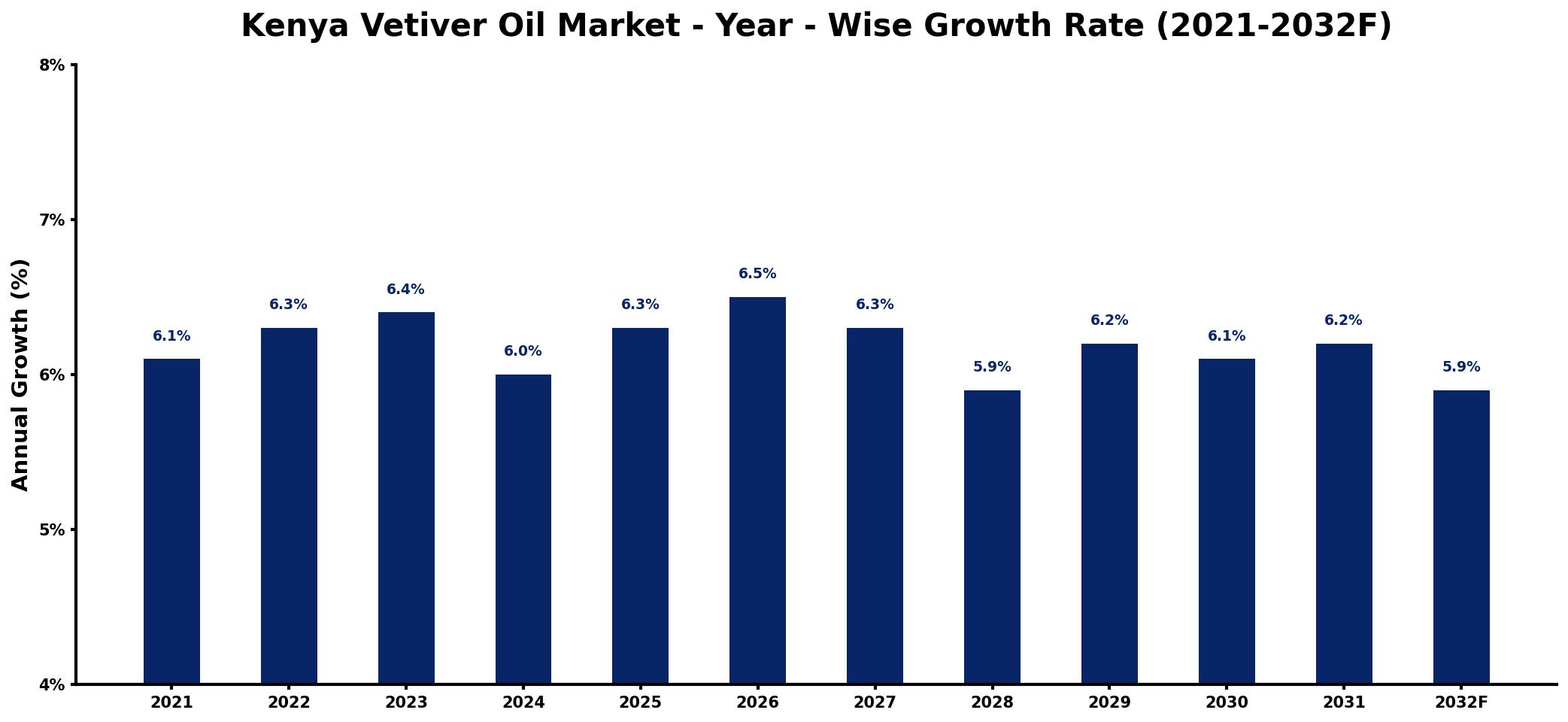
The table below presents the year‑wise growth rates along with the key drivers influencing the market
| Year | Growth Rate | Major Drivers |
| 2021 | 6.1% | increased demand for natural fragrances |
| 2022 | 6.3% | growing popularity in aromatherapy products |
| 2023 | 6.4% | rising interest in sustainable sourcing |
| 2024 | 6.0% | expansion of wellness industry applications |
| 2025 | 6.3% | enhanced product quality standards |
| 2026 | 6.5% | growing market for organic products |
| 2027 | 6.3% | boost in personal care formulations |
| 2028 | 5.9% | rising consumer preference for eco-friendly |
| 2029 | 6.2% | increased utilization in home fragrances |
| 2030 | 6.1% | increased domestic production output |
| 2031 | 6.2% | growing demand for holistic therapies |
| 2032 | 5.9% | increased focus on natural ingredients |
Note: Market size estimations and growth projections presented in this report are based on 6Wresearch's proprietary forecasting methodology, utilizing the latest available industry data, government publications, and primary research inputs.
Kenya Vetiver Oil Market Synopsis
The Kenya vetiver oil market is witnessing a surge in interest, fueled by growing consumer preference for sustainable and natural ingredients in various applications. The coastal regions of Kenya, which provide ideal conditions for vetiver cultivation, are becoming increasingly significant in global supply chains.
As a region rich in biodiversity, Kenya offers favorable climatic conditions that enhance the quality of vetiver oil. The increasing recognition of vetiver's calming and grounding attributes is leading to its integration into aromatherapy, further expanding its market potential.
Kenya Vetiver Oil Market Key Takeaways
- The market is primarily driven by the fragrance and cosmetic industries' rising demand.
- Awareness of vetiver's therapeutic benefits is widening its application across various sectors.
- Favorable climatic conditions in coastal Kenya enhance production capabilities.
- Government initiatives are promoting sustainable farming and fair trade practices.
- Despite challenges, investment opportunities continue to emerge as global demand increases.
Evaluation of Restraints in Kenya Vetiver Oil Market
Despite the growth prospects, the Kenya vetiver oil market contends with several restraints. Unpredictable weather conditions can significantly impact crop yields and overall oil quality. Moreover, the limited processing infrastructure poses a challenge, as it restricts the market's ability to scale effectively. Fluctuations in global demand coupled with price volatility further complicate the landscape, creating uncertainties for producers and investors alike.
Kenya Vetiver Oil Market Trends
Current trends indicate a shift towards sustainable sourcing and eco-friendly production methods, appealing to environmentally conscious consumers. Furthermore, the integration of digital platforms for marketing and distribution is becoming increasingly prevalent, enhancing market accessibility. Innovations in extraction techniques are also improving oil quality, positioning Kenyan vetiver oil as a premium product globally.
Kenya Vetiver Oil Market Opportunities
The burgeoning interest in natural ingredients presents significant growth opportunities for the Kenya vetiver oil market. Export potential remains high, especially as international markets pivot towards organic and sustainably sourced oils. Additionally, emerging trends in personal wellness and aromatherapy are creating new avenues for vetiver oil applications, particularly in therapeutic and cosmetic formulations.
Government Initiatives in the Kenya Vetiver Oil Market
The Kenyan government, through the Ministry of Agriculture and the Kenya Plant Health Inspectorate Service (KEPHIS), is actively promoting policies that support sustainable cultivation practices. These initiatives aim to improve quality standards and align local production with international export requirements. Moreover, programs focused on assisting small-scale farmers are pivotal in establishing fair trade practices and enhancing livelihoods within the vetiver farming community.
Future Insights of the Kenya Vetiver Oil Market
Looking ahead to 2026-2032, the Kenya vetiver oil market is set to benefit from increasing consumer inclination towards holistic wellness and sustainable living. As the demand for natural products continues to rise, the market is likely to see innovative applications in both personal care and therapeutic sectors. Investments in technology and infrastructure will be crucial for overcoming existing challenges and capitalizing on emerging opportunities, thereby ensuring sustained growth.
Kenya Vetiver Oil Market Latest Developments (2025 - 2026)
Recent developments in the Kenya vetiver oil market indicate a strong emphasis on sustainability and improved processing methods. There is a noticeable push from producers to adopt eco-friendly practices that appeal to the growing segment of environmentally conscious consumers. Additionally, various stakeholders are exploring partnerships to enhance market reach and bolster export capabilities, further integrating Kenyan vetiver oil into global supply chains.
Kenya Vetiver Oil Market - Key Attractiveness of the Report
- 10 Years of Market Numbers
- Historical Data Starting from 2022 to 2025
- Base Year: 2025
- Forecast Data until 2032
- Key Performance Indicators Impacting the Market
- Major Upcoming Developments and Projects
Key Highlights of the Report:
- Kenya Vetiver Oil Market Outlook
- Market Size of Kenya Vetiver Oil Market, 2025
- Forecast of Kenya Vetiver Oil Market, 2032
- Historical Data and Forecast of Kenya Vetiver Oil Revenues & Volume for the Period 2022-2032F
- Kenya Vetiver Oil Market Trend Evolution
- Kenya Vetiver Oil Market Drivers and Challenges
- Kenya Vetiver Oil Price Trends
- Kenya Vetiver Oil Porter's Five Forces
- Kenya Vetiver Oil Industry Life Cycle
- Historical Data and Forecast of Kenya Vetiver Oil Market Revenues & Volume By Application for the Period 2022-2032F
- Historical Data and Forecast of Kenya Vetiver Oil Market Revenues & Volume By Medical for the Period 2022-2032F
- Historical Data and Forecast of Kenya Vetiver Oil Market Revenues & Volume By Food & Beverage for the Period 2022-2032F
- Historical Data and Forecast of Kenya Vetiver Oil Market Revenues & Volume By Spa & Relaxation for the Period 2022-2032F
- Kenya Vetiver Oil Import Export Trade Statistics
- Market Opportunity Assessment By Application
- Kenya Vetiver Oil Top Companies Market Share
- Kenya Vetiver Oil Competitive Benchmarking By Technical and Operational Parameters
- Kenya Vetiver Oil Company Profiles
- Kenya Vetiver Oil Key Strategic Recommendations






































