Malaysia Digital Signature Market Size & Growth Rate (2026-2032)
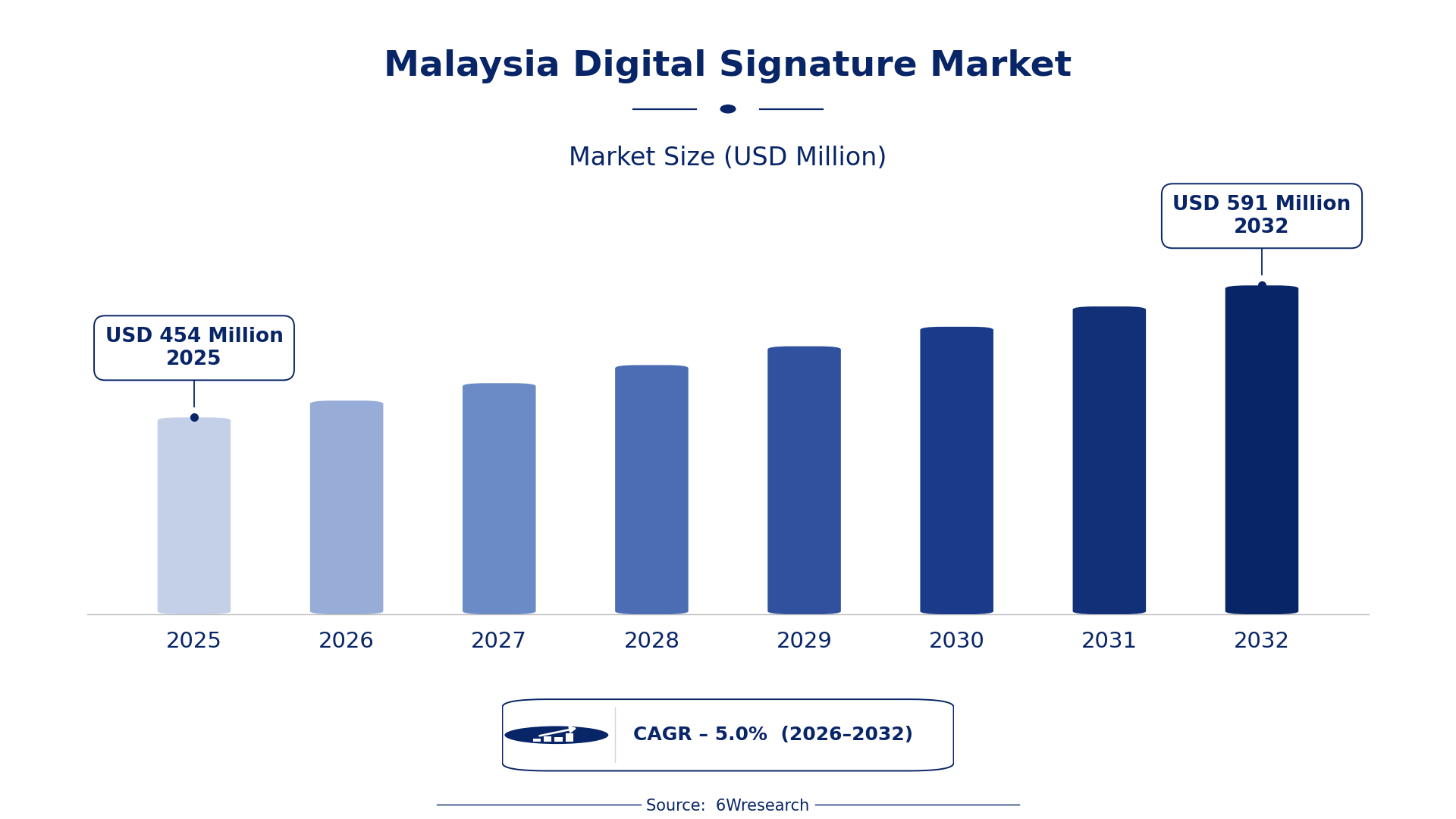
The Malaysia Digital Signature Market was estimated at USD 454 Million in 2025 and is projected to reach USD 591 Million by 2032, growing at a CAGR of 5.0% from 2026 to 2032.
Malaysia Digital Signature Market Synopsis
The driving force in the Malaysia Digital Signature Market is the increasing demand for secure, paperless transactions across various sectors. As the country emphasizes its digital economy and e-governance initiatives, digital signatures emerge as vital tools for legal and financial document authentication.
With the growing importance of security in digital communications, businesses and individuals alike are seeking reliable solutions for document verification. The ongoing push for digitization, coupled with the heightened awareness of cybersecurity, is transforming how transactions are conducted in Malaysia.
Malaysia Digital Signature Market Year-wise Growth Rate and Key Drivers
This graph illustrates the annual growth rates of the Malaysia Digital Signature Market from 2021 to 2032, highlighting a steady upward trajectory and projected expansion over the forecast period.
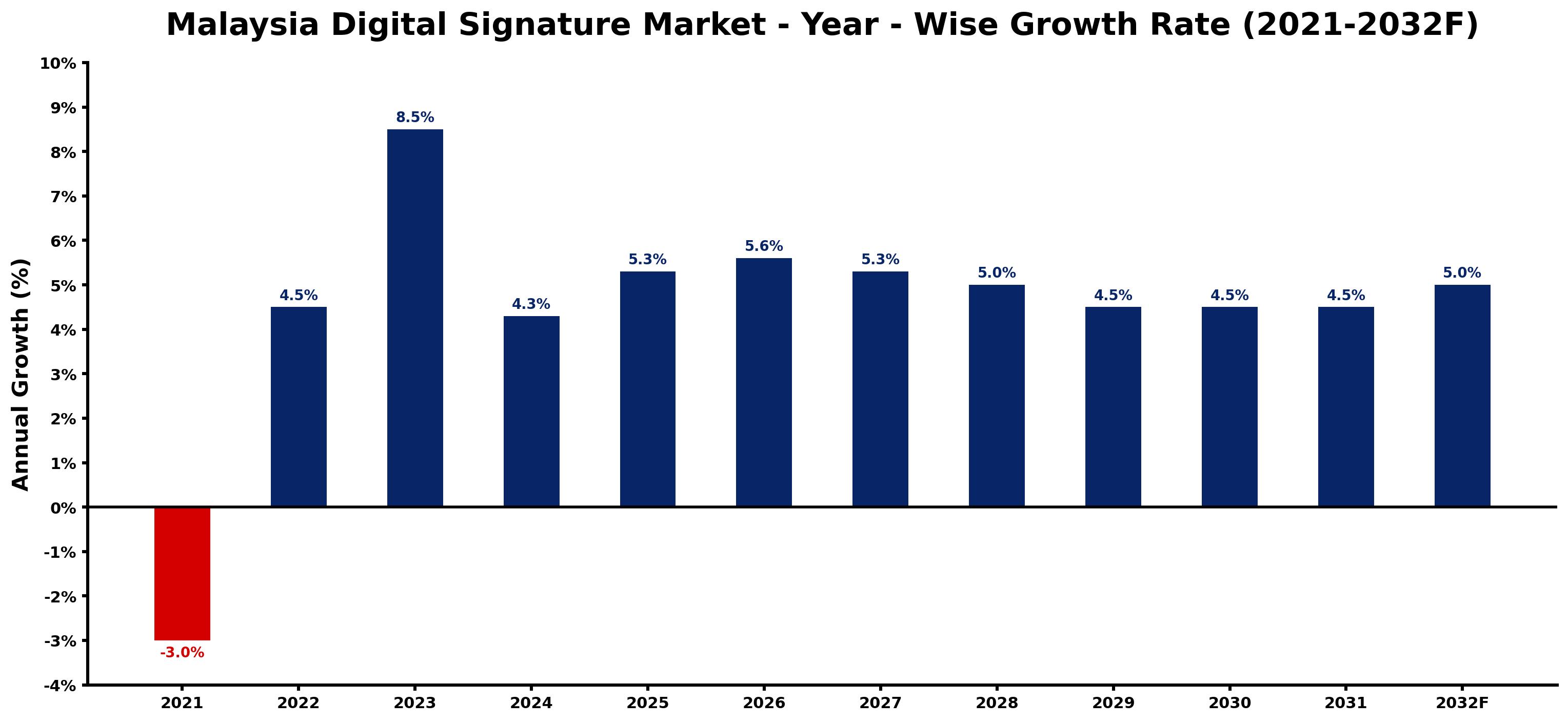
The table below presents the year‑wise growth rates along with the key drivers influencing the market
| Year | Growth Rate | Major Drivers |
| 2021 | -3.0% | MCMC delays approval of new digital signature regulations. |
| 2022 | 4.5% | MDEC's push for e-Government services growth. |
| 2023 | 8.5% | Enhanced cybersecurity regulations drive digital identity adoption. |
| 2024 | 4.3% | Increased online transactions boost demand for secure signatures. |
| 2025 | 5.3% | National digital economy blueprint emphasizes digital trust solutions. |
| 2026 | 5.6% | Rise in remote work accelerates acceptance of digital signatures. |
| 2027 | 5.3% | Regulatory compliance mandates for electronic documentation strengthen market. |
| 2028 | 5.0% | Corporate digital transformation initiatives enhance signature solutions usage. |
| 2029 | 4.5% | Demand for secure online communications rises amid digital fraud. |
| 2030 | 4.5% | Investment in fintech innovations supports digital signature applications. |
| 2031 | 4.5% | Greater awareness of digital signature benefits among SMEs. |
| 2032 | 5.0% | Legal reforms support recognition of electronic signatures. |
Note: Market size estimations and growth projections presented in this report are based on 6Wresearch's proprietary forecasting methodology, utilizing the latest available industry data, government publications, and primary research inputs.
Malaysia Digital Signature Market Key Takeaways
Below are some of the specific key takeaways from the market, including:
- The demand for digital signatures is primarily driven by increased emphasis on e-governance and digital transactions.
- Challenges such as lack of awareness and trust hinder wider adoption among potential users.
- COVID-19 acted as a catalyst, accelerating the need for secure online document signing solutions.
- Leading companies in the market are continually developing innovative technologies to enhance user experience.
- Future growth will hinge on government initiatives promoting digitalization across various sectors.
Evaluation of Restraints in Malaysia Digital Signature Market
Despite the promising growth trajectory, the Malaysia Digital Signature Market grapples with notable restraints. Chief among these is the prevailing lack of awareness surrounding the legality and security of digital signatures. Many potential users remain skeptical, hesitant to abandon traditional methods in favor of digital solutions. This skepticism is compounded by insufficient educational outreach from key stakeholders, resulting in a slow uptake despite clear advantages. As businesses and individuals become more informed, however, the market can anticipate gradual but steady progress.
Malaysia Digital Signature Market Trends
Several trends are influencing the Malaysia Digital Signature Market. The shift towards remote work has made secure digital transactions a necessity, not just a convenience. Organizations are increasingly implementing comprehensive digital workflows that integrate signature solutions to streamline operations. This trend is particularly evident in the financial services and legal sectors, where the requirement for secure document handling is paramount. Furthermore, enhanced technologies such as blockchain and artificial intelligence are being explored to bolster security and efficiency in the signature process.
Malaysia Digital Signature Market Opportunities
Opportunities abound in the Malaysia Digital Signature Market for those willing to innovate. As more organizations transition to digital platforms, there is a growing demand for tailored solutions that cater to specific industry needs. For instance, sectors such as healthcare and real estate are ripe for digital signature adoption, presenting untapped avenues for growth. Furthermore, partnerships between technology providers and businesses could pave the way for more integrated solutions, enhancing user trust and satisfaction.
Government Initiatives in the Malaysia Digital Signature Market
The Malaysian government is actively shaping the Digital Signature Market through various initiatives aimed at fostering a robust digital ecosystem. Regulatory frameworks are being established to provide clarity and confidence in digital transactions. Such policies are crucial as they serve not only to protect consumers but also to stimulate business innovation in the digital space.
- A national digital infrastructure upgrade programme launched in 2023 focuses on enhancing cybersecurity measures for online transactions.
- The current initiative for a centralized digital signature regulatory framework aims to standardize practices and bolster consumer trust.
- Recent public-private partnerships are underway to raise awareness about the benefits and legality of digital signatures, targeting small and medium enterprises.
- A planned initiative set to roll out in 2026 will include educational campaigns on digital signatures in educational institutions and among businesses.
Future Insights of the Malaysia Digital Signature Market
Looking ahead to 2026-2032, the Malaysia Digital Signature Market is set for notable expansion. As digital transformation accelerates, the adoption of digital signatures will likely become commonplace. Businesses will increasingly view digital signatures as essential for enhancing efficiency and security. Moreover, as trust in digital solutions builds, more users are expected to embrace this technology, paving the way for a more digitized economy.
Malaysia Digital Signature Market Latest Developments
Recent activity in the Malaysia Digital Signature Market reflects a growing momentum toward digital solutions, especially in response to shifting consumer demands and business needs. Companies are investing in technology upgrades and partnerships to streamline operations and improve service delivery. The market is witnessing a flurry of innovations designed to enhance user engagement and strengthen security.
- A major technology vendor launched a user-friendly digital signature platform in early 2025, aimed at small businesses seeking affordable solutions.
- In mid-2025, an initiative began to integrate digital signature capabilities into existing e-commerce platforms, enhancing transactional security.
- A collaborative project between government and private sectors is ongoing to establish a secure digital identification system that complements digital signatures, enhancing reliability.
- A new service expected to launch in late 2025 will offer advanced verification features using biometric technology to ensure document integrity.
Malaysia Digital Signature Market - Key Attractiveness of the Report
- 10 Years of Market Numbers
- Historical Data Starting from 2022 to 2025
- Base Year: 2025
- Forecast Data until 2032
- Key Performance Indicators Impacting the Market
- Major Upcoming Developments and Projects
Key Highlights of the Report:
- Malaysia Digital Signature Market Outlook
- Market Size of Malaysia Digital Signature Market, 2025
- Forecast of Malaysia Digital Signature Market, 2032
- Historical Data and Forecast of Malaysia Digital Signature Revenues & Volume for the Period 2022-2032F
- Malaysia Digital Signature Market Trend Evolution
- Malaysia Digital Signature Market Drivers and Challenges
- Malaysia Digital Signature Price Trends
- Malaysia Digital Signature Porter's Five Forces
- Malaysia Digital Signature Industry Life Cycle
- Historical Data and Forecast of Malaysia Digital Signature Market Revenues & Volume By Component for the Period 2022-2032F
- Historical Data and Forecast of Malaysia Digital Signature Market Revenues & Volume By Solutions for the Period 2022-2032F
- Historical Data and Forecast of Malaysia Digital Signature Market Revenues & Volume By Services for the Period 2022-2032F
- Historical Data and Forecast of Malaysia Digital Signature Market Revenues & Volume By Solution for the Period 2022-2032F
- Historical Data and Forecast of Malaysia Digital Signature Market Revenues & Volume By Software for the Period 2022-2032F
- Historical Data and Forecast of Malaysia Digital Signature Market Revenues & Volume By Hardware for the Period 2022-2032F
- Historical Data and Forecast of Malaysia Digital Signature Market Revenues & Volume By Vertical for the Period 2022-2032F
- Historical Data and Forecast of Malaysia Digital Signature Market Revenues & Volume By BFSI for the Period 2022-2032F
- Historical Data and Forecast of Malaysia Digital Signature Market Revenues & Volume By Government for the Period 2022-2032F
- Historical Data and Forecast of Malaysia Digital Signature Market Revenues & Volume By Defense for the Period 2022-2032F
- Historical Data and Forecast of Malaysia Digital Signature Market Revenues & Volume By Legal for the Period 2022-2032F
- Historical Data and Forecast of Malaysia Digital Signature Market Revenues & Volume By Real Estate for the Period 2022-2032F
- Historical Data and Forecast of Malaysia Digital Signature Market Revenues & Volume By Organization Size for the Period 2022-2032F
- Historical Data and Forecast of Malaysia Digital Signature Market Revenues & Volume By Large Enterprises for the Period 2022-2032F
- Historical Data and Forecast of Malaysia Digital Signature Market Revenues & Volume By Small and Medium-Sized Enterprises (SMEs) for the Period 2022-2032F
- Historical Data and Forecast of Malaysia Digital Signature Market Revenues & Volume By Deployment Mode for the Period 2022-2032F
- Historical Data and Forecast of Malaysia Digital Signature Market Revenues & Volume By Cloud for the Period 2022-2032F
- Historical Data and Forecast of Malaysia Digital Signature Market Revenues & Volume By On-Premises for the Period 2022-2032F
- Malaysia Digital Signature Import Export Trade Statistics
- Market Opportunity Assessment By Component
- Market Opportunity Assessment By Solution
- Market Opportunity Assessment By Vertical
- Market Opportunity Assessment By Organization Size
- Market Opportunity Assessment By Deployment Mode
- Malaysia Digital Signature Top Companies Market Share
- Malaysia Digital Signature Competitive Benchmarking By Technical and Operational Parameters
- Malaysia Digital Signature Company Profiles
- Malaysia Digital Signature Key Strategic Recommendations






































