Morocco Wholesale Market Summary
The morocco wholesale market was estimated at USD 1256 Million in 2025 and is projected to reach USD 1783 Million by 2032, growing at a CAGR of 5.7% from 2026 to 2032.
Morocco Wholesale Market Year-wise Growth Rate and Key Drivers
This graph highlights how the Morocco Wholesale Market has steadily grown over the past five years, supported by major growth factors.
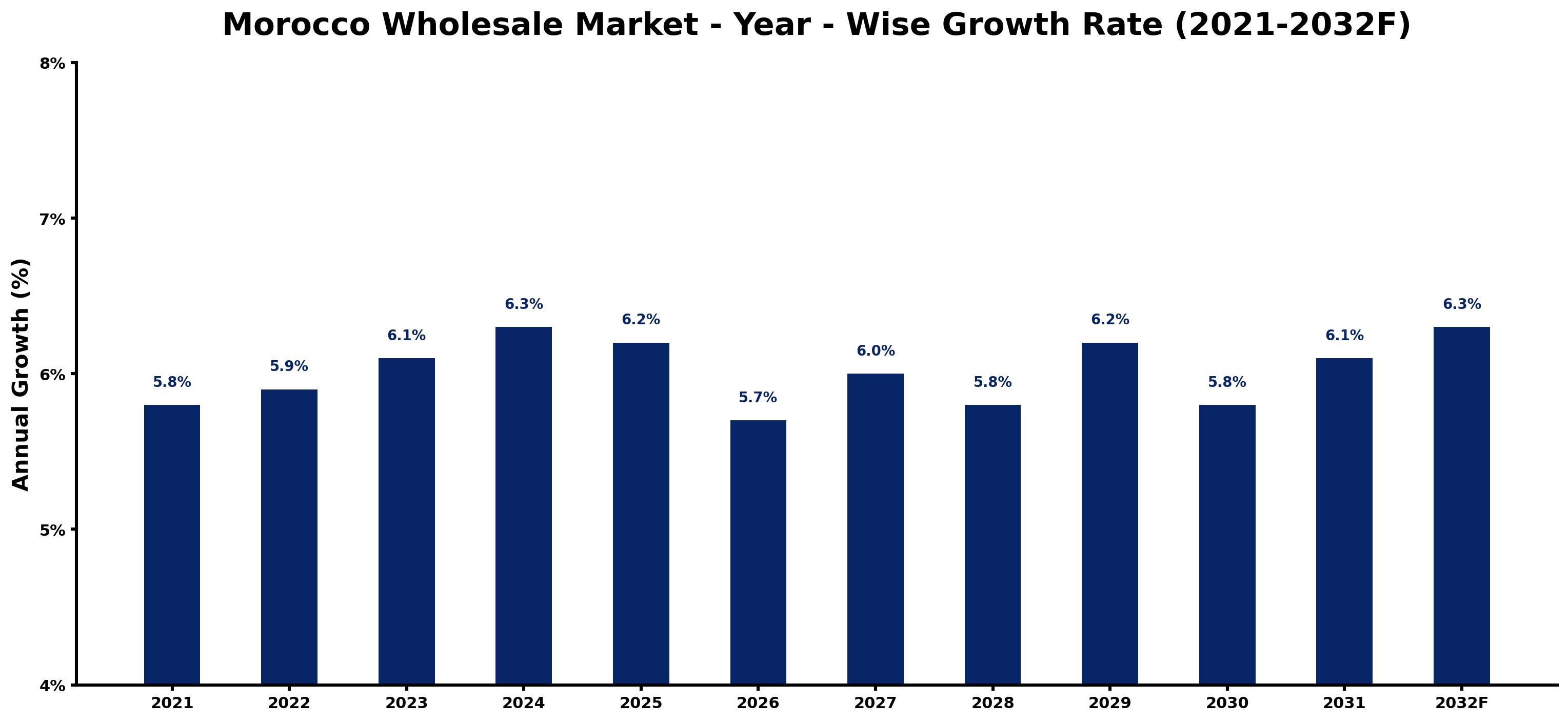
The table below presents the year wise growth rates along with the key drivers influencing the market
| Year | Growth Rate | Major Drivers |
| 2021 | 5.8% | Global supply chain disruptions led to increased reliance on local suppliers in Morocco. |
| 2022 | 5.9% | Wholesale businesses adapted to e-commerce, enhancing their market reach and efficiency. |
| 2023 | 6.1% | Economic recovery post-COVID-19 spurred investment in the wholesale sector, boosting growth. |
| 2024 | 6.3% | Infrastructure improvements, especially roads, facilitated smoother logistics for wholesalers. |
| 2025 | 6.2% | A younger demographic entering the market is driving innovation and market dynamism. |
| 2026 | 5.7% | Increased urbanization resulted in higher demand for diverse wholesale products. |
| 2027 | 6.0% | Sustainable practices in sourcing became a priority for many wholesale suppliers. |
| 2028 | 5.8% | Technological advancements in inventory management enhanced operational efficiency for wholesalers. |
| 2029 | 6.2% | Collaboration among local producers strengthened the wholesale market's resilience and competitiveness. |
| 2030 | 5.8% | Emerging markets across Africa offered new opportunities for Moroccan wholesalers to expand. |
| 2031 | 6.1% | Growing interest in organic and healthy products introduced new product lines for wholesalers. |
| 2032 | 6.3% | Continued regional trade agreements opened up more channels for Moroccan wholesale exports. |
Note - Market size estimations and growth projections presented in this report are based on 6Wresearch's advanced forecasting approach, validated with industry datasets as of June 2026.
Morocco Wholesale Market Synopsis
The Morocco Wholesale Market is projected to reach 5.7% and witness significant growth during the forecast period (2026-2032). This dynamic sector encompasses a wide range of products, including textiles, agricultural goods, electronics, and consumer items, reflecting the country's diverse economic landscape. The market is characterized by its combination of traditional and modern trading environments, which include bustling souks, contemporary wholesale centers, and emerging online platforms.
Morocco Wholesale Market Growth Drivers
Several factors are fueling the growth of the Morocco Wholesale Market. Firstly, the country's strategic geographical location serves as a vital trade gateway between Europe and Africa, enhancing its attractiveness to wholesalers and investors alike. Secondly, the robust growth of the middle class in Morocco is contributing to increased consumer spending, particularly on imported goods and modern retail products.
- The modernization of infrastructure and logistics is creating more efficient supply chains, enabling wholesalers to operate with improved agility and responsiveness.
- Government initiatives aimed at streamlining trade processes are contributing to a more favorable business environment for wholesalers, thereby encouraging local and foreign investment.
- Increased adoption of digital technologies and e-commerce is expanding market access and enhancing the operational capabilities of wholesalers in Morocco.
- Growing awareness and demand for sustainable and eco-friendly products are prompting wholesalers to diversify their offerings in line with consumer preferences.
- A favorable exchange rate for foreign investments is attracting international wholesalers to establish a presence in the Moroccan market.
Morocco Wholesale Market Trends and Opportunities
The Morocco Wholesale Market is seeing several notable trends that present opportunities for businesses. One significant trend is the shift towards sustainability, with rising consumer demand for organic and ethically sourced products. This shift is encouraging wholesalers to adapt their supply chains and product offerings accordingly.
- The increasing prevalence of e-commerce platforms is enabling wholesalers to reach a broader customer base, driving sales and market penetration.
- There is a marked trend towards product customization, with wholesalers recognizing the need to cater to specific consumer preferences and local tastes.
- Investment in technology, such as inventory management systems and supply chain analytics, is becoming critical for enhancing operational efficiency within wholesale businesses.
- Collaboration among industry stakeholders, including suppliers and retailers, is fostering innovation and improving the overall value chain.
- A focus on enhancing the quality and safety of products is influencing purchasing decisions, prompting wholesalers to engage in stringent quality control measures.
Morocco Wholesale Market Challenges and Restraints
While the Morocco Wholesale Market presents many opportunities, it is not without its challenges. One major hurdle is the intense competition among wholesalers, which often leads to price wars that can erode profitability. Additionally, inefficient supply chain management practices can result in operational delays and increased costs.
- Access to financing remains a significant barrier for small and medium-sized wholesalers, limiting their ability to expand and innovate.
- Regulatory challenges, including compliance with local laws and trade regulations, can complicate operations for wholesalers, particularly those looking to engage in exports.
- Fluctuations in currency exchange rates pose risks that can affect purchasing power and overall market stability.
- The wholesale sector's relatively slow adoption of modern technology can hinder efficiency and competitiveness compared to other regions.
- Economic uncertainties surrounding global markets may impact consumer confidence and spending patterns, affecting demand in the wholesale sector.
Morocco Wholesale Market Government Investment and Initiatives
The government plays a crucial role in shaping the Morocco Wholesale Market through various investment and regulatory initiatives. The Ministry of Industry, Trade, and Green and Digital Economy oversees the wholesale sector and implements policies aimed at fostering growth and competitiveness.
- Public spending on infrastructure development, including transportation and logistics, is enhancing connectivity for wholesalers, facilitating smoother operations.
- Initiatives to promote fair competition among wholesalers are being implemented to ensure a level playing field within the market.
- The government has established programs to support the modernization of wholesale markets, encouraging investment in new technologies and practices.
- Measures to reduce administrative barriers and streamline trade processes are being enforced to enhance the ease of doing business in Morocco.
- There is a focused effort on promoting sustainable practices within the wholesale sector, reflecting the government's commitment to environmental and social responsibility.
Morocco Wholesale Market Latest Developments (May 2025 - June 2026)
Recent developments in the Morocco Wholesale Market highlight a shift towards digital transformation and increased efforts to modernize trade practices. The rise of e-commerce platforms has gained momentum, providing wholesalers with new avenues for sales and customer engagement. Additionally, government-led initiatives aimed at improving the regulatory framework and supporting sustainable practices are gaining traction, fostering a more competitive market landscape.
- The growth of online marketplaces is enabling wholesalers to tap into a wider audience, enhancing sales opportunities significantly.
- Efforts to facilitate smoother logistics and supply chain processes have been recognized as critical to improving operational efficiency.
- Investment in green technology and sustainable sourcing practices is becoming more prominent as consumer demand for ethical products increases.
- Public-private partnerships are being explored to bolster infrastructure development, further supporting the wholesale sector's growth.
- The focus on improving digital literacy among wholesalers is essential in ensuring they can effectively utilize new technologies to enhance their market reach.
Morocco Wholesale Market - Key Attractiveness of the Report
- 10 Years of Market Numbers
- Historical Data Starting from 2022 to 2025
- Base Year: 2025
- Forecast Data until 2032
- Key Performance Indicators Impacting the Market
- Major Upcoming Developments and Projects
Key Highlights of the Report:
- Morocco Wholesale Market Outlook
- Market Size of Morocco Wholesale Market, 2025
- Forecast of Morocco Wholesale Market, 2032F
- Historical Data and Forecast of Morocco Wholesale Revenues & Volume for the Period 2022-2032F
- Morocco Wholesale Market Trend Evolution
- Morocco Wholesale Market Drivers and Challenges
- Morocco Wholesale Price Trends
- Morocco Wholesale Porter's Five Forces
- Morocco Wholesale Industry Life Cycle
- Historical Data and Forecast of Morocco Wholesale Market Revenues & Volume By Type for the Period 2022-2032F
- Historical Data and Forecast of Morocco Wholesale Market Revenues & Volume By Non-Durable Goods Merchant Wholesalers for the Period 2022-2032F
- Historical Data and Forecast of Morocco Wholesale Market Revenues & Volume By Wholesale Electronic Markets And Agents And Brokers for the Period 2022-2032F
- Historical Data and Forecast of Morocco Wholesale Market Revenues & Volume By Durable Goods Merchant Wholesalers for the Period 2022-2032F
- Historical Data and Forecast of Morocco Wholesale Market Revenues & Volume By Ownership for the Period 2022-2032F
- Historical Data and Forecast of Morocco Wholesale Market Revenues & Volume By Wholesale/Distribution Chain for the Period 2022-2032F
- Historical Data and Forecast of Morocco Wholesale Market Revenues & Volume By Independent Wholesalers for the Period 2022-2032F
- Morocco Wholesale Import Export Trade Statistics
- Market Opportunity Assessment By Type
- Market Opportunity Assessment By Ownership
- Morocco Wholesale Top Companies Market Share
- Morocco Wholesale Competitive Benchmarking By Technical and Operational Parameters
- Morocco Wholesale Company Profiles
- Morocco Wholesale Key Strategic Recommendations






































