Nepal Phenol Market Size Growth Rate
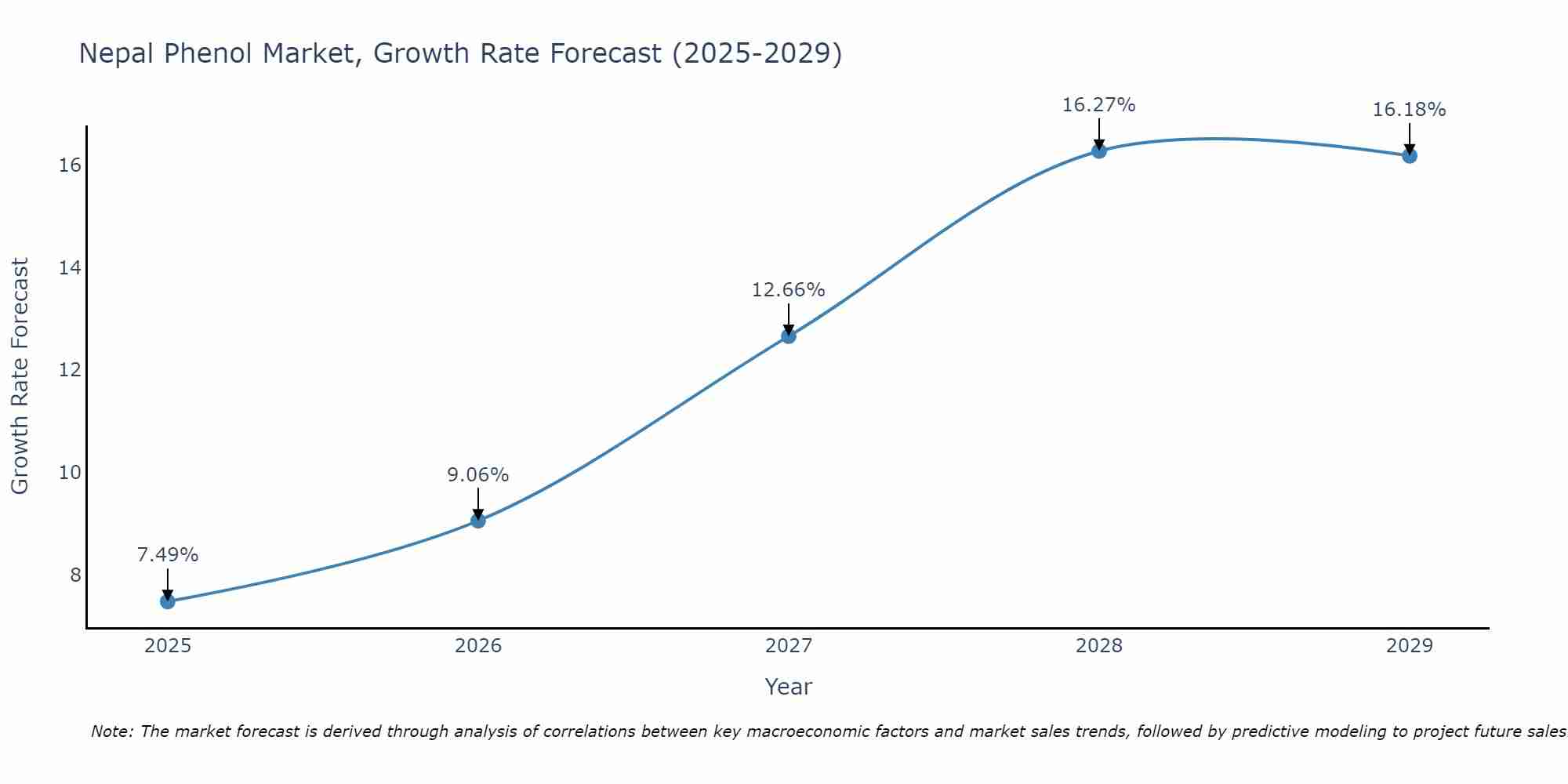
The Nepal Phenol Market is projected to witness mixed growth rate patterns during 2025 to 2029. The growth rate begins at 7.49% in 2025, climbs to a high of 16.27% in 2028, and moderates to 16.18% by 2029.
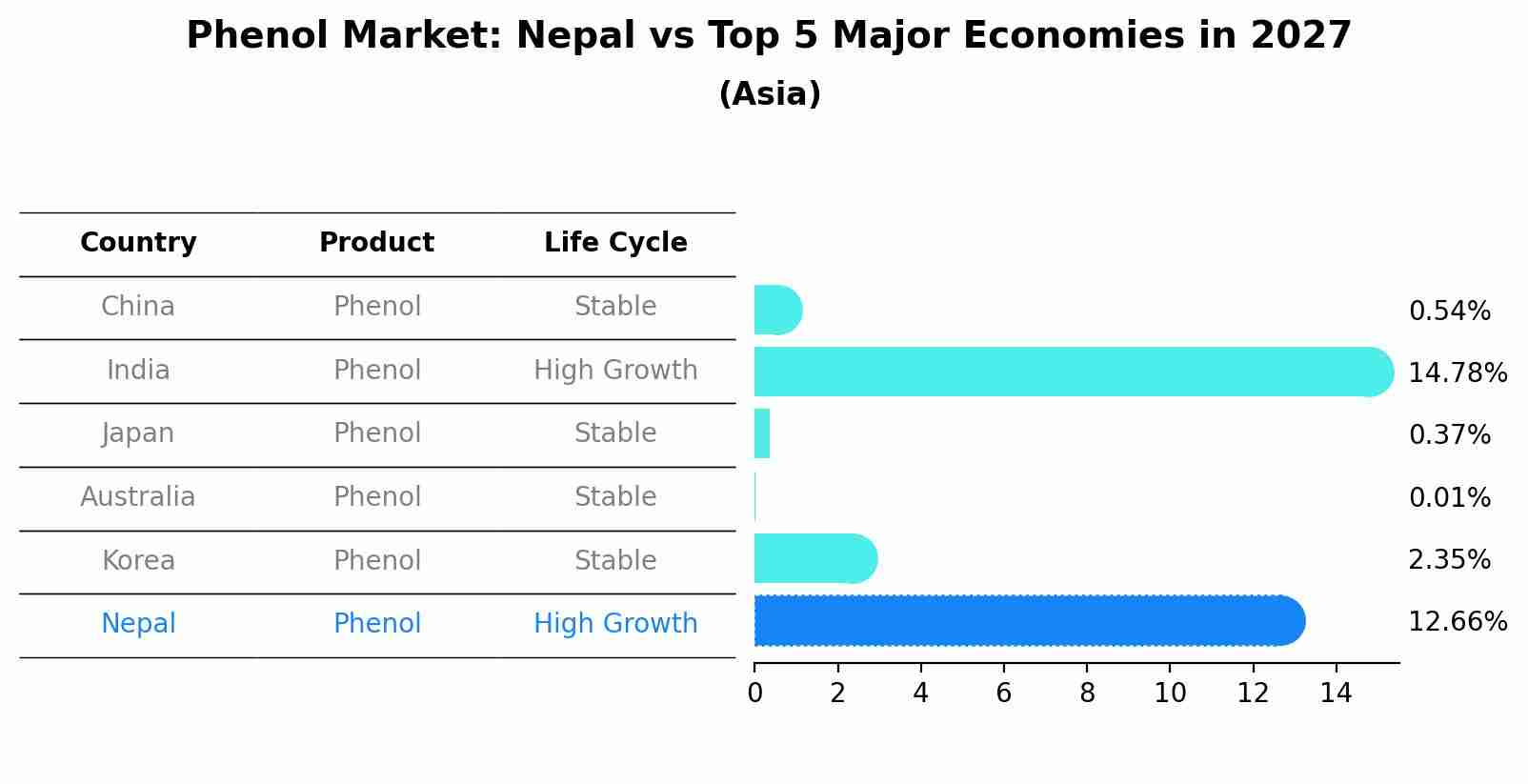
Phenol Market: Nepal vs Top 5 Major Economies in 2027 (Asia)
The Phenol market in Nepal is projected to grow at a high growth rate of 12.66% by 2027, highlighting the country's increasing focus on advanced technologies within the Asia region, where China holds the dominant position, followed closely by India, Japan, Australia and South Korea, shaping overall regional demand.
Nepal Phenol Market Overview
The Nepal Phenol Market is experiencing steady growth driven by increasing demand from various industries such as pharmaceuticals, automotive, and construction. Phenol, a versatile chemical used in the production of resins, adhesives, and other industrial chemicals, is witnessing a rise in consumption due to its widespread applications. The market is also benefiting from the growth in end-use sectors like healthcare, electronics, and paints & coatings. Factors such as urbanization, infrastructure development, and rising disposable income are contributing to the market expansion. However, challenges such as fluctuating raw material prices and environmental regulations could impact market growth. Overall, the Nepal Phenol Market is poised for continued growth with opportunities for market players to innovate products and expand their presence in the region.
Nepal Phenol Market Trends
The Nepal phenol market is witnessing steady growth driven by the increasing demand from various industries such as healthcare, construction, and automotive. The rising awareness about the benefits of phenol in disinfectants, pharmaceuticals, and resin production has contributed to its growing popularity. Additionally, the expanding construction sector in Nepal has led to an increased use of phenol-based products in adhesives and sealants. However, the market is facing challenges such as fluctuating raw material prices and environmental concerns associated with phenol production. To address these issues, manufacturers are focusing on sustainable production methods and exploring alternative sources of phenol. Overall, the Nepal phenol market is expected to continue its growth trajectory, driven by the diverse applications of phenol across industries.
Nepal Phenol Market Challenges
In the Nepal Phenol market, some key challenges include fluctuations in raw material prices, reliance on imports for phenol supply, limited domestic production capacity, and lack of technological advancements in the local industry. The volatility in raw material prices can impact the overall production costs and pricing strategies of phenol manufacturers in Nepal. Additionally, the country`s dependency on imports for phenol exposes the market to supply chain disruptions and foreign exchange risks. The limited domestic production capacity results in a gap between demand and supply, leading to potential shortages or price fluctuations. Furthermore, the lack of technological advancements in the local industry hinders the ability to enhance production efficiency and competitiveness in the global market. Addressing these challenges will be crucial for the sustainable growth and development of the Nepal Phenol market.
Nepal Phenol Market Investment Opportunities
One significant investment opportunity in the Nepal Phenol Market is the growing demand for phenol-based products in various industries such as pharmaceuticals, agriculture, and manufacturing. With the increasing focus on sustainability and environmentally friendly solutions, there is a rising interest in bio-based phenol production methods, offering potential for investment in innovative technologies. Additionally, the government`s initiatives to promote industrial growth and attract foreign investments present a favorable business environment for investors looking to capitalize on the country`s developing phenol market. Partnering with local manufacturers or establishing a production facility in Nepal could provide a strategic entry point to benefit from the expanding market opportunities and contribute to the country`s economic development.
Nepal Phenol Market Government Policy
The Nepal government has implemented various policies to regulate the Phenol market in the country. These policies include setting quality standards for Phenol production, import, and distribution to ensure consumer safety and environmental protection. The government also imposes taxes and tariffs on Phenol imports to promote local production and reduce dependency on foreign markets. Additionally, there are regulations in place to monitor and control the pricing of Phenol products to prevent price manipulation and ensure fair competition in the market. Overall, the government`s policies aim to promote a sustainable and competitive Phenol market in Nepal while safeguarding the interests of consumers and the environment.
Nepal Phenol Market Future Outlook
The future outlook for the Nepal Phenol Market appears promising, driven by growth in various end-use industries such as pharmaceuticals, agriculture, and construction. Increasing demand for phenol in the production of resins, adhesives, and other chemical compounds is expected to fuel market expansion. The rising awareness regarding environmental sustainability and the shift towards bio-based phenol production methods are also likely to shape the market`s trajectory. Additionally, government initiatives promoting industrial growth and investments in infrastructure development are anticipated to further boost market demand. However, challenges such as fluctuating raw material prices and stringent regulations on chemical production may impact market growth. Overall, the Nepal Phenol Market is forecasted to witness steady growth in the coming years, supported by evolving industry trends and increasing applications.
Key Highlights of the Report:
- Nepal Phenol Market Outlook
- Market Size of Nepal Phenol Market, 2021
- Forecast of Nepal Phenol Market, 2031
- Historical Data and Forecast of Nepal Phenol Revenues & Volume for the Period 2021 - 2031
- Nepal Phenol Market Trend Evolution
- Nepal Phenol Market Drivers and Challenges
- Nepal Phenol Price Trends
- Nepal Phenol Porter's Five Forces
- Nepal Phenol Industry Life Cycle
- Historical Data and Forecast of Nepal Phenol Market Revenues & Volume By End-users for the Period 2021 - 2031
- Historical Data and Forecast of Nepal Phenol Market Revenues & Volume By Bisphenol A for the Period 2021 - 2031
- Historical Data and Forecast of Nepal Phenol Market Revenues & Volume By Phenolic Resins for the Period 2021 - 2031
- Historical Data and Forecast of Nepal Phenol Market Revenues & Volume By Caprolactam for the Period 2021 - 2031
- Historical Data and Forecast of Nepal Phenol Market Revenues & Volume By Alkyl Phenyls for the Period 2021 - 2031
- Historical Data and Forecast of Nepal Phenol Market Revenues & Volume By Others for the Period 2021 - 2031
- Nepal Phenol Import Export Trade Statistics
- Market Opportunity Assessment By End-users
- Nepal Phenol Top Companies Market Share
- Nepal Phenol Competitive Benchmarking By Technical and Operational Parameters
- Nepal Phenol Company Profiles
- Nepal Phenol Key Strategic Recommendations






































