Peru 3D Animation Market Size & Growth Rate (2026-2032)
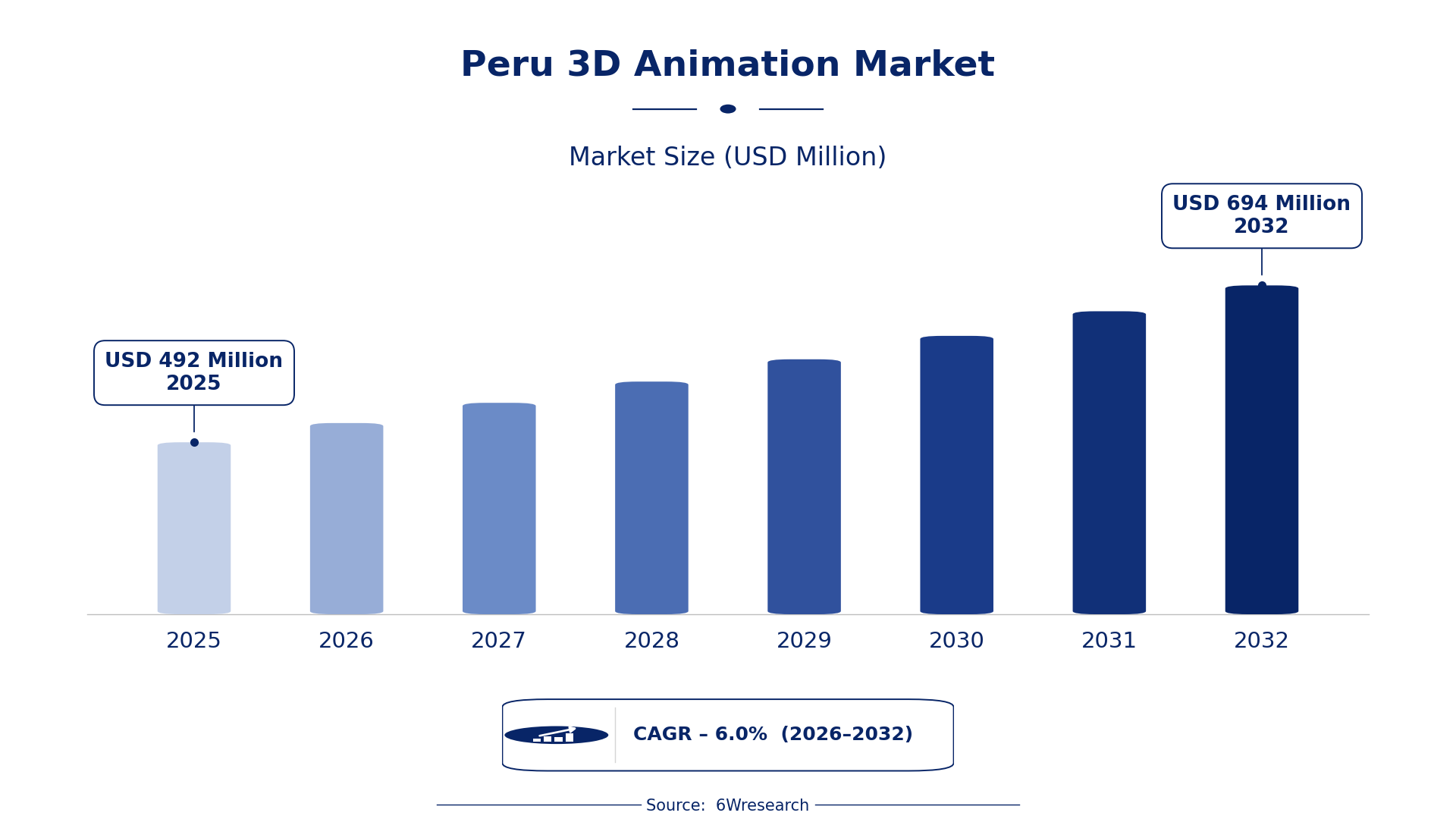
The Peru 3D Animation Market was estimated at USD 492 Million in 2025 and is projected to reach USD 694 Million by 2032, growing at a CAGR of 6.0% from 2026 to 2032.
Peru 3D Animation Market Synopsis
The demand for high-quality 3D animated content in Peru is on the rise, driven by sectors such as entertainment, advertising, and gaming. This increasing appetite for visually engaging media is prompting a surge in the number of animation studios and freelance animators looking to cater to both local and international clients.
Technological advancements are also playing a crucial role in this growth. Improved animation software and hardware are making it easier for creators to produce sophisticated visuals. Coupled with government support aimed at enhancing the creative industry, the Peru 3D animation market is becoming a prominent player in the Latin American region.
Peru 3D Animation Market Year-wise Growth Rate and Key Drivers
This graph illustrates the annual growth rates of the Peru 3D Animation Market from 2021 to 2032, highlighting a steady upward trajectory and projected expansion over the forecast period.
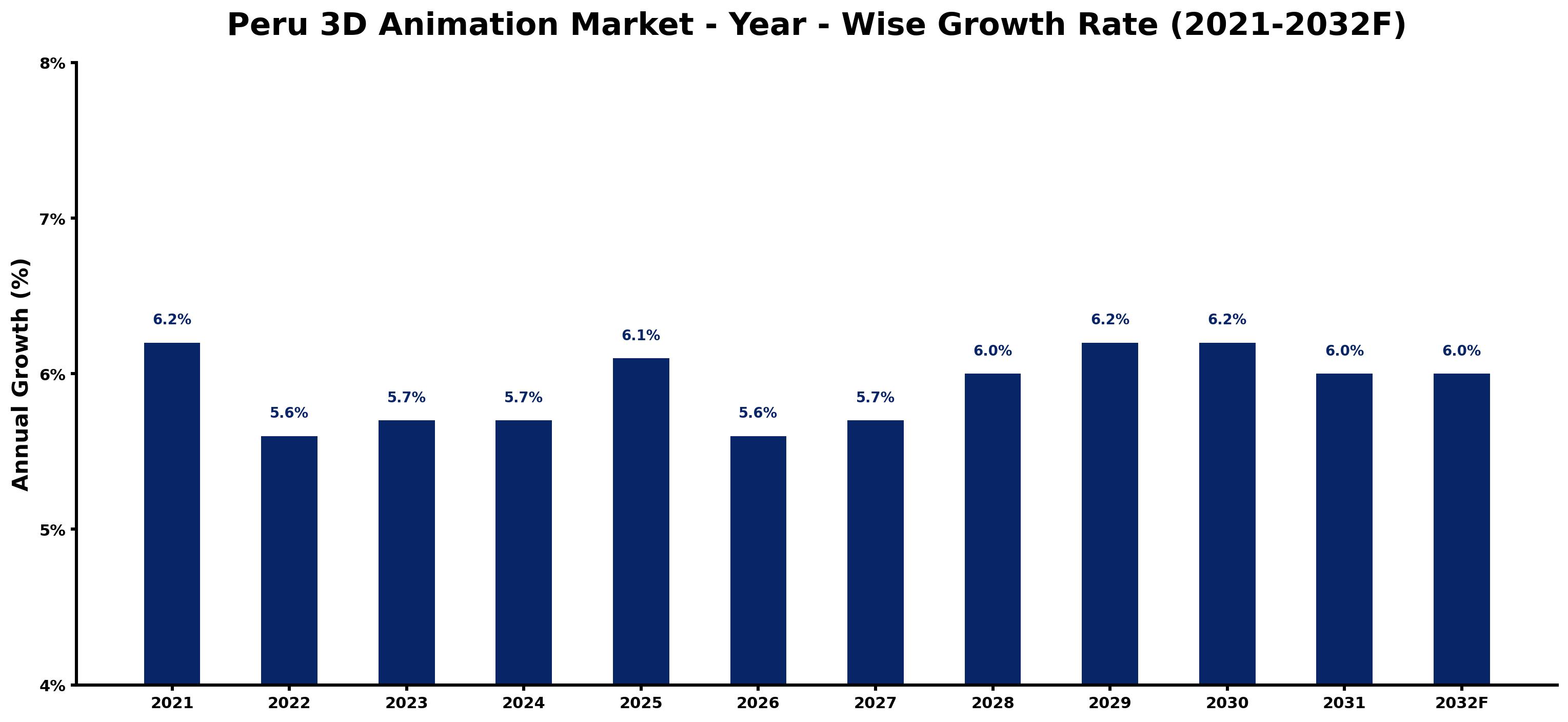
The table below presents the year‑wise growth rates along with the key drivers influencing the market
| Year | Growth Rate | Major Drivers |
| 2021 | 6.2% | Increased demand for local animated content production. |
| 2022 | 5.6% | Government grants for digital arts education programs. |
| 2023 | 5.7% | Growing popularity of Peruvian cultural exports in media. |
| 2024 | 5.7% | Emergence of startups focusing on digital animation. |
| 2025 | 6.1% | Investment in animation software by local tech firms. |
| 2026 | 5.6% | Rising usage of 3D animation in advertising campaigns. |
| 2027 | 5.7% | Post-pandemic digital content consumption surge. |
| 2028 | 6.0% | Enhanced internet accessibility boosts online animated content. |
| 2029 | 6.2% | Collaborations with international animation studios increase. |
| 2030 | 6.2% | Strong local university programs in digital animation. |
| 2031 | 6.0% | Recognition of Peruvian 3D artists in international festivals. |
| 2032 | 6.0% | Adoption of 3D animation in educational platforms. |
Note: Market size estimations and growth projections presented in this report are based on 6Wresearch's proprietary forecasting methodology, utilizing the latest available industry data, government publications, and primary research inputs.
Peru 3D Animation Market Key Takeaways
Below are some of the specific key takeaways from the market, including:
- The market is benefitting from a growing pool of skilled animators and production companies.
- Technological innovations are enhancing the quality and efficiency of animation production.
- Government initiatives are designed to attract foreign investment and support local talent.
- Emerging trends in virtual and augmented reality are creating new opportunities for animation applications.
- Digital marketing is increasingly relying on 3D animation for engaging content delivery.
Evaluation of Restraints in Peru 3D Animation Market
Despite its growth potential, the Peru 3D animation market faces several constraints. Access to advanced technology and software remains limited for many local studios, hindering their competitiveness on a global scale. Additionally, there is a noticeable shortage of skilled professionals who specialize in 3D animation techniques, which exacerbates the talent gap in the industry. The lack of a well-established infrastructure and support systems further complicates the market's ability to flourish, as funding opportunities and training programs are not yet fully developed. Addressing these issues will be critical for sustained growth.
Peru 3D Animation Market Trends
Current trends show a marked increase in the popularity of 3D animated films and series, which are capturing audiences both domestically and internationally. This trend is complemented by the rising adoption of immersive technologies such as virtual reality (VR) and augmented reality (AR), creating new avenues for animation. on top of that, the expansion of streaming platforms is pushing content creators to produce more engaging animated material, driving demand for high-quality production.
Peru 3D Animation Market Opportunities
The market presents genuine opportunities for local animation studios to collaborate with international entities for co-productions. There's also a growing demand for 3D animation services beyond entertainment, such as in architecture, education, and healthcare. With the increasing integration of digital content creation tools, animators have a chance to showcase their skills to a broader audience, both locally and globally, driving future growth.
Government Initiatives in the Peru 3D Animation Market
The Peruvian government is actively fostering the growth of the 3D animation sector through various initiatives. These efforts focus on creating an environment conducive to creative industries and attracting foreign investments. By implementing supportive policies, the government aims to cultivate local talent and infrastructure, ensuring that the animation market can thrive in a competitive landscape.
- A tax incentive program launched in early 2025 aims to boost investments in local animation production companies.
- Ongoing partnerships with educational institutions are being established to enhance training programs in animation techniques.
- A public-private initiative expected to expand digital infrastructure access for animation studios is currently underway.
- Funding programs to support emerging animators are being implemented to nurture local talent.
- Plans for a national animation festival to promote Peruvian talent and creativity are set for late 2026.
Future Insights of the Peru 3D Animation Market
Looking ahead to 2026-2032, the Peru 3D animation market is likely to experience significant expansion. The increasing demand for high-quality visual effects across various industries, including gaming, entertainment, and education, will drive this growth. As technology continues to evolve and the government maintains its supportive stance, the market is positioned to solidify its status as a key player in the Latin American animation industry.
Peru 3D Animation Market Latest Developments
In the past year, the Peru 3D animation market has witnessed notable developments that indicate a positive trajectory for the industry. As more studios emerge and technology advances, the landscape of 3D animation is changing rapidly, with both local and international interest growing.
- A new animation software platform was launched in early 2025, designed specifically for local animators to enhance their production capabilities.
- A collaborative project between local studios and international partners began in mid-2025, focusing on developing an animated series aimed at the global market.
- Ongoing discussions are taking place for a major animation festival set to take place in late 2026, aimed at showcasing Peruvian talent.
- An initiative to upgrade digital infrastructure across animation studios started in early 2025 and remains underway.
- Plans for a nationwide competition to promote animation skills among students are expected to launch in early 2026.
Peru 3D Animation Market - Key Attractiveness of the Report
- 10 Years of Market Numbers
- Historical Data Starting from 2022 to 2025
- Base Year: 2025
- Forecast Data until 2032
- Key Performance Indicators Impacting the Market
- Major Upcoming Developments and Projects
Key Highlights of the Report:
- Peru 3D Animation Market Outlook
- Market Size of Peru 3D Animation Market, 2025
- Forecast of Peru 3D Animation Market, 2032
- Historical Data and Forecast of Peru 3D Animation Revenues & Volume for the Period 2022-2032F
- Peru 3D Animation Market Trend Evolution
- Peru 3D Animation Market Drivers and Challenges
- Peru 3D Animation Price Trends
- Peru 3D Animation Porter's Five Forces
- Peru 3D Animation Industry Life Cycle
- Historical Data and Forecast of Peru 3D Animation Market Revenues & Volume By Technology for the Period 2022-2032F
- Historical Data and Forecast of Peru 3D Animation Market Revenues & Volume By 3D Modeling for the Period 2022-2032F
- Historical Data and Forecast of Peru 3D Animation Market Revenues & Volume By Motion Graphics for the Period 2022-2032F
- Historical Data and Forecast of Peru 3D Animation Market Revenues & Volume By 3D Rendering for the Period 2022-2032F
- Historical Data and Forecast of Peru 3D Animation Market Revenues & Volume By Visual Effects for the Period 2022-2032F
- Historical Data and Forecast of Peru 3D Animation Market Revenues & Volume By Service for the Period 2022-2032F
- Historical Data and Forecast of Peru 3D Animation Market Revenues & Volume By Consulting for the Period 2022-2032F
- Historical Data and Forecast of Peru 3D Animation Market Revenues & Volume By Support and Maintenance for the Period 2022-2032F
- Historical Data and Forecast of Peru 3D Animation Market Revenues & Volume By Integration and Deployment for the Period 2022-2032F
- Historical Data and Forecast of Peru 3D Animation Market Revenues & Volume By Education and Training for the Period 2022-2032F
- Historical Data and Forecast of Peru 3D Animation Market Revenues & Volume By Vertical for the Period 2022-2032F
- Historical Data and Forecast of Peru 3D Animation Market Revenues & Volume By Media and Entertainment for the Period 2022-2032F
- Historical Data and Forecast of Peru 3D Animation Market Revenues & Volume By Construction and Architecture for the Period 2022-2032F
- Historical Data and Forecast of Peru 3D Animation Market Revenues & Volume By Healthcare and Lifesciences for the Period 2022-2032F
- Historical Data and Forecast of Peru 3D Animation Market Revenues & Volume By Manufacturing for the Period 2022-2032F
- Historical Data and Forecast of Peru 3D Animation Market Revenues & Volume By Education and Academia for the Period 2022-2032F
- Historical Data and Forecast of Peru 3D Animation Market Revenues & Volume By Others for the Period 2022-2032F
- Historical Data and Forecast of Peru 3D Animation Market Revenues & Volume By Deployment for the Period 2022-2032F
- Historical Data and Forecast of Peru 3D Animation Market Revenues & Volume By On-Premises for the Period 2022-2032F
- Historical Data and Forecast of Peru 3D Animation Market Revenues & Volume By On-Demand for the Period 2022-2032F
- Peru 3D Animation Import Export Trade Statistics
- Market Opportunity Assessment By Technology
- Market Opportunity Assessment By Service
- Market Opportunity Assessment By Vertical
- Market Opportunity Assessment By Deployment
- Peru 3D Animation Top Companies Market Share
- Peru 3D Animation Competitive Benchmarking By Technical and Operational Parameters
- Peru 3D Animation Company Profiles
- Peru 3D Animation Key Strategic Recommendations






































