Philippines Electrical Testing Market Summary
The philippines electrical testing market was estimated at USD 455 Million in 2025 and is projected to reach USD 657 Million by 2032, growing at a CAGR of 6.1% from 2026 to 2032.
Philippines Electrical Testing Market Year-wise Growth Rate and Key Drivers
This graph highlights how the Philippines Electrical Testing Market has steadily grown over the past five years, supported by major growth factors.
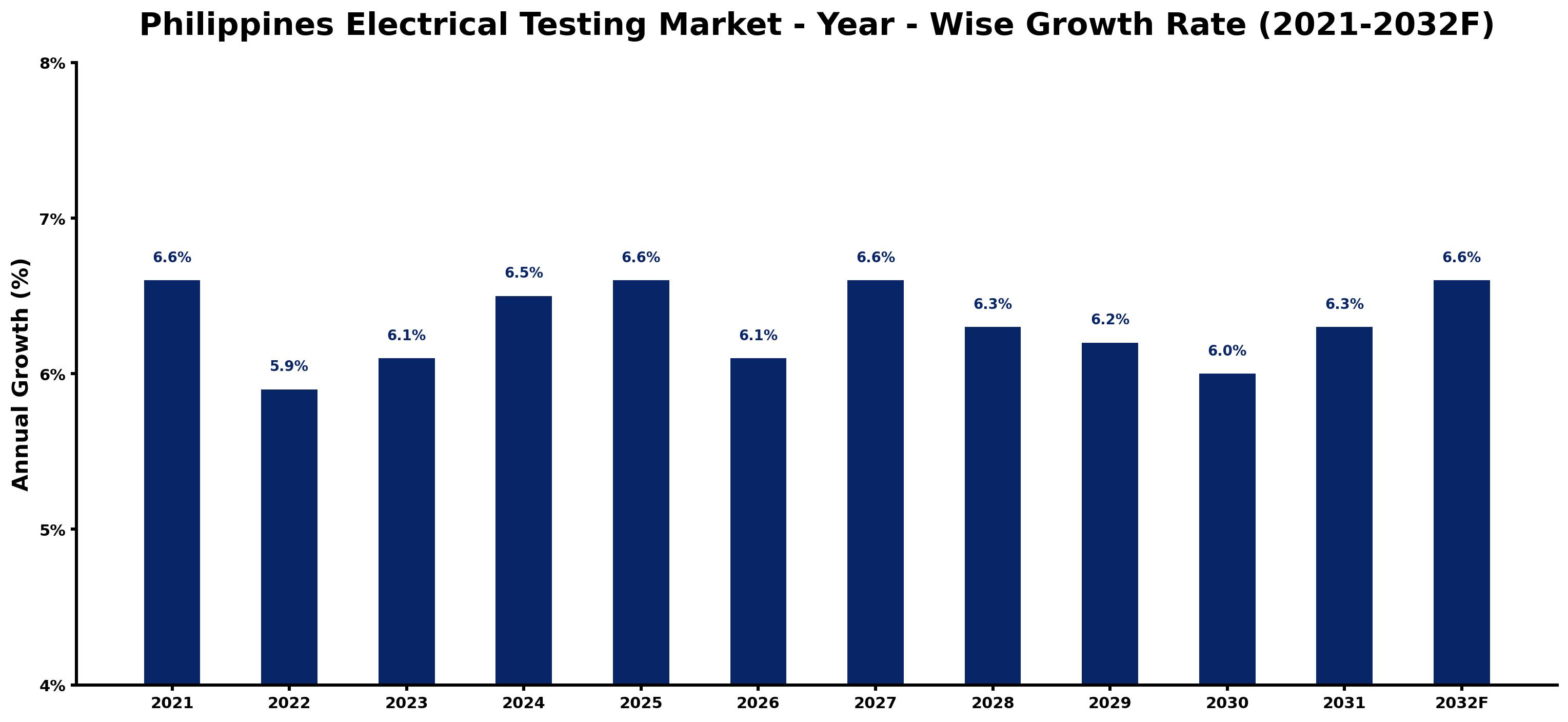
The table below presents the year wise growth rates along with the key drivers influencing the market
| Year | Growth Rate | Major Drivers |
| 2021 | 6.6% | Infrastructure development programs initiated by the government stimulated the electrical testing sector. |
| 2022 | 5.9% | Local manufacturers increasingly focused on quality assurance and compliance with international standards. |
| 2023 | 6.1% | Investment in renewable energy prompted the need for advanced electrical testing solutions. |
| 2024 | 6.5% | Emerging construction projects increased the demand for reliable electrical systems and testing services. |
| 2025 | 6.6% | Technological innovations in testing equipment enhanced efficiency, driving market interest significantly. |
| 2026 | 6.1% | Corporate mergers in the sector expanded service offerings and increased competitive dynamics. |
| 2027 | 6.6% | The rise of smart grid technologies required extensive testing for integration and performance. |
| 2028 | 6.3% | Urbanization trends intensified the need for robust electrical infrastructure and reliable testing methodologies. |
| 2029 | 6.2% | International partnerships bolstered local expertise in electrical testing and quality assurance practices. |
| 2030 | 6.0% | Sustainability targets in the energy sector underscored the importance of rigorous electrical assessments. |
| 2031 | 6.3% | Digital transformation initiatives led to a higher demand for automated electrical testing solutions. |
| 2032 | 6.6% | Consumer awareness of safety standards necessitated comprehensive testing services across industries. |
Note - Market size estimations and growth projections presented in this report are based on 6Wresearch's advanced forecasting approach, validated with industry datasets as of June 2026.
Philippines Electrical Testing Market Synopsis
The Philippines Electrical Testing Market is projected to reach 6.1% and witness significant growth during the forecast period (2026-2032). This growth is anticipated at a compound annual growth rate (CAGR) of 5.1%, driven by various factors, including heightened government initiatives geared toward enhancing the electricity infrastructure across the nation. Additionally, the demand for safe and reliable power delivery systems is on the rise, alongside increasing investments in renewable energy projects and rapid advancements in technology.
Philippines Electrical Testing Market Growth Drivers
Several key drivers are contributing to the upward trajectory of the Philippines Electrical Testing Market. Firstly, the ongoing government initiatives focused on improving electricity infrastructure are a significant catalyst. The National Electrification Administration (NEA) and other regulatory bodies are enforcing stringent safety regulations that necessitate regular electrical testing.
- Investment in renewable energy projects is increasing, prompting a greater need for comprehensive electrical testing to ensure compliance with safety standards.
- The growing awareness regarding energy efficiency and conservation among commercial establishments necessitates regular electrical inspections to meet regulatory requirements.
- Technological advancements are facilitating automated testing solutions, which are preferred by service providers for quicker resolution of electrical issues.
- Increased public and private sector investments are focusing on developing sustainable infrastructure powered by renewable energy sources.
- Regular testing is crucial for educational institutions and healthcare facilities that must adhere to safety standards, thus driving demand in these sectors.
Philippines Electrical Testing Market Trends and Opportunities
Current trends in the Philippines Electrical Testing Market illustrate a shift towards automation and advanced technologies. Automated test solutions are gaining traction, allowing service providers across various sectors to perform assessments with greater efficiency and accuracy.
- Integration of smart technologies into testing equipment is enhancing safety features, helping mitigate risks associated with faulty installations.
- The emergence of digital platforms for remote testing and monitoring presents a new frontier for industry players looking to streamline operations.
- Collaboration between private companies and government institutions is becoming increasingly important as both sectors seek to improve electrical safety across the nation.
- Research and development efforts are intensifying, focusing on creating more sophisticated devices that can contribute to enhanced safety protocols.
- Efforts to educate stakeholders about the importance of electrical testing are being prioritized, further amplifying the adoption of these essential services.
Philippines Electrical Testing Market Challenges and Restraints
Despite the favorable growth prospects, the Philippines Electrical Testing Market is facing several challenges that could hinder progress. A notable concern is the shortage of skilled labor capable of managing complex electrical testing operations.
- The lack of qualified personnel poses a risk of service disruptions, adversely affecting business revenues in the sector.
- Fluctuating prices of raw materials used in manufacturing testing equipment can lead to increased operational costs, impacting competitiveness.
- Compliance with evolving safety regulations requires continuous investment in training and infrastructure, which can strain resources for businesses.
- Resistance to change within some organizations can slow the adoption of new testing technologies, hindering market growth.
- Cyclical economic downturns may affect public spending on infrastructure projects, directly impacting the demand for electrical testing services.
Philippines Electrical Testing Market Government Investment and Initiatives
The Philippine government has initiated numerous investments and policies designed to bolster the electrical testing market. These initiatives primarily focus on improving the country's electrical infrastructure through various public spending programs.
- Government funding is increasingly directed toward modernizing existing electrical systems to ensure they meet contemporary safety standards.
- Initiatives aimed at enhancing energy efficiency are being implemented, encouraging businesses to engage in regular electrical testing to comply with new regulations.
- The government promotes partnerships with private sectors to foster innovation and investment in electrical testing technologies.
- Public awareness campaigns regarding the importance of electrical safety and testing are being increased to engage consumers and businesses alike.
- Long-term plans are being developed to further integrate renewable energy sources into the national grid, necessitating enhanced testing protocols for new installations.
Philippines Electrical Testing Market Latest Developments (May 2025 - June 2026)
Recent developments in the Philippines Electrical Testing Market indicate a growing focus on technology integration and regulatory compliance. Over the past year, there has been an uptick in the adoption of automated testing solutions, allowing for greater efficiency in operations.
- Regulatory bodies are actively revising existing safety standards, prompting companies to upgrade their testing processes accordingly.
- There is an increasing trend of public-private partnerships, which are aimed at enhancing the country's electrical infrastructure through innovative testing methodologies.
- Conferences and workshops focused on electrical testing technologies are being organized, providing platforms for information exchange among industry stakeholders.
- Industry players are placing greater emphasis on sustainable practices, integrating eco-friendly solutions into their electrical testing services.
- Emerging technologies, such as IoT and AI, are expected to feature prominently in future electrical testing protocols, further enhancing operational effectiveness.
Philippines Electrical Testing Market - Key Attractiveness of the Report
- 10 Years of Market Numbers
- Historical Data Starting from 2022 to 2025
- Base Year: 2025
- Forecast Data until 2032
- Key Performance Indicators Impacting the Market
- Major Upcoming Developments and Projects
Key Highlights of the Report:
- Philippines Electrical Testing Market Outlook
- Market Size of Philippines Electrical Testing Market, 2025
- Forecast of Philippines Electrical Testing Market, 2032
- Historical Data and Forecast of Philippines Electrical Testing Revenues & Volume for the Period 2022-2032F
- Philippines Electrical Testing Market Trend Evolution
- Philippines Electrical Testing Market Drivers and Challenges
- Philippines Electrical Testing Price Trends
- Philippines Electrical Testing Porter's Five Forces
- Philippines Electrical Testing Industry Life Cycle
- Historical Data and Forecast of Philippines Electrical Testing Market Revenues & Volume By Testing Application for the Period 2022-2032F
- Historical Data and Forecast of Philippines Electrical Testing Market Revenues & Volume By Voltage Testing for the Period 2022-2032F
- Historical Data and Forecast of Philippines Electrical Testing Market Revenues & Volume By Functionality Testing for the Period 2022-2032F
- Historical Data and Forecast of Philippines Electrical Testing Market Revenues & Volume By Other for the Period 2022-2032F
- Historical Data and Forecast of Philippines Electrical Testing Market Revenues & Volume By Industry Application for the Period 2022-2032F
- Historical Data and Forecast of Philippines Electrical Testing Market Revenues & Volume By Energy & Power for the Period 2022-2032F
- Historical Data and Forecast of Philippines Electrical Testing Market Revenues & Volume By Aerospace & Defense for the Period 2022-2032F
- Historical Data and Forecast of Philippines Electrical Testing Market Revenues & Volume By Manufacturing for the Period 2022-2032F
- Historical Data and Forecast of Philippines Electrical Testing Market Revenues & Volume By Consumer Electronics for the Period 2022-2032F
- Historical Data and Forecast of Philippines Electrical Testing Market Revenues & Volume By Oil and Gas for the Period 2022-2032F
- Historical Data and Forecast of Philippines Electrical Testing Market Revenues & Volume By Other? for the Period 2022-2032F
- Philippines Electrical Testing Import Export Trade Statistics
- Market Opportunity Assessment By Testing Application
- Market Opportunity Assessment By Industry Application
- Philippines Electrical Testing Top Companies Market Share
- Philippines Electrical Testing Competitive Benchmarking By Technical and Operational Parameters
- Philippines Electrical Testing Company Profiles
- Philippines Electrical Testing Key Strategic Recommendations






































