Qatar Asphalt Market Summary
The qatar asphalt market was estimated at USD 358 Million in 2025 and is projected to reach USD 476 Million by 2032, growing at a CAGR of 5.0% from 2026 to 2032.
Qatar Asphalt Market Year-wise Growth Rate and Key Drivers
This graph highlights how the Qatar Asphalt Market has steadily grown over the past five years, supported by major growth factors.
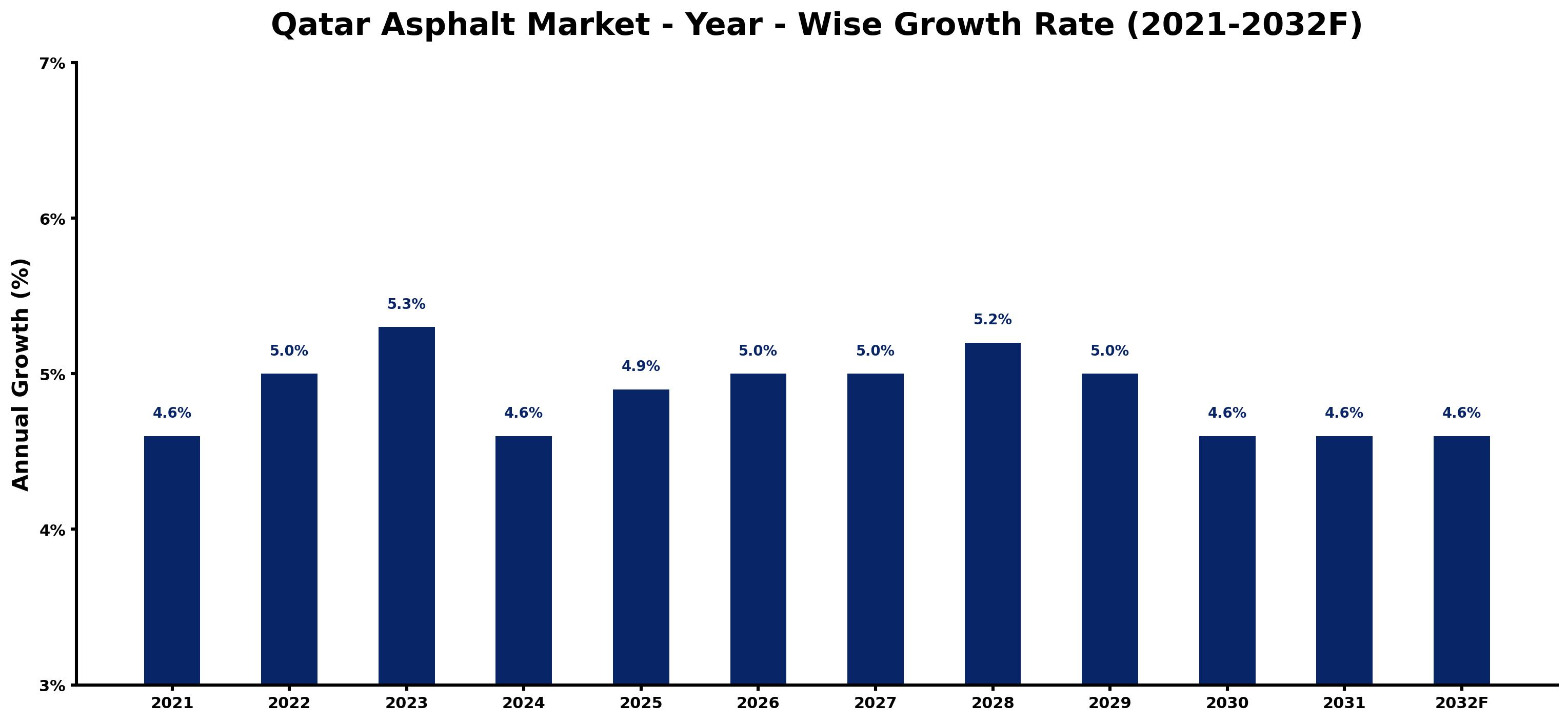
The table below presents the year wise growth rates along with the key drivers influencing the market
| Year | Growth Rate | Major Drivers |
| 2021 | 4.6% | Construction momentum builds with infrastructure projects reactivating after pandemic disruptions. |
| 2022 | 5.0% | Regional economic recovery supports increased investments in public and private construction ventures. |
| 2023 | 5.3% | Qatar's hosting of global events boosts demand for durable asphalt solutions and innovations. |
| 2024 | 4.6% | Infrastructure goals align with Qatar National Vision, emphasizing sustainable development practices. |
| 2025 | 4.9% | Urbanization trends prompt enhanced road networks and increased asphalt consumption across cities. |
| 2026 | 5.0% | New regulations push for higher standards, influencing asphalt quality and production methods. |
| 2027 | 5.0% | Investments in smart city projects create additional avenues for advanced asphalt applications. |
| 2028 | 5.2% | Growing awareness of climate adaptability drives research into eco-friendly asphalt formulations. |
| 2029 | 5.0% | Partnerships among construction firms and asphalt suppliers enhance product availability and quality. |
| 2030 | 4.6% | Qatar's population growth fosters expansion of transportation infrastructure, increasing asphalt demand. |
| 2031 | 4.6% | Technological innovations streamline asphalt production, improving efficiency and reducing costs. |
| 2032 | 4.6% | Regional collaborations in GCC amplify construction activities, further elevating asphalt market dynamics. |
Note - Market size estimations and growth projections presented in this report are based on 6Wresearch's advanced forecasting approach, validated with industry datasets as of June 2026.
Qatar Asphalt Market Synopsis
The Qatar Asphalt Market is projected to reach 5.0% and witness significant growth during the forecast period (2026-2032). This growth will be significantly driven by increasing construction activities across the country. With its cost-effectiveness, ease of installation, durability, and overall superior quality, asphalt has become the material of choice for roads and highways in Qatar. The demand for asphalt is further supported by substantial investments in the infrastructure sector and government initiatives aimed at urban development, encompassing road maintenance, repair works, and new road constructions.
Qatar Asphalt Market Growth Drivers
The primary drivers influencing the Qatar asphalt market are multi-faceted and stem from both governmental and technological advancements:
- There is a noted increase in investments in infrastructure projects led by the government, which is expected to significantly enhance the demand for asphalt as a primary construction material.
- Urban development initiatives, particularly focused on improving transportation networks, are driving the construction of new roads and the maintenance of existing ones, consequently increasing demand for asphalt.
- The evolution of technology in asphalt production has resulted in more efficient manufacturing processes, allowing for quicker and more cost-effective production, thereby making it an attractive choice among end-users.
- Stricter regulations regarding emissions are prompting a transition from conventional petroleum-based products to more environmentally friendly alternatives such as asphalt, boosting its popularity in the construction sector.
- There's a growing recognition of the importance of sustainability in infrastructure development, with asphalt being celebrated for its recyclability and lower environmental impact compared to traditional materials.
Qatar Asphalt Market Challenges and Restraints
Despite its robust growth prospects, the Qatar asphalt market faces several challenges that could impede expansion:
- Fluctuations in the prices of raw materials essential for asphalt production can lead to instability in profit margins for manufacturers, making long-term planning difficult.
- The availability of cheaper, inferior substitutes may pose a risk to market share, as some contractors might opt for lower-cost alternatives over higher-quality asphalt.
- Manufacturers may struggle to adapt to the rapid changes within the market, especially when it comes to technological innovations which could streamline production and improve product quality.
- Regulatory barriers concerning environmental compliance can increase operational costs and present challenges for companies looking to enter the market or expand their operations.
- The aftereffects of the Covid-19 pandemic have left a lingering impact on the construction industry, leading to delays and reduced orders, which could affect market dynamics in the short term.
Qatar Asphalt Market Government Investment and Initiatives
The Qatari government continues to play a significant role in fostering growth within the asphalt market through various initiatives and substantial public expenditures:
- Strategic investment in the infrastructure sector, spearheaded by national development plans, aims to improve road networks, thus directly influencing the demand for asphalt.
- Qatar's National Vision 2030 outlines extensive plans for sustainable urban development, creating an environment conducive for growth in construction and, by extension, in the asphalt market.
- Public-private partnerships are being encouraged for large-scale infrastructure projects, which include provisions for asphalt roads, boosting the overall industry.
- Government incentives aimed at reducing the carbon footprint promote the use of environmentally friendly materials like asphalt, reinforcing its position in construction.
- Ongoing maintenance programs funded by the government ensure that existing road infrastructure is kept in optimal condition, further driving the need for asphalt in repair and maintenance works.
Qatar Asphalt Market Latest Developments (May 2025 - June 2026)
In the timeframe from May 2025 to June 2026, the Qatar asphalt market is expected to experience several notable developments:
- The local government is likely to unveil new contracts for road construction and maintenance as part of its ongoing infrastructure enhancement initiatives.
- Technological advancements in asphalt production are anticipated, potentially leading to the introduction of newer, more efficient production techniques that can minimize costs.
- New regulations concerning environmental impact may be introduced, compelling asphalt manufacturers to adapt and embrace sustainable practices.
- Increased collaboration between government entities and private construction firms is expected, fostering a more integrated approach to infrastructure development.
- The industry is anticipated to see a renewed focus on the maintenance of existing roads, as aging infrastructure poses challenges that require immediate attention, thereby sustaining demand for asphalt.
Qatar Asphalt Market - Key Attractiveness of the Report
- 10 Years of Market Numbers
- Historical Data Starting from 2022 to 2025
- Base Year: 2025
- Forecast Data until 2032
- Key Performance Indicators Impacting the Market
- Major Upcoming Developments and Projects
Key Highlights of the Report:
- Qatar Asphalt Market Outlook
- Market Size of Qatar Asphalt Market, 2025
- Forecast of Qatar Asphalt Market, 2032
- Historical Data and Forecast of Qatar Asphalt Revenues & Volume for the Period 2022-2032F
- Qatar Asphalt Market Trend Evolution
- Qatar Asphalt Market Drivers and Challenges
- Qatar Asphalt Price Trends
- Qatar Asphalt Porter's Five Forces
- Qatar Asphalt Industry Life Cycle
- Historical Data and Forecast of Qatar Asphalt Market Revenues & Volume By Type for the Period 2022-2032F
- Historical Data and Forecast of Qatar Asphalt Market Revenues & Volume By Paving Petroleum Asphalt for the Period 2022-2032F
- Historical Data and Forecast of Qatar Asphalt Market Revenues & Volume By Industrial Petroleum Asphalt for the Period 2022-2032F
- Historical Data and Forecast of Qatar Asphalt Market Revenues & Volume By Others for the Period 2022-2032F
- Historical Data and Forecast of Qatar Asphalt Market Revenues & Volume By Application for the Period 2022-2032F
- Historical Data and Forecast of Qatar Asphalt Market Revenues & Volume By Paving for the Period 2022-2032F
- Historical Data and Forecast of Qatar Asphalt Market Revenues & Volume By Roofing for the Period 2022-2032F
- Historical Data and Forecast of Qatar Asphalt Market Revenues & Volume By Others for the Period 2022-2032F
- Qatar Asphalt Import Export Trade Statistics
- Market Opportunity Assessment By Type
- Market Opportunity Assessment By Application
- Qatar Asphalt Top Companies Market Share
- Qatar Asphalt Competitive Benchmarking By Technical and Operational Parameters
- Qatar Asphalt Company Profiles
- Qatar Asphalt Key Strategic Recommendations






































