Qatar Functional Apparel Market Size, Share & Growth Rate
The Qatar Functional Apparel Market was estimated at USD 484 Million in 2025 and is projected to reach USD 647 Million by 2032, growing at a CAGR of 4.2% from 2026 to 2032. This upward trajectory is primarily driven by a population increasingly committed to fitness and healthy living, alongside government initiatives promoting sports and wellness. As sporting events and outdoor activities gain traction in Qatar, the demand for specialized functional apparel is poised to grow even further.
Qatar Functional Apparel Market Year-wise Growth Rate and Key Drivers
This graph highlights how the Qatar Functional Apparel Market has steadily grown over the years, supported by major growth factors.
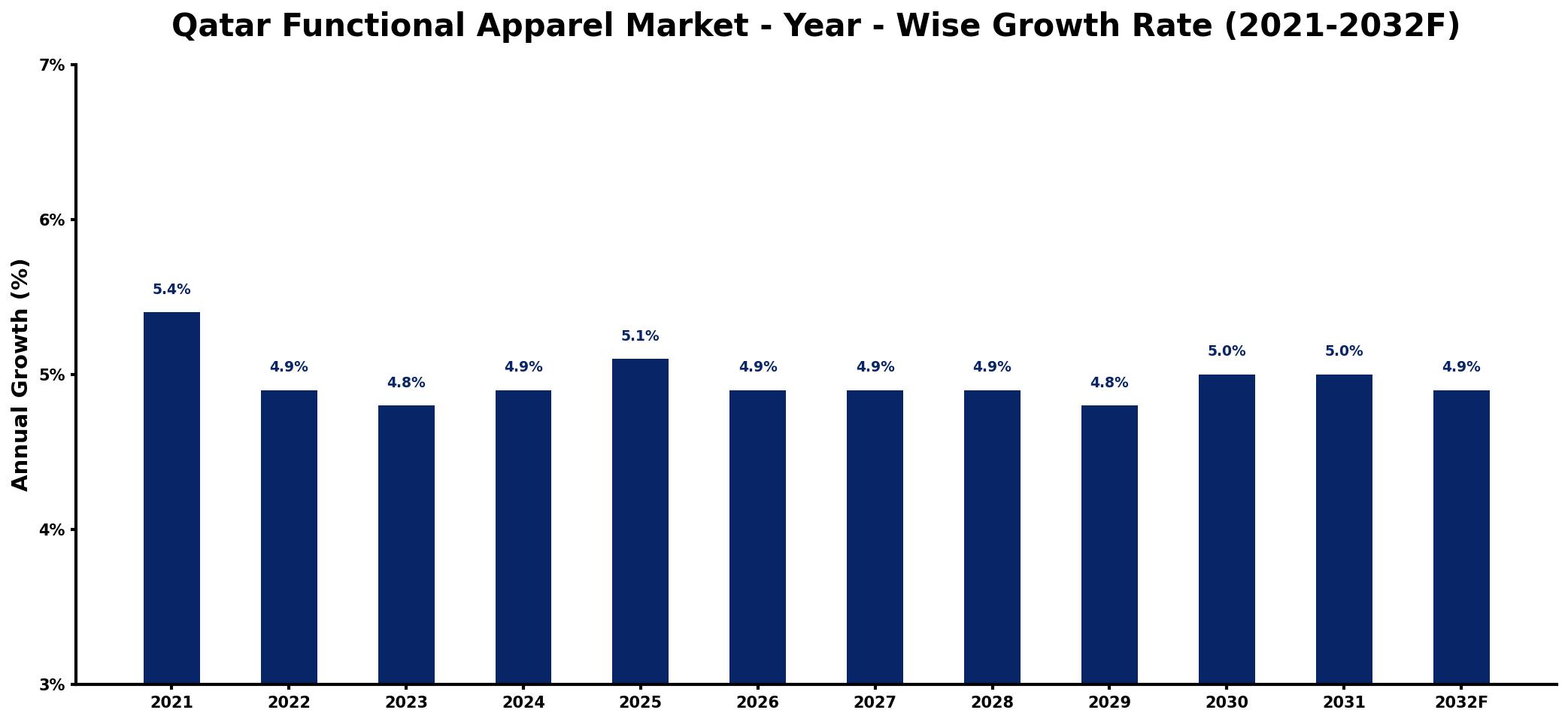
The table below presents the year‑wise growth rates along with the key drivers influencing the market
| Year | Growth Rate | Major Drivers |
| 2021 | 5.4% | increased fitness awareness trends |
| 2022 | 4.9% | growing outdoor activity participation |
| 2023 | 4.8% | rising demand for sustainability |
| 2024 | 4.9% | expansion of sports events |
| 2025 | 5.1% | increased digital shopping platforms |
| 2026 | 4.9% | growth in health consciousness |
| 2027 | 4.9% | rising disposable income levels |
| 2028 | 4.9% | increased investment in innovation |
| 2029 | 4.8% | growing popularity of athleisure |
| 2030 | 5.0% | expanding e-commerce market share |
| 2031 | 5.0% | increased urban lifestyle adoption |
| 2032 | 4.9% | growing focus on performance technology |
Note: Market size estimations and growth projections presented in this report are based on 6Wresearch's proprietary forecasting methodology, utilizing the latest available industry data, government publications, and primary research inputs.
Qatar Functional Apparel Market Synopsis
The functional apparel segment in Qatar is increasingly catering to both the aesthetic and practical needs of consumers, with a notable surge in interest for athleisure and performance wear. As a result of the country's unique climate and active lifestyle, consumers are seeking garments that offer not only style but also functionality and comfort.
This market is not only influenced by individual consumer preferences but also by the broader cultural shift towards health and fitness. With the nation hosting major sports events and outdoor initiatives, there is a strong correlation between increased activity levels and the demand for high-performance apparel designed to enhance athletic performance.
Qatar Functional Apparel Market Key Takeaways
- Growing health consciousness among Qatar's population is a significant driver for functional apparel demand.
- The blend of technology and clothing features enhances consumer appeal, pushing innovation in the market.
- Increased government focus on health and wellness is fostering community engagement in sports and fitness.
- Awareness campaigns are essential for educating consumers about the benefits of advanced functional apparel.
- The COVID-19 pandemic has shifted focus toward athleisure wear as home fitness gains popularity.
Evaluation of Restraints in Qatar Functional Apparel Market
Despite robust growth prospects, the Qatar Functional Apparel Market faces challenges in consumer education regarding the advantages of specialized apparel. Many consumers remain unfamiliar with advanced features, such as moisture-wicking or UV protection. To capitalize on market potential, brands must effectively communicate the value of these technologies. Additionally, fluctuations in global supply chains may impact product availability and pricing, making it imperative for businesses to navigate these challenges effectively to sustain growth.
Qatar Functional Apparel Market Trends
Current trends indicate a growing preference for sustainable and eco-friendly materials in functional apparel, as consumers become increasingly environmentally conscious. Additionally, the integration of smart technology in clothing is gaining traction, offering features such as real-time performance tracking. The popularity of social media influencers and fitness personalities also plays a significant role in shaping consumer preferences, as they advocate for active lifestyles and promote functional apparel brands.
Qatar Functional Apparel Market Opportunities
The Qatar Functional Apparel Market presents substantial opportunities for growth in segments like smart apparel and eco-friendly textiles. Companies can explore collaborations with local fitness centers and sports events to enhance brand visibility. The burgeoning youth population represents a key demographic that values performance-enhancing apparel, creating avenues for targeted marketing and specialized product development that meets their needs. Furthermore, leveraging online retail channels can significantly expand market reach.
Government Initiatives in the Qatar Functional Apparel Market
The Qatari government has made significant strides in promoting health and wellness through various initiatives. Policies that encourage sports participation and the development of public spaces for physical activities are paramount. Programs focusing on community health campaigns underscore the governments commitment to fostering an active lifestyle among its citizens, ultimately benefiting the functional apparel market. Investments in sports infrastructure and hosting international sporting events further elevate the importance of functional apparel in the country.
Future Insights of the Qatar Functional Apparel Market
Looking ahead to 2026-2032, the Qatar Functional Apparel Market is expected to evolve in line with technological advancements and changing consumer preferences. A greater emphasis on personalized products, including customizable options, may drive future market dynamics. Additionally, as Qatar continues to position itself as a hub for sporting events, the demand for high-performance apparel designed for extreme climates will likely see a notable increase, paving the way for innovative solutions tailored to meet the specific needs of this unique market.
Qatar Functional Apparel Market Latest Developments (2025 - 2026)
Recent developments in the Qatar Functional Apparel Market have highlighted a shift toward greater integration of sustainability and technology in product offerings. The industry has witnessed a rise in brands focusing on eco-friendly materials and smart apparel, with several companies launching new lines aimed at health-conscious consumers. Engagement with local fitness communities has become a prominent marketing strategy, resulting in collaborations that emphasize active lifestyles. Overall, the market is adapting to the evolving consumer landscape with innovative solutions.
Qatar Functional Apparel Market - Key Attractiveness of the Report
- 10 Years of Market Numbers
- Historical Data Starting from 2022 to 2025
- Base Year: 2025
- Forecast Data until 2032
- Key Performance Indicators Impacting the Market
- Major Upcoming Developments and Projects
Key Highlights of the Report:
- Qatar Functional Apparel Market Outlook
- Market Size of Qatar Functional Apparel Market, 2025
- Forecast of Qatar Functional Apparel Market, 2032
- Historical Data and Forecast of Qatar Functional Apparel Revenues & Volume for the Period 2022-2032F
- Qatar Functional Apparel Market Trend Evolution
- Qatar Functional Apparel Market Drivers and Challenges
- Qatar Functional Apparel Price Trends
- Qatar Functional Apparel Porter's Five Forces
- Qatar Functional Apparel Industry Life Cycle
- Historical Data and Forecast of Qatar Functional Apparel Market Revenues & Volume By Product Type for the Period 2022-2032F
- Historical Data and Forecast of Qatar Functional Apparel Market Revenues & Volume By Sportswear for the Period 2022-2032F
- Historical Data and Forecast of Qatar Functional Apparel Market Revenues & Volume By Activewear for the Period 2022-2032F
- Historical Data and Forecast of Qatar Functional Apparel Market Revenues & Volume By Protective Clothing for the Period 2022-2032F
- Historical Data and Forecast of Qatar Functional Apparel Market Revenues & Volume By Others for the Period 2022-2032F
- Historical Data and Forecast of Qatar Functional Apparel Market Revenues & Volume By Application for the Period 2022-2032F
- Historical Data and Forecast of Qatar Functional Apparel Market Revenues & Volume By Sports Industry for the Period 2022-2032F
- Historical Data and Forecast of Qatar Functional Apparel Market Revenues & Volume By Outdoor Clothing for the Period 2022-2032F
- Historical Data and Forecast of Qatar Functional Apparel Market Revenues & Volume By Healthcare sector for the Period 2022-2032F
- Historical Data and Forecast of Qatar Functional Apparel Market Revenues & Volume By Distribution Channel for the Period 2022-2032F
- Historical Data and Forecast of Qatar Functional Apparel Market Revenues & Volume By Offline Store for the Period 2022-2032F
- Historical Data and Forecast of Qatar Functional Apparel Market Revenues & Volume By Online Store for the Period 2022-2032F
- Qatar Functional Apparel Import Export Trade Statistics
- Market Opportunity Assessment By Product Type
- Market Opportunity Assessment By Application
- Market Opportunity Assessment By Distribution Channel
- Qatar Functional Apparel Top Companies Market Share
- Qatar Functional Apparel Competitive Benchmarking By Technical and Operational Parameters
- Qatar Functional Apparel Company Profiles
- Qatar Functional Apparel Key Strategic Recommendations






































