Qatar Policy Management in Telecom Market Size & Growth Rate (2026-2032)
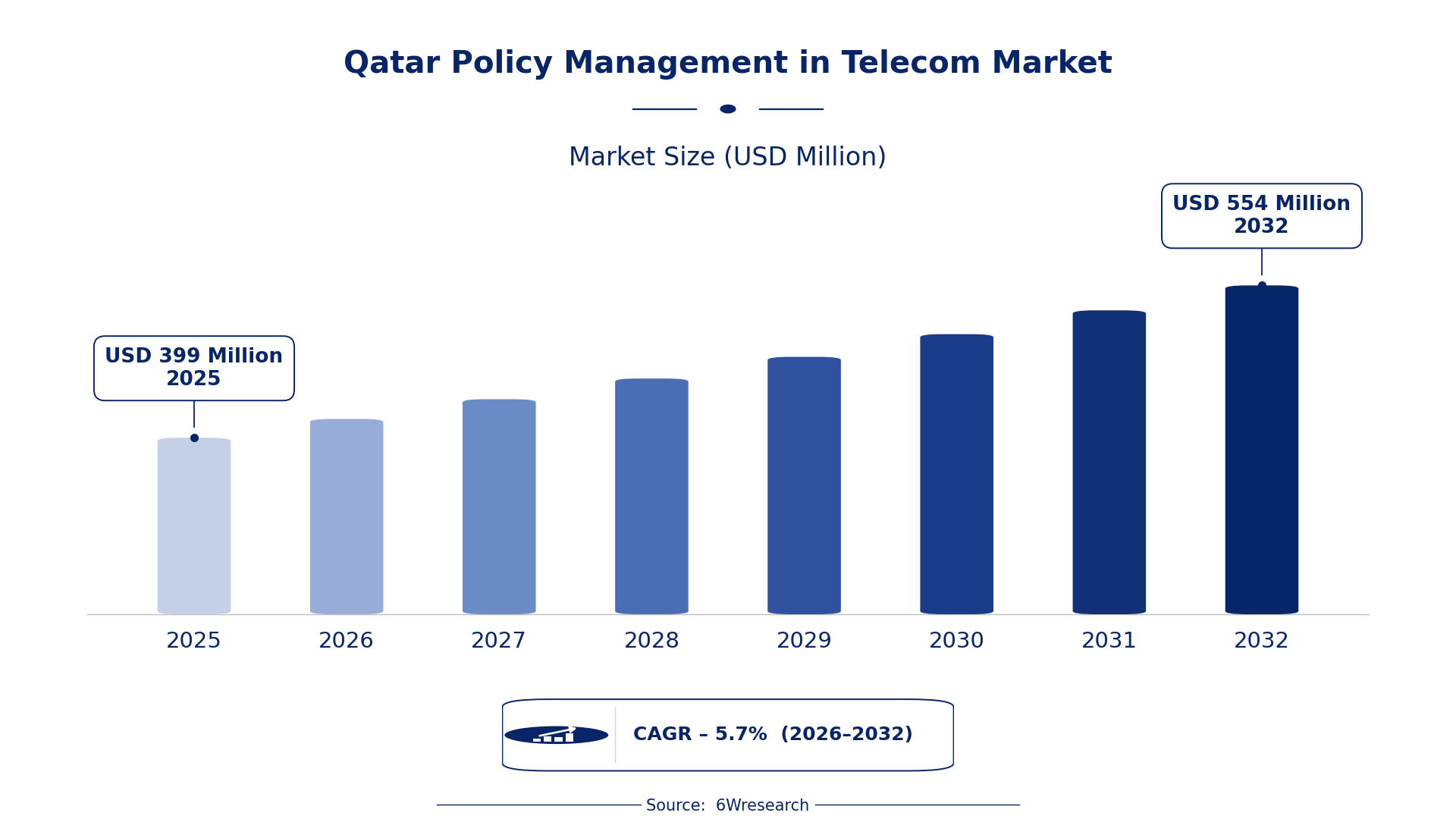
The Qatar Policy Management in Telecom Market was estimated at USD 399 Million in 2025 and is projected to reach USD 554 Million by 2032, growing at a CAGR of 5.7% from 2026 to 2032.
Qatar Policy Management in Telecom Market Synopsis
The telecom sector in Qatar is undergoing a transformative shift as operators strive to implement advanced policy management systems. These systems are crucial in managing network traffic, optimizing service delivery, and ensuring compliance with regulatory frameworks. The ability to enforce policies effectively is becoming a key differentiator among service providers.
As the market evolves, there is a marked emphasis on integrating new technologies like 5G and IoT. This integration demands sophisticated policy management solutions to enhance subscriber experiences and drive revenue through personalized service offerings. Such developments will undoubtedly influence market dynamics for years to come.
Qatar Policy Management in Telecom Market Year-wise Growth Rate and Key Drivers
This graph illustrates the annual growth rates of the Qatar Policy Management in Telecom Market from 2021 to 2032, highlighting a steady upward trajectory and projected expansion over the forecast period.
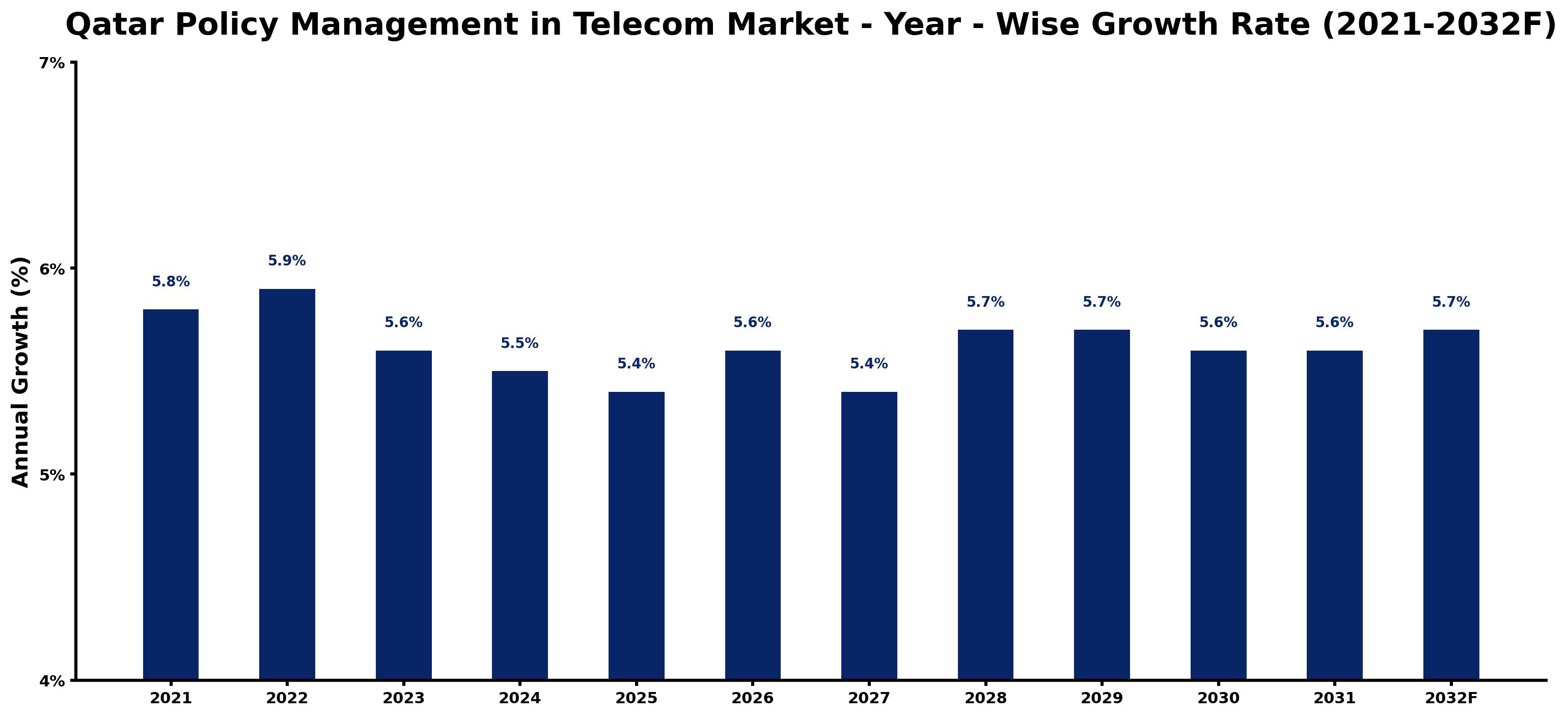
The table below presents the year‑wise growth rates along with the key drivers influencing the market
| Year | Growth Rate | Major Drivers |
| 2021 | 5.8% | Qatar's National Vision 2030 prioritizes telecom regulatory reforms. |
| 2022 | 5.9% | Strong population growth increases demand for telecom policy updates. |
| 2023 | 5.6% | Qatar Communications Regulatory Authority enhances telecom competition policies. |
| 2024 | 5.5% | Launch of 5G services drives regulatory adaptations and guidelines. |
| 2025 | 5.4% | Digital Qatar Initiative boosts telecommunications policy management processes. |
| 2026 | 5.6% | Increased foreign investment prompts regulatory framework adjustments. |
| 2027 | 5.4% | Qatar's hosting of international events enhances telecom service standards. |
| 2028 | 5.7% | Focus on sustainable practices influences telecom regulatory policies. |
| 2029 | 5.7% | Growing youth demographic demands innovative telecom service regulations. |
| 2030 | 5.6% | Regional geopolitical stability encourages telecom market growth initiatives. |
| 2031 | 5.6% | Smart city projects necessitate advanced telecom policy frameworks. |
| 2032 | 5.7% | Integration of IoT solutions drives regulatory compliance focus. |
Note: Market size estimations and growth projections presented in this report are based on 6Wresearch's proprietary forecasting methodology, utilizing the latest available industry data, government publications, and primary research inputs.
Qatar Policy Management in Telecom Market Key Takeaways
Below are some of the specific key takeaways from the market, including:
- The demand for personalized telecom services is driving innovation in policy management solutions.
- Effective policy control is essential for managing complex networks and ensuring quality service delivery.
- The expansion of 5G technology is creating new avenues for revenue through tailored offerings.
- Regulatory compliance remains a top priority as telecom operators navigate a complex legal environment.
- Emerging technologies, like IoT, are necessitating sophisticated policy enforcement mechanisms.
Evaluation of Restraints in Qatar Policy Management in Telecom Market
Despite its growth potential, the Qatar Policy Management in Telecom Market faces certain constraints. The rapid advancement of telecommunications services introduces complexities that make policy formulation and enforcement challenging. Operators must balance user demands with regulatory requirements, which can often conflict. The need for adaptive and comprehensive policy management systems becomes imperative, yet it requires substantial investment and expertise. Navigating these challenges will be crucial for operators aiming to maintain competitive advantages.
Qatar Policy Management in Telecom Market Trends
Key trends are shaping the Qatar Policy Management in Telecom Market, particularly the increasing reliance on cloud-based solutions. Telecom operators are progressively adopting cloud architectures to enhance flexibility and scalability in service delivery. Additionally, AI and machine learning technologies are being integrated into policy management systems to enable real-time data analysis and automated decision-making. This shift is resulting in more responsive services tailored to individual customer needs.
Qatar Policy Management in Telecom Market Opportunities
As the telecom landscape evolves, several growth opportunities emerge. There is a significant potential for operators to invest in AI-driven analytics platforms that enhance policy management capabilities. The shift towards 5G also opens doors for new revenue streams through advanced service offerings like smart city solutions and enhanced IoT connectivity. Companies that prioritize investment in innovative technologies will likely capitalize on these burgeoning opportunities.
Government Initiatives in the Qatar Policy Management in Telecom Market
The Qatari government is actively fostering a supportive environment for the telecommunications sector, recognizing its strategic importance in national development. Public policy initiatives are currently focused on enhancing regulatory frameworks and promoting digital transformation. Such efforts are pivotal for shaping the Qatar Policy Management in Telecom Market, particularly as the country aims to advance its technological infrastructure and improve service quality.
- A regulatory framework introduced in 2025 mandates transparency in billing practices among telecom operators.
- A national digital infrastructure upgrade programme is currently underway, aimed at improving connectivity across urban and rural areas.
- A planned public-private initiative is expected to expand telecom infrastructure access by 2028, fostering greater competition.
- Ongoing assessments of telecom regulations are being conducted to ensure compliance with international best practices.
- A recent initiative focused on IoT standards was launched in early 2025 to streamline the integration of emerging technologies.
Future Insights of the Qatar Policy Management in Telecom Market
Looking ahead, the Qatar Policy Management in Telecom Market is set to experience substantial growth driven by technological advancements and increased demand for personalized services. As 5G technology becomes more widespread, policy management systems will need to evolve to accommodate new service models. The interplay between regulatory compliance and innovative service delivery will define the next phase of development in this market, ensuring it remains dynamic and competitive.
Qatar Policy Management in Telecom Market Latest Developments
In the last year, the Qatar Policy Management in Telecom Market has seen significant activity as telecom operators and technology providers collaborate to enhance service delivery. Recent innovations are primarily centered around improved policy control systems that adapt to changing consumer needs and regulatory requirements. This momentum reflects a strategic focus on integrating advanced technologies into existing frameworks.
- A leading regional operator launched a new policy management solution in Q3 2025 aimed at enhancing customer experience and service personalization.
- Currently ongoing are collaborative projects between telecom providers and technology vendors to implement AI-driven policy frameworks.
- A major rollout of an upgraded network management system is expected to begin in early 2026, enhancing operational efficiency.
- In mid-2025, an initiative was completed that focused on integrating multi-network capabilities to optimize service delivery.
- Upcoming plans include a transition to a cloud-based policy management system expected to commence by late 2026.
Qatar Policy Management in Telecom Market - Key Attractiveness of the Report
- 10 Years of Market Numbers
- Historical Data Starting from 2022 to 2025
- Base Year: 2025
- Forecast Data until 2032
- Key Performance Indicators Impacting the Market
- Major Upcoming Developments and Projects
Key Highlights of the Report:
- Qatar Policy Management in Telecom Market Outlook
- Market Size of Qatar Policy Management in Telecom Market, 2025
- Forecast of Qatar Policy Management in Telecom Market, 2032
- Historical Data and Forecast of Qatar Policy Management in Telecom Revenues & Volume for the Period 2022-2032F
- Qatar Policy Management in Telecom Market Trend Evolution
- Qatar Policy Management in Telecom Market Drivers and Challenges
- Qatar Policy Management in Telecom Price Trends
- Qatar Policy Management in Telecom Porter's Five Forces
- Qatar Policy Management in Telecom Industry Life Cycle
- Historical Data and Forecast of Qatar Policy Management in Telecom Market Revenues & Volume By Network for the Period 2022-2032F
- Historical Data and Forecast of Qatar Policy Management in Telecom Market Revenues & Volume By Fixed for the Period 2022-2032F
- Historical Data and Forecast of Qatar Policy Management in Telecom Market Revenues & Volume By Wireless for the Period 2022-2032F
- Historical Data and Forecast of Qatar Policy Management in Telecom Market Revenues & Volume By Component for the Period 2022-2032F
- Historical Data and Forecast of Qatar Policy Management in Telecom Market Revenues & Volume By Solutions for the Period 2022-2032F
- Historical Data and Forecast of Qatar Policy Management in Telecom Market Revenues & Volume By Services for the Period 2022-2032F
- Historical Data and Forecast of Qatar Policy Management in Telecom Market Revenues & Volume By Deployment for the Period 2022-2032F
- Historical Data and Forecast of Qatar Policy Management in Telecom Market Revenues & Volume By Cloud for the Period 2022-2032F
- Historical Data and Forecast of Qatar Policy Management in Telecom Market Revenues & Volume By On-Premises for the Period 2022-2032F
- Qatar Policy Management in Telecom Import Export Trade Statistics
- Market Opportunity Assessment By Network
- Market Opportunity Assessment By Component
- Market Opportunity Assessment By Deployment
- Qatar Policy Management in Telecom Top Companies Market Share
- Qatar Policy Management in Telecom Competitive Benchmarking By Technical and Operational Parameters
- Qatar Policy Management in Telecom Company Profiles
- Qatar Policy Management in Telecom Key Strategic Recommendations






































