Thailand Bus Market Size, Share & Growth Rate
The Thailand Bus Market was estimated at USD 249 Million in 2025 and is projected to reach USD 286 Million by 2032, growing at a CAGR of 2.0% from 2026 to 2032. This growth trajectory reflects the increasing urbanization and burgeoning public transportation initiatives across the country. As the demand for efficient and environmentally friendly transport systems rises, the market is set to evolve significantly, driven by government investments and the flourishing tourism sector.
Thailand Bus Market Year-wise Growth Rate and Key Drivers
This graph highlights how the Thailand Bus Market has steadily grown over the years, supported by major growth factors.
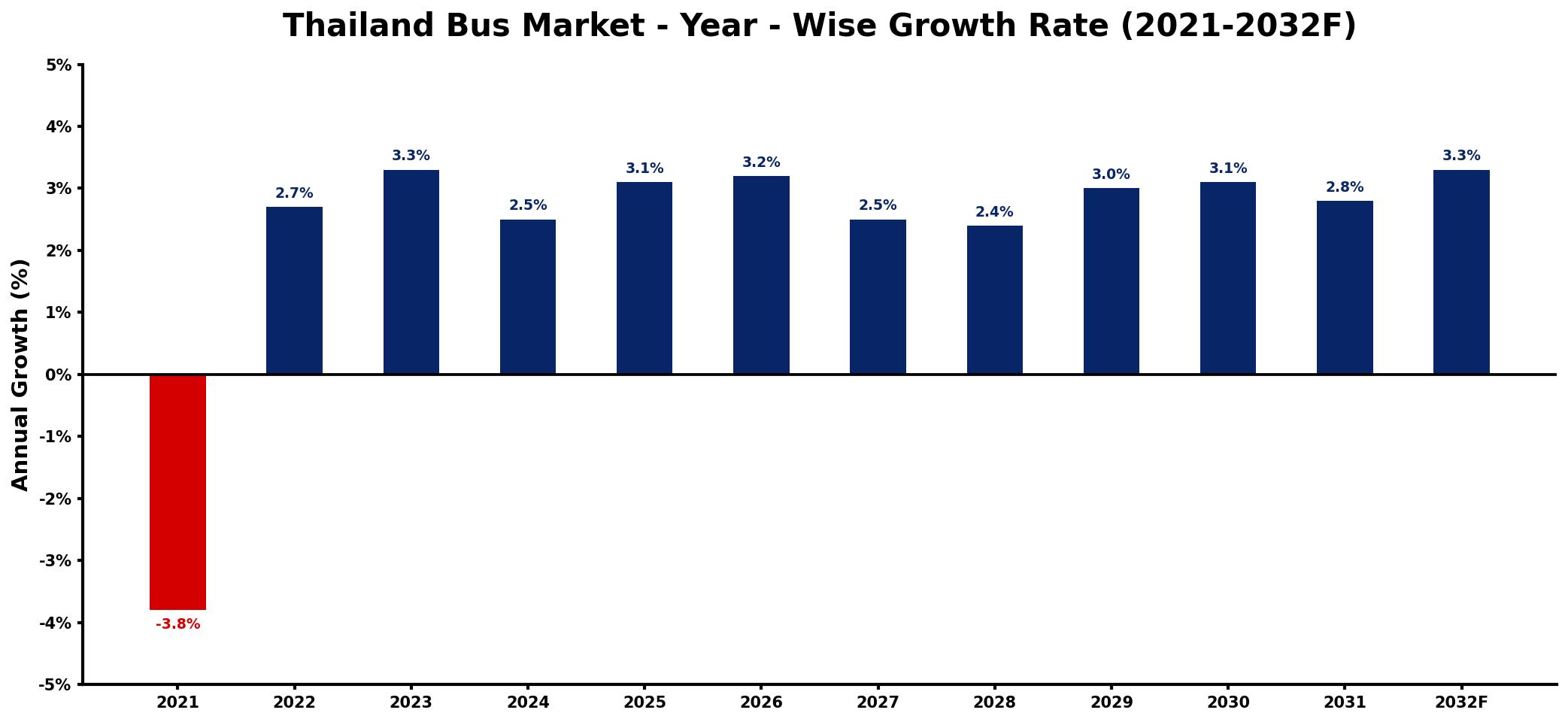
The table below presents the year‑wise growth rates along with the key drivers influencing the market
| Year | Growth Rate | Major Drivers |
| 2021 | -3.8% | decrease in public transportation usage |
| 2022 | 2.7% | rise in urban population density |
| 2023 | 3.3% | increased investment in infrastructure |
| 2024 | 2.5% | growing demand for eco-friendly transport |
| 2025 | 3.1% | expansion of tourism activities |
| 2026 | 3.2% | enhanced government transport policies |
| 2027 | 2.5% | improvement in economic stability |
| 2028 | 2.4% | advancements in vehicle technology |
| 2029 | 3.0% | growth in commuter convenience services |
| 2030 | 3.1% | increased focus on urban mobility |
| 2031 | 2.8% | rising infrastructure development spending |
| 2032 | 3.3% | growing popularity of shared transport |
Note: Market size estimations and growth projections presented in this report are based on 6Wresearch's proprietary forecasting methodology, utilizing the latest available industry data, government publications, and primary research inputs.
Thailand Bus Market Synopsis
In recent years, the Thailand bus market has shown notable resilience amid challenges, particularly following the pandemic's disruptions. Now, as the country emerges from the effects of COVID-19, the market is shifting towards recovery, propelled by strategic government investments and a renewed focus on sustainable public transit solutions.
Looking ahead, the demand for buses will likely continue to grow, fueled by rapid urbanization and a growing emphasis on eco-friendly transportation options. The need for modernized fleets and improved infrastructure is becoming increasingly critical to meet the rising demands of urban populations and tourists alike.
Thailand Bus Market Key Takeaways
- Urbanization and public transport expansion are pivotal drivers of market growth.
- The tourism industry remains a significant contributor, underpinning demand for various bus types.
- Government initiatives are essential for developing and modernizing transport systems.
- Sustainability trends are steering manufacturers towards eco-friendly bus options.
- Adapting to regulatory changes is crucial for market players navigating emission standards.
Evaluation of Restraints in Thailand Bus Market
The Thailand bus market grapples with several constraints that may hinder its full potential. Chief among these are the stringent transportation policies that can shift demand unexpectedly. Furthermore, economic fluctuations, which impact public spending on infrastructure, can directly influence bus procurement. Another pressing issue is the aging bus fleet that necessitates continuous investment for maintenance and upgrades. As the market transitions towards more efficient and compliant vehicles, staying ahead of evolving emission standards and technological advancements poses a significant challenge for operators.
Thailand Bus Market Trends
Current trends within the Thailand bus market indicate a marked shift towards electrification and sustainability. The introduction of eco-friendly buses is gaining traction, driven by both consumer demand and regulatory pressures. Additionally, smart transport technologies are being integrated into bus systems, enhancing operational efficiency and passenger experience. An increasing emphasis on creating seamless connections between different modes of transportation is reshaping urban mobility strategies, further defining the future landscape of the market.
Thailand Bus Market Opportunities
The Thailand bus market presents a myriad of investment opportunities, particularly in the realm of electric and hybrid buses. As the government commits to sustainable mobility initiatives, manufacturers can capitalize on this trend to innovate and offer environmentally friendly solutions. Moreover, public-private partnerships could play a vital role in financing the modernization of aging bus fleets, enhancing infrastructure, and expanding service coverage. The revival of tourism post-pandemic also offers unique avenues for growth in bus services tailored to travelers.
Government Initiatives in the Thailand Bus Market
The Thai government is actively promoting initiatives aimed at enhancing public transportation systems. Investment in mass transit infrastructure, particularly in urban areas, is a priority, along with the establishment of incentives for adopting green technologies. Programs aimed at reducing traffic congestion through improved bus services and the development of dedicated bus lanes are also being implemented, aligning with broader goals of sustainable urban development.
Future Insights of the Thailand Bus Market
Between 2026 and 2032, the Thailand bus market is expected to embrace transformative changes. A combination of technological advancements and policy-driven initiatives will likely result in a more robust public transportation ecosystem. Investments in electric bus fleets and the integration of smart transportation solutions are anticipated to take center stage, as public and private sectors collaborate to enhance the overall efficiency and sustainability of the bus systems. As urban populations grow and travel demands evolve, adaptability will be key for stakeholders in navigating the competitive landscape.
Thailand Bus Market Latest Developments (2025 - 2026)
Recent developments in the Thailand bus market reflect a significant pivot towards sustainability and modernization. As more operators explore electric and hybrid solutions, trials and pilot programs have begun to emerge, testing the viability of new technologies. Additionally, there has been an uptick in government partnerships aimed at enhancing infrastructure and service efficiency, signaling a progressive direction for public transportation in Thailand. Various local entities are also adapting their offerings to meet the shifting needs of urban commuters, enhancing their competitive edge in this evolving market.
Thailand Bus Market - Key Attractiveness of the Report
- 10 Years of Market Numbers
- Historical Data Starting from 2022 to 2025
- Base Year: 2025
- Forecast Data until 2032
- Key Performance Indicators Impacting the Market
- Major Upcoming Developments and Projects
Key Highlights of the Report:
- Thailand Bus Market Outlook
- Market Size of Thailand Bus Market, 2025
- Forecast of Thailand Bus Market, 2032
- Historical Data and Forecast of Thailand Bus Revenues & Volume for the Period 2022-2032F
- Thailand Bus Market Trend Evolution
- Thailand Bus Market Drivers and Challenges
- Thailand Bus Price Trends
- Thailand Bus Porter's Five Forces
- Thailand Bus Industry Life Cycle
- Historical Data and Forecast of Thailand Bus Market Revenues & Volume By Type for the Period 2022-2032F
- Historical Data and Forecast of Thailand Bus Market Revenues & Volume By Single Deck for the Period 2022-2032F
- Historical Data and Forecast of Thailand Bus Market Revenues & Volume By Double Deck for the Period 2022-2032F
- Historical Data and Forecast of Thailand Bus Market Revenues & Volume By Application for the Period 2022-2032F
- Historical Data and Forecast of Thailand Bus Market Revenues & Volume By Transit for the Period 2022-2032F
- Historical Data and Forecast of Thailand Bus Market Revenues & Volume By Coaches for the Period 2022-2032F
- Historical Data and Forecast of Thailand Bus Market Revenues & Volume By Others for the Period 2022-2032F
- Historical Data and Forecast of Thailand Bus Market Revenues & Volume By Fuel Type for the Period 2022-2032F
- Historical Data and Forecast of Thailand Bus Market Revenues & Volume By Diesel for the Period 2022-2032F
- Historical Data and Forecast of Thailand Bus Market Revenues & Volume By Electric and Hybrid for the Period 2022-2032F
- Historical Data and Forecast of Thailand Bus Market Revenues & Volume By Others for the Period 2022-2032F
- Historical Data and Forecast of Thailand Bus Market Revenues & Volume By Seat Capacity for the Period 2022-2032F
- Historical Data and Forecast of Thailand Bus Market Revenues & Volume By 15-30 Seats for the Period 2022-2032F
- Historical Data and Forecast of Thailand Bus Market Revenues & Volume By 31-50 Seats for the Period 2022-2032F
- Historical Data and Forecast of Thailand Bus Market Revenues & Volume By More than 50 Seats for the Period 2022-2032F
- Thailand Bus Import Export Trade Statistics
- Market Opportunity Assessment By Type
- Market Opportunity Assessment By Application
- Market Opportunity Assessment By Fuel Type
- Market Opportunity Assessment By Seat Capacity
- Thailand Bus Top Companies Market Share
- Thailand Bus Competitive Benchmarking By Technical and Operational Parameters
- Thailand Bus Company Profiles
- Thailand Bus Key Strategic Recommendations






































