Thailand Electronic Components Market Summary
The thailand electronic components market was estimated at USD 239 Million in 2025 and is projected to reach USD 276 Million by 2032, growing at a CAGR of 3.1% from 2026 to 2032.
Thailand Electronic Components Market Year-wise Growth Rate and Key Drivers
This graph highlights how the Thailand Electronic Components Market has steadily grown over the past five years, supported by major growth factors.
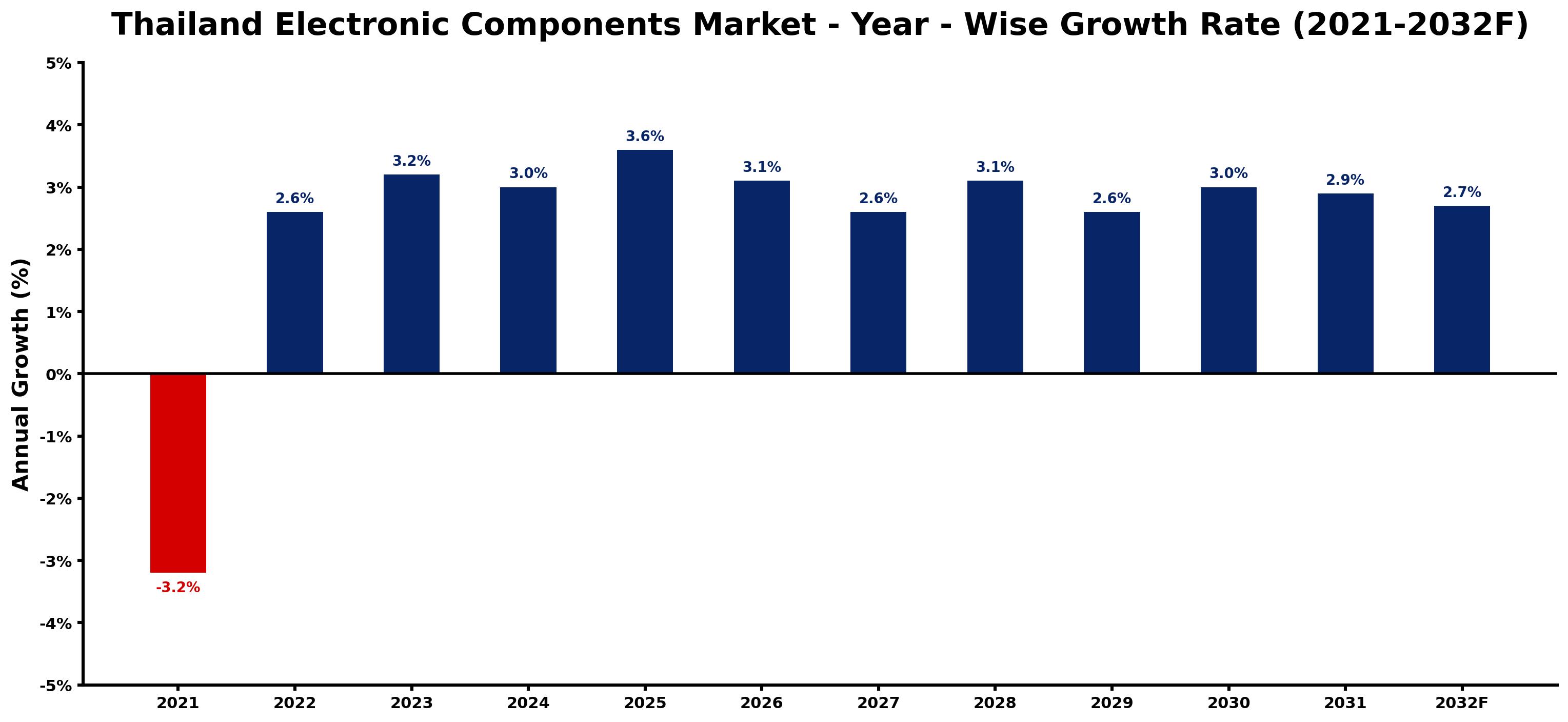
The table below presents the year wise growth rates along with the key drivers influencing the market
| Year | Growth Rate | Major Drivers |
| 2021 | -3.2% | Supply chain disruptions due to ongoing pandemicrelated restrictions hampered production capacity and delayed product availability. |
| 2022 | 2.6% | Supply chain disruptions highlighted the need for localized manufacturing solutions and partnerships. |
| 2023 | 3.2% | Investment in smart city initiatives boosted demand for advanced electronic components significantly. |
| 2024 | 3.0% | Emerging tech startups focused on IoT products increased competition for component suppliers. |
| 2025 | 3.6% | Infrastructure projects aimed at connecting rural areas drove electronics demand across Thailand. |
| 2026 | 3.1% | Shifts toward renewable energy sources created new markets for electronic components in Thailand. |
| 2027 | 2.6% | Upgrades in telecommunications infrastructure supported the rollout of 5G networks nationwide. |
| 2028 | 3.1% | Consumer preferences for smart home technologies resulted in higher demand for sensors and devices. |
| 2029 | 2.6% | International collaborations in electronics manufacturing strengthened Thailand's market position regionally. |
| 2030 | 3.0% | Cybersecurity concerns drove innovation in secure electronic components for various industries. |
| 2031 | 2.9% | Sustainability trends pushed manufacturers toward eco-friendly electronic component production methods. |
| 2032 | 2.7% | Technological advancements in AI integration created new opportunities within the electronic components sector. |
Note - Market size estimations and growth projections presented in this report are based on 6Wresearch's advanced forecasting approach, validated with industry datasets as of June 2026.
Thailand Electronic Components Market Synopsis
The Thailand Electronic Components Market is projected to reach 3.1% and witness significant growth during the forecast period (2026-2032). This expansion is anticipated at a compound annual growth rate (CAGR) of 5.1%, driven by increasing demands across consumer electronics and automotive sectors. The development of cutting-edge technologies in electronic components further bolsters this growth narrative, with substantial foreign investments establishing manufacturing plants within Thailand, thereby creating ample opportunities for local suppliers.
Thailand Electronic Components Market Growth Drivers
The growth of the Thailand electronic components market is underscored by various dynamic drivers, which include:
- The rising adoption of advanced technologies such as artificial intelligence and the Internet of Things (IoT) has fueled demand for sophisticated consumer electronics, necessitating a wide array of electronic components.
- The automotive industry's growth, highlighted by increasing sales in both domestic and international markets, is driving demand for essential electronic parts like sensors and encoders, which are vital for modern vehicle functionality.
- An uptick in the healthcare sector, driven by digital transformation, has further increased the need for reliable electronic components to support advanced medical devices and systems.
- Investment in manufacturing capabilities by global companies in Thailand is likely to enhance local production capacity, thereby reducing reliance on imports and further stimulating market growth.
- Innovation in electronic components, including the development of more efficient integrated circuits and semiconductor technologies, continues to create new opportunities in the market, attracting consumer interest and investment.
Thailand Electronic Components Market Challenges and Restraints
Despite the promising growth trajectory, the Thailand electronic components market faces several challenges that could hamper its progress:
- Price sensitivity remains a significant issue, particularly in urban areas where consumers are cautious in spending on high-value electronics, affecting overall market profitability.
- The ongoing effects of the Covid-19 pandemic have highlighted vulnerabilities in global supply chains, causing delays and increased costs that impact local manufacturers.
- Intense competition within the market can lead to pricing wars, which may negatively affect revenue margins for manufacturers striving to maintain market share.
- Regulatory challenges related to electronic waste and environmental concerns necessitate compliance investments, which could divert capital from innovation and growth.
- The rapid pace of technology change demands continuous adaptation from manufacturers, requiring substantial investment in research and development efforts to keep pace with market expectations.
Thailand Electronic Components Market Government Investment and Initiatives
The Thai government has recognized the importance of the electronic components sector in driving economic growth and is actively supporting the industry through various initiatives. Investments in infrastructure development, such as technology parks and industrial zones, aim to create an ecosystem conducive to innovation and production efficiency. Furthermore, government incentives for foreign direct investment, including tax benefits and streamlined regulatory processes, are designed to attract international companies to establish operations in Thailand. Programs aimed at strengthening human capital in the electronics sector through vocational training and educational initiatives are also underway, enhancing the skill set of the local workforce and ensuring a sustainable growth trajectory for the electronic components market.
Thailand Electronic Components Market Latest Developments (May 2025 - June 2026)
In the period from May 2025 to June 2026, the Thailand electronic components market has experienced notable developments. The industry has witnessed a resurgence in demand for semiconductors and printed circuit boards as supply chains begin to stabilize post-pandemic. Additionally, advancements in AI technology have prompted manufacturers to invest in R&D for next-generation electronic components, focusing on efficiency and sustainability. Collaborations between local universities and electronic firms have also increased, fostering innovation and enhancing the local talent pool. Continuous government efforts to streamline investment processes have led to an influx of new projects aimed at boosting manufacturing capacities in the region.
Thailand Electronic Components Market - Key Attractiveness of the Report
- 10 Years of Market Numbers
- Historical Data Starting from 2022 to 2025
- Base Year: 2025
- Forecast Data until 2032
- Key Performance Indicators Impacting the Market
- Major Upcoming Developments and Projects
Key Highlights of the Report:
- Thailand Electronic Components Market Outlook
- Market Size of Thailand Electronic Components Market, 2025
- Forecast of Thailand Electronic Components Market, 2032
- Historical Data and Forecast of Thailand Electronic Components Revenues & Volume for the Period 2022-2032F
- Thailand Electronic Components Market Trend Evolution
- Thailand Electronic Components Market Drivers and Challenges
- Thailand Electronic Components Price Trends
- Thailand Electronic Components Porter's Five Forces
- Thailand Electronic Components Industry Life Cycle
- Historical Data and Forecast of Thailand Electronic Components Market Revenues & Volume By Types for the Period 2022-2032F
- Historical Data and Forecast of Thailand Electronic Components Market Revenues & Volume By Passive for the Period 2022-2032F
- Historical Data and Forecast of Thailand Electronic Components Market Revenues & Volume By Active for the Period 2022-2032F
- Historical Data and Forecast of Thailand Electronic Components Market Revenues & Volume By Electro Mechanic for the Period 2022-2032F
- Historical Data and Forecast of Thailand Electronic Components Market Revenues & Volume By Applications for the Period 2022-2032F
- Historical Data and Forecast of Thailand Electronic Components Market Revenues & Volume By Automotive for the Period 2022-2032F
- Historical Data and Forecast of Thailand Electronic Components Market Revenues & Volume By Communications for the Period 2022-2032F
- Historical Data and Forecast of Thailand Electronic Components Market Revenues & Volume By Industrial for the Period 2022-2032F
- Historical Data and Forecast of Thailand Electronic Components Market Revenues & Volume By Computing Applications for the Period 2022-2032F
- Historical Data and Forecast of Thailand Electronic Components Market Revenues & Volume By Others for the Period 2022-2032F
- Thailand Electronic Components Import Export Trade Statistics
- Market Opportunity Assessment By Types
- Market Opportunity Assessment By Applications
- Thailand Electronic Components Top Companies Market Share
- Thailand Electronic Components Competitive Benchmarking By Technical and Operational Parameters
- Thailand Electronic Components Company Profiles
- Thailand Electronic Components Key Strategic Recommendations






































