United Kingdom (UK) Bathroom Linen Market Size, Share & Growth Rate
The United Kingdom (UK) Bathroom Linen Market was estimated at USD 211 Million in 2025 and is projected to reach USD 260 Million by 2032, growing at a CAGR of 3.0% from 2026 to 2032. This growth trajectory is primarily fueled by a heightened consumer interest in premium home décor products and a robust trend toward sustainable materials. Additionally, the convenience and variety offered by online retail platforms are further propelling market dynamics.
United Kingdom (UK) Bathroom Linen Market Year-wise Growth Rate and Key Drivers
This graph highlights how the United Kingdom (UK) Bathroom Linen Market has steadily grown over the years, supported by major growth factors.
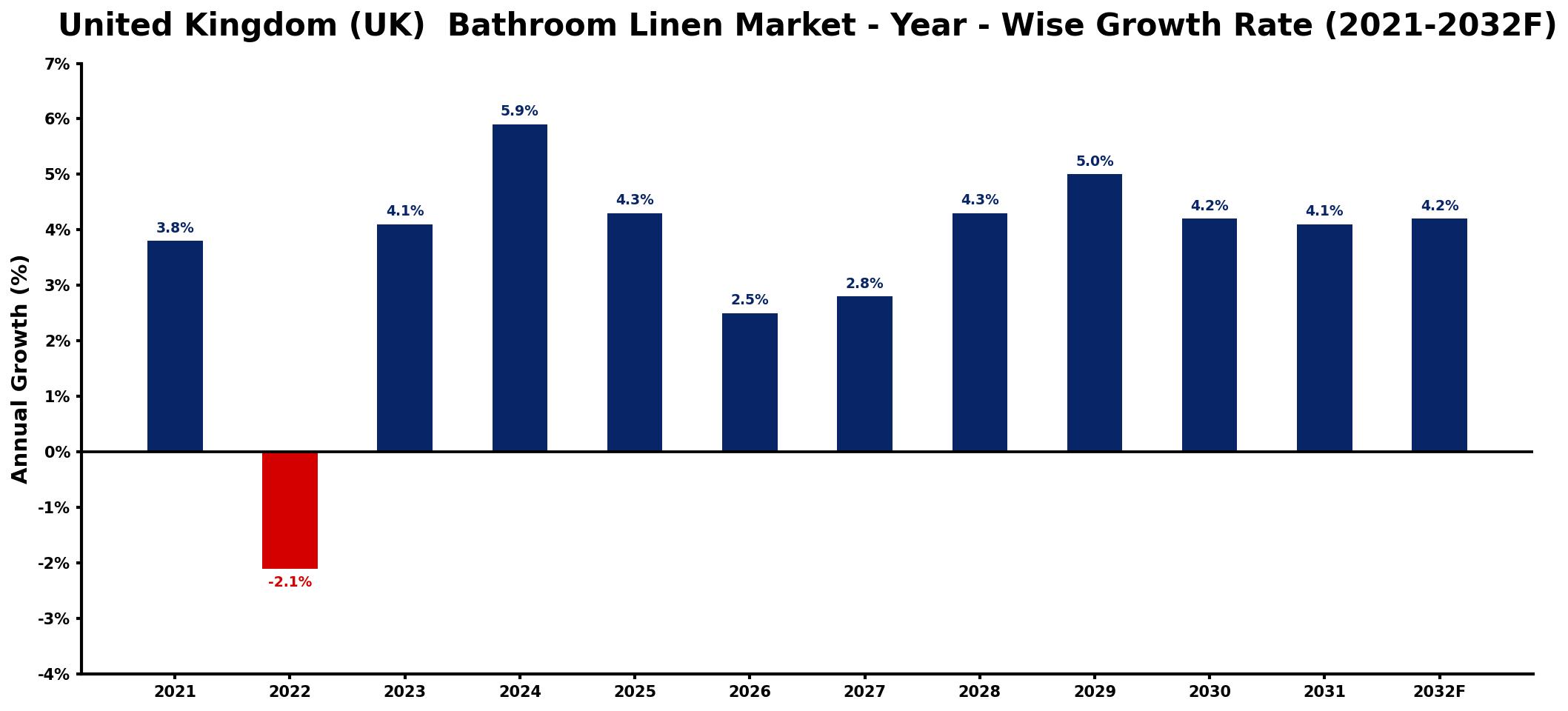
The table below presents the year‑wise growth rates along with the key drivers influencing the market
| Year | Growth Rate | Major Drivers |
| 2021 | 3.8% | Rising home improvement investments |
| 2022 | -2.1% | Decreased consumer spending patterns |
| 2023 | 4.1% | Increased online shopping trends |
| 2024 | 5.9% | Growing eco-friendly product demand |
| 2025 | 4.3% | Expanding luxury home market |
| 2026 | 2.5% | Enhanced retail distribution networks |
| 2027 | 2.8% | Surge in home renovation projects |
| 2028 | 4.3% | Boost in e-commerce sales growth |
| 2029 | 5.0% | Rising disposable income levels |
| 2030 | 4.2% | Increased focus on sustainability |
| 2031 | 4.1% | Growth in health and wellness |
| 2032 | 4.2% | Emergence of smart home technology |
Note: Market size estimations and growth projections presented in this report are based on 6Wresearch's proprietary forecasting methodology, utilizing the latest available industry data, government publications, and primary research inputs.
United Kingdom (UK) Bathroom Linen Market Synopsis
In recent years, the UK bathroom linen market has transformed into a vibrant landscape where quality meets style. The growing consumer preference for luxury and eco-conscious products is reshaping market offerings, leading to a surge in demand for organic and high-end bathroom textiles.
Amidst the competitive atmosphere, innovations in materials and designs have emerged, with a focus on sustainability and functionality. The expansion of e-commerce further enhances accessibility, allowing consumers to explore diverse options, thereby fostering a stronger market presence.
United Kingdom (UK) Bathroom Linen Market Key Takeaways
- The market is witnessing a shift towards sustainable, eco-friendly materials like organic cotton and bamboo.
- Rising consumer interest in luxury living standards is driving demand for premium bathroom linen products.
- Online retail channels are gaining significant traction, providing consumers with greater convenience and product variety.
- Design innovation, including bold patterns and multifunctional products, is key to attracting contemporary consumers.
- Challenges related to price competition and raw material costs are influencing market strategies.
Evaluation of Restraints in United Kingdom (UK) Bathroom Linen Market
Despite its growth potential, the UK bathroom linen market faces several constraints that could impede progress. Increasing competition, particularly from online retailers and international brands, intensifies pricing pressures. Furthermore, fluctuating raw material costs, stemming from global economic factors, pose a persistent challenge. Companies must also navigate the complexities introduced by Brexit, which has the potential to disrupt supply chains and increase operational costs. Addressing these issues requires strategic innovation and a commitment to quality while ensuring competitive pricing.
United Kingdom (UK) Bathroom Linen Market Trends
A significant trend in the UK bathroom linen market is the growing consumer demand for eco-friendly and sustainable products. Shoppers are increasingly inclined towards items that not only enhance their bathroom aesthetics but also contribute positively to the environment. Additionally, multi-functional bathroom linens are gaining popularity, appealing to consumers with limited space who desire practicality without compromising style. The market is also witnessing a rise in the popularity of unique and bold designs, emphasizing consumer interest in personalization and individuality within their homes.
United Kingdom (UK) Bathroom Linen Market Opportunities
The UK bathroom linen market presents several lucrative investment opportunities. The trend towards premium and eco-friendly products opens avenues for companies specializing in high-quality, sustainable materials. Moreover, the rapid growth of online retail channels provides a platform for reaching diverse customer demographics. Investing in innovative manufacturing technologies, such as antimicrobial fabrics and smart textiles, can further differentiate brands in this competitive landscape. Overall, aligning with consumer preferences for quality and sustainability will be key in seizing these market opportunities.
Government Initiatives in the United Kingdom (UK) Bathroom Linen Market
The UK government has established various policies aimed at fostering a competitive and sustainable bathroom linen market. Regulations surrounding consumer protection, such as the Consumer Rights Act, ensure that customers are safeguarded from misleading advertising and faulty products. Environmental policies encourage the use of sustainable materials and eco-friendly practices in production processes. Furthermore, fair trade initiatives support ethical sourcing and responsible labor standards within the industry, enhancing the overall integrity of the market.
Future Insights of the United Kingdom (UK) Bathroom Linen Market
Looking ahead to the period from 2026 to 2032, the United Kingdom bathroom linen market is poised for steady growth. The dual forces of consumer desire for home décor enhancements and a growing commitment to sustainable living will likely dictate market trends. The evolving luxury home experience, increasingly focused on comfort and aesthetics, will further catalyze demand for high-quality bathroom textiles. As companies innovate and adapt, the market will continue to evolve, presenting new opportunities for brands that can successfully align with consumer expectations.
United Kingdom (UK) Bathroom Linen Market Latest Developments (2025 - 2026)
Recent developments in the UK bathroom linen market indicate a significant shift toward innovative product offerings and sustainability initiatives. Many manufacturers are increasingly investing in research and development to create eco-friendly products that appeal to the environmentally-conscious consumer. Simultaneously, the rise of influencer marketing within e-commerce channels is reshaping how brands engage with their customers, enhancing visibility and driving sales.
United Kingdom (UK) Bathroom Linen Market - Key Attractiveness of the Report
- 10 Years of Market Numbers
- Historical Data Starting from 2022 to 2025
- Base Year: 2025
- Forecast Data until 2032
- Key Performance Indicators Impacting the Market
- Major Upcoming Developments and Projects
Key Highlights of the Report:
- United Kingdom (UK) Bathroom Linen Market Outlook
- Market Size of United Kingdom (UK) Bathroom Linen Market, 2025
- Forecast of United Kingdom (UK) Bathroom Linen Market, 2032
- Historical Data and Forecast of United Kingdom (UK) Bathroom Linen Revenues & Volume for the Period 2022-2032F
- United Kingdom (UK) Bathroom Linen Market Trend Evolution
- United Kingdom (UK) Bathroom Linen Market Drivers and Challenges
- United Kingdom (UK) Bathroom Linen Price Trends
- United Kingdom (UK) Bathroom Linen Porter's Five Forces
- United Kingdom (UK) Bathroom Linen Industry Life Cycle
- Historical Data and Forecast of United Kingdom (UK) Bathroom Linen Market Revenues & Volume By Product for the Period 2022-2032F
- Historical Data and Forecast of United Kingdom (UK) Bathroom Linen Market Revenues & Volume By Bath Towels for the Period 2022-2032F
- Historical Data and Forecast of United Kingdom (UK) Bathroom Linen Market Revenues & Volume By Bathrobes for the Period 2022-2032F
- Historical Data and Forecast of United Kingdom (UK) Bathroom Linen Market Revenues & Volume By Others for the Period 2022-2032F
- United Kingdom (UK) Bathroom Linen Import Export Trade Statistics
- Market Opportunity Assessment By Product
- United Kingdom (UK) Bathroom Linen Top Companies Market Share
- United Kingdom (UK) Bathroom Linen Competitive Benchmarking By Technical and Operational Parameters
- United Kingdom (UK) Bathroom Linen Company Profiles
- United Kingdom (UK) Bathroom Linen Key Strategic Recommendations






































