United Kingdom (UK) Curtains and Window Blinds Market Size, Share & Growth Rate
The United Kingdom (UK) Curtains and Window Blinds Market was estimated at USD 310 Million in 2025 and is projected to reach USD 447 Million by 2032, growing at a CAGR of 5.4% from 2026 to 2032. This upward trajectory is primarily fueled by an evolving consumer interest in home aesthetics, driven by rising disposable incomes and a desire for personalized living spaces. The shift towards energy-efficient and sustainable products is also playing a pivotal role in propelling market growth.
United Kingdom (UK) Curtains and Window Blinds Market Year-wise Growth Rate and Key Drivers
This graph highlights how the United Kingdom (UK) Curtains and Window Blinds Market has steadily grown over the years, supported by major growth factors.
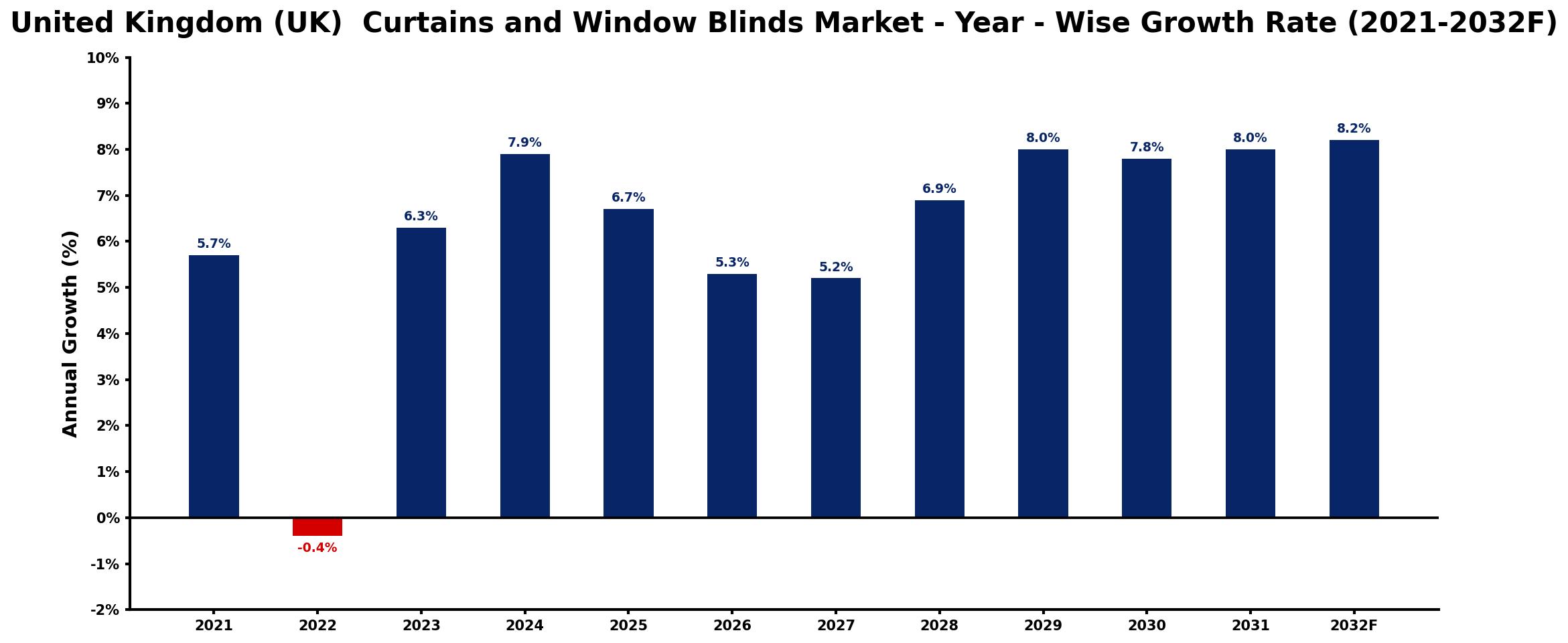
The table below presents the year‑wise growth rates along with the key drivers influencing the market
| Year | Growth Rate | Major Drivers |
| 2021 | 5.7% | Rising home renovation projects |
| 2022 | -0.4% | Reduced consumer spending confidence |
| 2023 | 6.3% | Increased disposable income levels |
| 2024 | 7.9% | Growing focus on interior design |
| 2025 | 6.7% | Expansion of online retail channels |
| 2026 | 5.3% | Higher demand for sustainable materials |
| 2027 | 5.2% | Increased investments in housing market |
| 2028 | 6.9% | Surge in home automation trends |
| 2029 | 8.0% | Growing popularity of smart homes |
| 2030 | 7.8% | Enhanced consumer awareness about aesthetics |
| 2031 | 8.0% | Rising demand for customization options |
| 2032 | 8.2% | expanding manufacturing base activity |
Note: Market size estimations and growth projections presented in this report are based on 6Wresearch's proprietary forecasting methodology, utilizing the latest available industry data, government publications, and primary research inputs.
United Kingdom (UK) Curtains and Window Blinds Market Synopsis
The UK Curtains and Window Blinds Market has established itself as a dynamic sector characterized by innovation and a blend of traditional and contemporary designs. With consumers increasingly valuing aesthetics and functionality, a variety of offerings, from classic curtains to modern smart blinds, cater to diverse tastes and preferences.
Sustainability continues to gain traction, as more consumers seek eco-friendly options made from recycled and organic materials. This growing awareness is reshaping product development strategies, compelling brands to innovate and meet the demands of an environmentally conscious market.
United Kingdom (UK) Curtains and Window Blinds Market Key Takeaways
- The market demonstrates robust growth potential, driven by increased consumer demand for stylish and functional home solutions.
- Customization and personalization are emerging as key differentiators, allowing brands to cater to unique consumer preferences.
- Technological advancements, particularly in smart window treatments, are redefining user experiences and convenience.
- Online retail channels are expanding rapidly, providing consumers with more accessibility to a diverse range of products.
- The trend towards sustainable materials is prompting manufacturers to innovate and develop eco-friendly product lines.
Evaluation of Restraints in United Kingdom (UK) Curtains and Window Blinds Market
Despite the promising outlook, the UK Curtains and Window Blinds Market faces several challenges that could hinder growth. Intense competition among both domestic and international players creates a saturated landscape where differentiation is paramount. Furthermore, fluctuations in consumer preferences can lead to rapid changes in market dynamics, compelling companies to adapt quickly. Economic uncertainties and rising raw material costs, particularly for premium fabrics, may strain profit margins. Additionally, the imperative to innovate continuously in response to consumer demand for sustainable solutions places pressure on manufacturers, who must align their practices with evolving market expectations.
United Kingdom (UK) Curtains and Window Blinds Market Trends
Currently, the market is witnessing a notable shift towards sustainable and energy-efficient window coverings. Consumers are increasingly prioritizing products made from recycled and organic materials, driven by environmental concerns. Customization remains a dominant trend, with consumers seeking tailor-made solutions that reflect their individual tastes and enhance their home environments. Furthermore, the incorporation of smart technology—such as motorized blinds and remote-controlled curtains—adds a layer of convenience and sophistication to window treatments, appealing to tech-savvy consumers. The minimalist design trend also continues to gain traction, as individuals strive to create serene and uncluttered living spaces.
United Kingdom (UK) Curtains and Window Blinds Market Opportunities
Investment opportunities abound in the UK Curtains and Window Blinds Market, particularly in areas such as energy-efficient window coverings and bespoke solutions. The growing consumer inclination towards customization opens up avenues for companies that can provide tailored options. Additionally, the digital shift towards online retailing presents significant opportunities for e-commerce platforms to expand their market share. By investing in innovative materials and integrating smart technologies, companies can differentiate themselves in this competitive landscape, appealing to a broader range of consumers and meeting the demand for stylish yet functional window treatments.
Government Initiatives in the United Kingdom (UK) Curtains and Window Blinds Market
The UK government is actively implementing policies that influence the Curtains and Window Blinds Market. Key initiatives focus on promoting product safety standards and energy efficiency, aligning with the sustainability trend prevalent in the industry. Regulations aim to ensure that consumers are protected while also encouraging manufacturers to adopt environmentally friendly practices. Furthermore, support for local businesses through funding and grants underscores the government's commitment to fostering growth in this sector. Recent trade regulations post-Brexit have also necessitated adjustments, impacting the dynamics of imports and exports in the curtains and blinds market.
Future Insights of the United Kingdom (UK) Curtains and Window Blinds Market
Looking ahead to 2026-2032, the UK Curtains and Window Blinds Market is poised for steady growth. Factors driving this momentum include an increasing focus on home décor, consumer renovation projects, and an escalating interest in energy-efficient window treatments. Technological innovations, particularly in smart blinds and home automation, are expected to further enhance market demand. Additionally, the rise of e-commerce and the trend towards personalized products will likely create new opportunities for market expansion. However, stakeholders must remain cognizant of economic fluctuations and competition from alternative solutions as they navigate this evolving landscape.
United Kingdom (UK) Curtains and Window Blinds Market Latest Developments (2025 - 2026)
Recent developments in the UK Curtains and Window Blinds Market reflect a growing focus on sustainability and smart technology. Manufacturers are increasingly launching products designed to meet eco-friendly standards while incorporating smart features for enhanced usability. This trend is indicative of a broader shift towards innovation, with brands adapting to emerging consumer preferences. Online sales channels continue to expand, providing consumers with greater access to an array of stylish options. Overall, the landscape is evolving rapidly as the industry responds to both consumer demands and technological advancements.
United Kingdom (UK) Curtains and Window Blinds Market - Key Attractiveness of the Report
- 10 Years of Market Numbers
- Historical Data Starting from 2022 to 2025
- Base Year: 2025
- Forecast Data until 2032
- Key Performance Indicators Impacting the Market
- Major Upcoming Developments and Projects
Key Highlights of the Report:
- United Kingdom (UK) Curtains and Window Blinds Market Outlook
- Market Size of United Kingdom (UK) Curtains and Window Blinds Market, 2025
- Forecast of United Kingdom (UK) Curtains and Window Blinds Market, 2032
- Historical Data and Forecast of United Kingdom (UK) Curtains and Window Blinds Revenues & Volume for the Period 2022-2032F
- United Kingdom (UK) Curtains and Window Blinds Market Trend Evolution
- United Kingdom (UK) Curtains and Window Blinds Market Drivers and Challenges
- United Kingdom (UK) Curtains and Window Blinds Price Trends
- United Kingdom (UK) Curtains and Window Blinds Porter's Five Forces
- United Kingdom (UK) Curtains and Window Blinds Industry Life Cycle
- Historical Data and Forecast of United Kingdom (UK) Curtains and Window Blinds Market Revenues & Volume By Materials for the Period 2022-2032F
- Historical Data and Forecast of United Kingdom (UK) Curtains and Window Blinds Market Revenues & Volume By Curtains (Cotton, Linen, Polyester) for the Period 2022-2032F
- Historical Data and Forecast of United Kingdom (UK) Curtains and Window Blinds Market Revenues & Volume By Window Blinds (Cotton, Linen, Wood, PVC, Metal) for the Period 2022-2032F
- Historical Data and Forecast of United Kingdom (UK) Curtains and Window Blinds Market Revenues & Volume By Product for the Period 2022-2032F
- Historical Data and Forecast of United Kingdom (UK) Curtains and Window Blinds Market Revenues & Volume By Curtains (Box pleat curtains, Pinch pleat curtains & drapery, Goblet pleat curtains & drapery, Eyelet curtains & drapery) for the Period 2022-2032F
- Historical Data and Forecast of United Kingdom (UK) Curtains and Window Blinds Market Revenues & Volume By Window Blinds (Window Shades,, Window Screens, Connected) for the Period 2022-2032F
- Historical Data and Forecast of United Kingdom (UK) Curtains and Window Blinds Market Revenues & Volume By Distribution Channel for the Period 2022-2032F
- Historical Data and Forecast of United Kingdom (UK) Curtains and Window Blinds Market Revenues & Volume By B2B for the Period 2022-2032F
- Historical Data and Forecast of United Kingdom (UK) Curtains and Window Blinds Market Revenues & Volume By B2C for the Period 2022-2032F
- Historical Data and Forecast of United Kingdom (UK) Curtains and Window Blinds Market Revenues & Volume By E-commerce for the Period 2022-2032F
- Historical Data and Forecast of United Kingdom (UK) Curtains and Window Blinds Market Revenues & Volume By Price Range for the Period 2022-2032F
- Historical Data and Forecast of United Kingdom (UK) Curtains and Window Blinds Market Revenues & Volume By High for the Period 2022-2032F
- Historical Data and Forecast of United Kingdom (UK) Curtains and Window Blinds Market Revenues & Volume By Medium for the Period 2022-2032F
- Historical Data and Forecast of United Kingdom (UK) Curtains and Window Blinds Market Revenues & Volume By Low for the Period 2022-2032F
- United Kingdom (UK) Curtains and Window Blinds Import Export Trade Statistics
- Market Opportunity Assessment By Materials
- Market Opportunity Assessment By Product
- Market Opportunity Assessment By Distribution Channel
- Market Opportunity Assessment By Price Range
- United Kingdom (UK) Curtains and Window Blinds Top Companies Market Share
- United Kingdom (UK) Curtains and Window Blinds Competitive Benchmarking By Technical and Operational Parameters
- United Kingdom (UK) Curtains and Window Blinds Company Profiles
- United Kingdom (UK) Curtains and Window Blinds Key Strategic Recommendations






































