United States (US) Gold Plating Chemicals Market Size, Share & Growth Rate
The United States (US) Gold Plating Chemicals Market was estimated at USD 91 Million in 2025 and is projected to reach USD 106 Million by 2032, growing at a CAGR of 2.2% from 2026 to 2032. This growth trajectory is driven by the increasing consumer preference for gold-plated products, particularly in the electronics and jewelry sectors. Additionally, the automotive and aerospace industries are actively adopting gold plating for its superior conductivity and aesthetic appeal, further propelling market demand.
United States (US) Gold Plating Chemicals Market Year-wise Growth Rate and Key Drivers
This graph highlights how the United States (US) Gold Plating Chemicals Market has steadily grown over the years, supported by major growth factors.
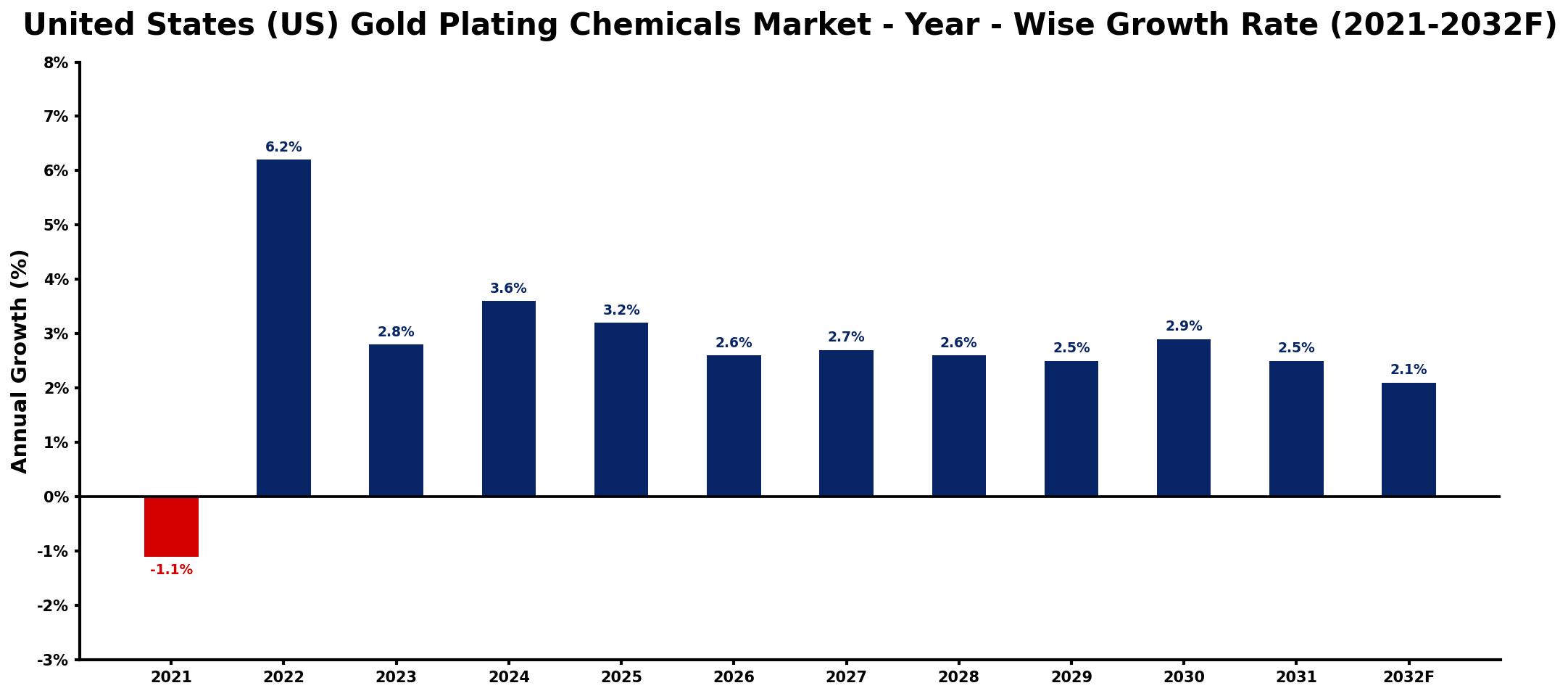
The table below presents the year‑wise growth rates along with the key drivers influencing the market
| Year | Growth Rate | Major Drivers |
| 2021 | -1.1% | Decrease in manufacturing activities |
| 2022 | 6.2% | Rising demand from electronics sector |
| 2023 | 2.8% | Increased investment in automotive industry |
| 2024 | 3.6% | Growth in renewable energy applications |
| 2025 | 3.2% | Expansion of aerospace technologies |
| 2026 | 2.6% | Surge in consumer electronics production |
| 2027 | 2.7% | Advancements in telecommunications infrastructure |
| 2028 | 2.6% | Growing markets for jewelry manufacturing |
| 2029 | 2.5% | Increased focus on sustainable practices |
| 2030 | 2.9% | increased overall sector activity |
| 2031 | 2.5% | stronger distribution network expansion |
| 2032 | 2.1% | increased domestic production output |
Note: Market size estimations and growth projections presented in this report are based on 6Wresearch's proprietary forecasting methodology, utilizing the latest available industry data, government publications, and primary research inputs.
United States (US) Gold Plating Chemicals Market Synopsis
Recently, the US Gold Plating Chemicals Market has experienced substantial momentum, primarily fueled by an uptick in luxury and personalized goods. However, as the market evolves, manufacturers are increasingly tasked with navigating environmental regulations and fluctuating raw material costs, which will shape future growth.
Looking ahead, the integration of innovative technologies and environmentally friendly formulations will likely redefine industry standards. While the demand for traditional gold plating solutions remains robust, the market is shifting towards sustainable practices that align with consumer expectations for ethical sourcing and minimal environmental impact.
United States (US) Gold Plating Chemicals Market Key Takeaways
- The market is set for steady growth, driven by rising consumer demand in sectors like electronics, automotive, and jewelry.
- Manufacturers are increasingly focusing on sustainable and environmentally friendly gold plating solutions.
- Technological innovations are leading to enhanced durability and aesthetic appeal of gold-plated products.
- Fluctuating gold prices and regulatory pressures pose ongoing challenges for manufacturers in maintaining profitability.
- The trend towards customization and personalized luxury items is reshaping product offerings in the market.
Evaluation of Restraints in United States (US) Gold Plating Chemicals Market
The US Gold Plating Chemicals Market faces several significant restraints that could limit its growth potential. One of the primary challenges is the volatility of gold prices, which directly affects the cost of raw materials required for gold plating processes. This price fluctuation can lead to unpredictable profit margins for manufacturers. Furthermore, stringent environmental regulations regarding hazardous chemicals pose a compliance burden, requiring companies to invest in sustainable practices and technologies. The emergence of alternative materials, which provide similar aesthetic qualities at a lower cost, also presents a competitive challenge for traditional gold plating chemicals. Navigating these restraints while leveraging opportunities for innovation is crucial for market players.
United States (US) Gold Plating Chemicals Market Trends
Several current and emerging trends are shaping the demand for gold plating chemicals in the United States. Notably, there is a marked shift towards environmentally friendly formulations as consumers increasingly prioritize sustainable products. Companies are investing in research and development to create innovative chemicals that not only meet aesthetic requirements but also adhere to strict environmental standards. Additionally, the customization trend is growing; consumers are actively seeking unique, personalized gold-plated items, driving manufacturers to offer tailored solutions that cater to this demand.
United States (US) Gold Plating Chemicals Market Opportunities
The US Gold Plating Chemicals Market is ripe with investment opportunities, particularly for companies that focus on innovative and eco-friendly solutions. The ongoing demand for gold-plated products across various industries indicates a stable market for potential investors. Moreover, initiatives surrounding sustainability and ethical sourcing are creating avenues for businesses that prioritize these practices. Advancements in research and development present a chance to create next-generation formulations, allowing companies to capture a more significant market share and enhance long-term profitability.
Government Initiatives in the United States (US) Gold Plating Chemicals Market
Government policies impacting the US Gold Plating Chemicals Market primarily center around regulations established by bodies such as the Environmental Protection Agency (EPA) and the Occupational Safety and Health Administration (OSHA). These regulations are designed to ensure safe chemical handling and disposal practices, thereby protecting both the environment and worker safety. Compliance with these standards is crucial for businesses, as it not only helps avoid potential legal repercussions but also enhances company reputation in a market increasingly conscious of sustainability.
Future Insights of the United States (US) Gold Plating Chemicals Market
The outlook for the United States Gold Plating Chemicals Market through 2026-2032 is optimistic. Steady growth is anticipated, driven by the increasing demand in sectors such as electronics, automotive, and jewelry. Technological advancements in gold plating chemicals will enhance product efficiency and quality, making these offerings more attractive. Additionally, the personalization trend is expected to further boost the adoption of gold plating. Nonetheless, stakeholders must remain vigilant to fluctuating raw material costs and stringent regulatory frameworks, as these factors could impact growth dynamics.
United States (US) Gold Plating Chemicals Market Latest Developments (2025 - 2026)
Recent developments in the US Gold Plating Chemicals Market indicate a strong shift towards sustainability. Numerous manufacturers are launching innovative, eco-friendly chemical formulations that comply with emerging environmental regulations. Meanwhile, as consumer trends shift towards personalized luxury items, companies are increasingly offering customization options in their gold plating services. The industry's focus on enhancing durability and aesthetic appeal through technological advancements remains paramount, as players strive to meet evolving market demands.
United States (US) Gold Plating Chemicals Market - Key Attractiveness of the Report
- 10 Years of Market Numbers
- Historical Data Starting from 2022 to 2025
- Base Year: 2025
- Forecast Data until 2032
- Key Performance Indicators Impacting the Market
- Major Upcoming Developments and Projects
Key Highlights of the Report:
- United States (US) Gold Plating Chemicals Market Outlook
- Market Size of United States (US) Gold Plating Chemicals Market, 2025
- Forecast of United States (US) Gold Plating Chemicals Market, 2032
- Historical Data and Forecast of United States (US) Gold Plating Chemicals Revenues & Volume for the Period 2022-2032F
- United States (US) Gold Plating Chemicals Market Trend Evolution
- United States (US) Gold Plating Chemicals Market Drivers and Challenges
- United States (US) Gold Plating Chemicals Price Trends
- United States (US) Gold Plating Chemicals Porter's Five Forces
- United States (US) Gold Plating Chemicals Industry Life Cycle
- Historical Data and Forecast of United States (US) Gold Plating Chemicals Market Revenues & Volume By Product Type for the Period 2022-2032F
- Historical Data and Forecast of United States (US) Gold Plating Chemicals Market Revenues & Volume By Cleaning Chemicals for the Period 2022-2032F
- Historical Data and Forecast of United States (US) Gold Plating Chemicals Market Revenues & Volume By Pre-treaters for the Period 2022-2032F
- Historical Data and Forecast of United States (US) Gold Plating Chemicals Market Revenues & Volume By Electrolyte Solutions for the Period 2022-2032F
- Historical Data and Forecast of United States (US) Gold Plating Chemicals Market Revenues & Volume By Acids for the Period 2022-2032F
- Historical Data and Forecast of United States (US) Gold Plating Chemicals Market Revenues & Volume By Additives for the Period 2022-2032F
- Historical Data and Forecast of United States (US) Gold Plating Chemicals Market Revenues & Volume By Others for the Period 2022-2032F
- Historical Data and Forecast of United States (US) Gold Plating Chemicals Market Revenues & Volume By Chemical Type for the Period 2022-2032F
- Historical Data and Forecast of United States (US) Gold Plating Chemicals Market Revenues & Volume By Potassium Gold Cyanide for the Period 2022-2032F
- Historical Data and Forecast of United States (US) Gold Plating Chemicals Market Revenues & Volume By Palladium acetate for the Period 2022-2032F
- Historical Data and Forecast of United States (US) Gold Plating Chemicals Market Revenues & Volume By Sodium succinate for the Period 2022-2032F
- Historical Data and Forecast of United States (US) Gold Plating Chemicals Market Revenues & Volume By Succinic acid for the Period 2022-2032F
- Historical Data and Forecast of United States (US) Gold Plating Chemicals Market Revenues & Volume By EDTA for the Period 2022-2032F
- Historical Data and Forecast of United States (US) Gold Plating Chemicals Market Revenues & Volume By Others for the Period 2022-2032F
- Historical Data and Forecast of United States (US) Gold Plating Chemicals Market Revenues & Volume By Application for the Period 2022-2032F
- Historical Data and Forecast of United States (US) Gold Plating Chemicals Market Revenues & Volume By Jewellery for the Period 2022-2032F
- Historical Data and Forecast of United States (US) Gold Plating Chemicals Market Revenues & Volume By Infrared Reflectors for the Period 2022-2032F
- Historical Data and Forecast of United States (US) Gold Plating Chemicals Market Revenues & Volume By Grating for the Period 2022-2032F
- United States (US) Gold Plating Chemicals Import Export Trade Statistics
- Market Opportunity Assessment By Product Type
- Market Opportunity Assessment By Chemical Type
- Market Opportunity Assessment By Application
- United States (US) Gold Plating Chemicals Top Companies Market Share
- United States (US) Gold Plating Chemicals Competitive Benchmarking By Technical and Operational Parameters
- United States (US) Gold Plating Chemicals Company Profiles
- United States (US) Gold Plating Chemicals Key Strategic Recommendations






































