Venezuela Construction Aggregates Market Size, Share & Growth Rate
The Venezuela Construction Aggregates Market was estimated at USD 444 Million in 2025 and is projected to reach USD 611 Million by 2032, growing at a CAGR of 4.7% from 2026 to 2032. This growth trajectory is driven primarily by increased government spending on infrastructure projects aimed at revitalizing the country's beleaguered economy and improving connectivity. The ongoing construction of roads, bridges, and public facilities is expected to sustain demand for essential aggregates such as sand, gravel, and crushed stone, creating a conducive environment for market expansion.
Venezuela Construction Aggregates Market Year-wise Growth Rate and Key Drivers
This graph highlights how the Venezuela Construction Aggregates Market has steadily grown over the years, supported by major growth factors.
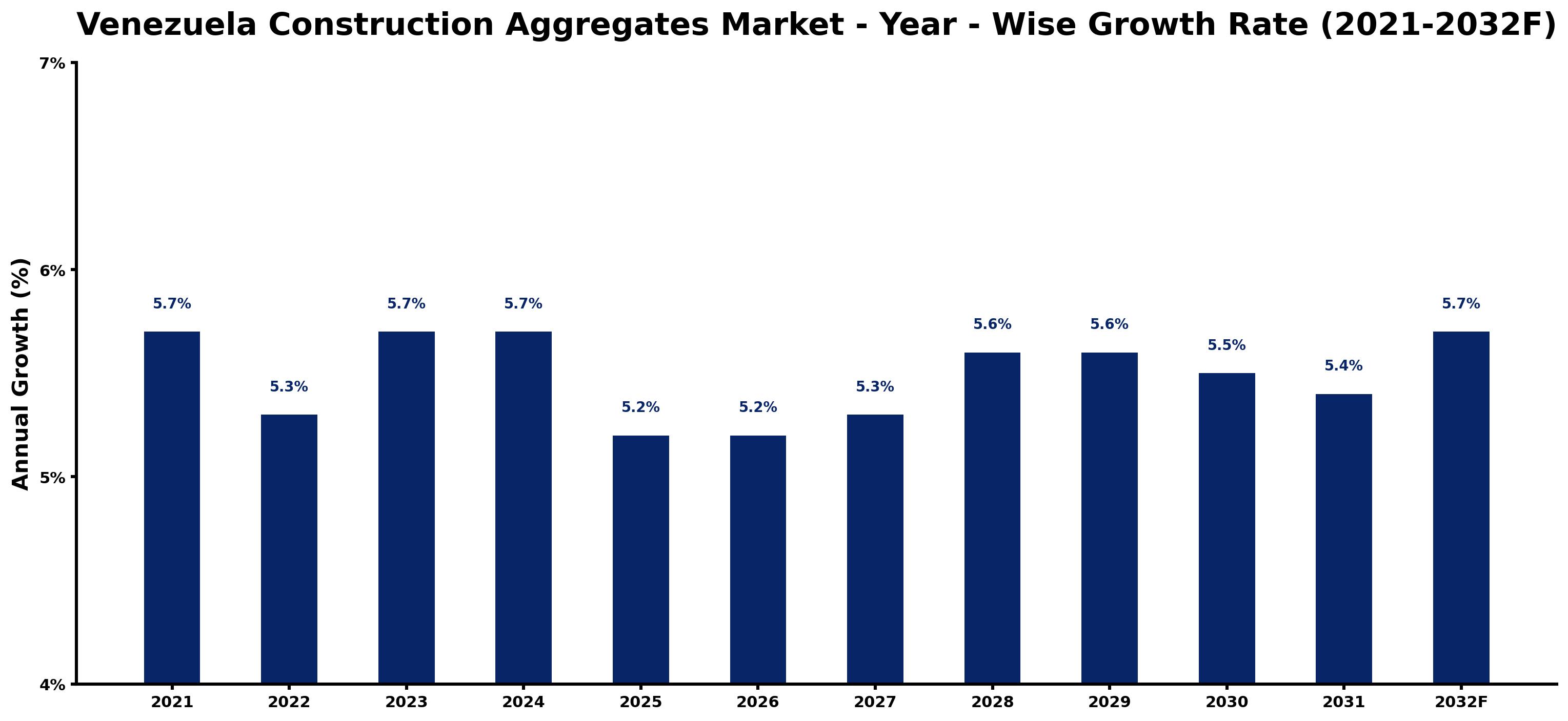
The table below presents the year‑wise growth rates along with the key drivers influencing the market
| Year | Growth Rate | Major Drivers |
| 2021 | 5.7% | Increasing industrial infrastructure investments |
| 2022 | 5.3% | Rising electricity demand across industries |
| 2023 | 5.7% | Government infrastructure modernization initiatives |
| 2024 | 5.7% | Increasing industrial automation investments |
| 2025 | 5.2% | Increasing smart city development projects |
| 2026 | 5.2% | Expansion of transportation and logistics networks |
| 2027 | 5.3% | Rapid growth in telecom and data center sectors |
| 2028 | 5.6% | Expansion of transportation and logistics networks |
| 2029 | 5.6% | Rapid growth in telecom and data center sectors |
| 2030 | 5.5% | Increasing smart city development projects |
| 2031 | 5.4% | Increasing industrial infrastructure investments |
| 2032 | 5.7% | Increasing adoption of advanced technologies |
Note - Market size estimations and growth projections presented in this report are based on 6Wresearch's advanced forecasting approach, validated with industry datasets as of June 2026.
Venezuela Construction Aggregates Market Synopsis
The demand for construction aggregates in Venezuela is notably influenced by the urgent need for infrastructure repair and development. In light of deteriorating conditions, local governments are prioritizing infrastructure projects that require substantial amounts of construction aggregates, thereby stimulating market activity.
On the supply side, advancements in technology and a growing focus on sustainable practices are reshaping production methods. Companies are increasingly integrating recycled materials into their offerings, aligning with global trends towards environmentally responsible construction practices.
Venezuela Construction Aggregates Market Key Takeaways
- The construction aggregates market is on a path of steady growth, bolstered by government initiatives aimed at infrastructure improvement.
- Sustainability is becoming a cornerstone of the industry, with rising use of recycled and eco-friendly materials.
- Political and economic factors significantly impact market dynamics, creating an environment of uncertainty.
- Investors have potential opportunities in the production and supply of aggregates to support critical infrastructure projects.
- Quality control and product innovation are increasingly important in meeting the demands of modern construction projects.
Evaluation of Restraints in Venezuela Construction Aggregates Market
The Venezuela Construction Aggregates Market is constrained by a combination of factors including ongoing political instability and an unstable economy. These elements have led to fluctuating construction activity and diminished investment appetite among stakeholders. Additionally, the scarcity of raw materials and limited access to advanced production technologies significantly hinder operational efficiencies. The macroeconomic situation, characterized by hyperinflation and currency volatility, further complicates cost structures, making it challenging for companies to maintain competitive pricing in an already tough market.
Venezuela Construction Aggregates Market Trends
A significant trend shaping the Venezuela Construction Aggregates Market is the increasing commitment to sustainability. The industry's shift towards using recycled aggregates reflects heightened awareness about the environmental impacts associated with conventional extraction methods. Moreover, the ongoing demand for high-quality aggregates in infrastructure projects underscores a growing focus on quality assurance and technological advancements in production processes. Alongside these trends, government initiatives are beginning to create a favorable climate for construction activities, paving the way for further innovation and growth.
Venezuela Construction Aggregates Market Opportunities
Opportunities abound in the Venezuela Construction Aggregates Market, particularly as the government seeks to stimulate economic growth through infrastructure investments. The construction of new roads, bridges, and residential developments necessitates a reliable supply of aggregates, presenting an attractive prospect for investors. Additionally, the push for sustainable construction methods opens avenues for companies that can deliver eco-friendly aggregates. Thorough market research and risk assessments will be essential for entities looking to capitalize on these growth opportunities while navigating the complexities of the local economic landscape.
Government Initiatives in the Venezuela Construction Aggregates Market
Government policies have a significant impact on the Venezuela Construction Aggregates Market, primarily through regulations governing mining activities and control over mineral resources. The Venezuelan government has undertaken steps to nationalize certain key operations and enforce price controls, which can create a challenging environment for aggregate suppliers. However, public spending initiatives focused on infrastructure development indicate a willingness to invest in the construction sector, aiming to stimulate economic activity and enhance the overall business landscape.
Future Insights of the Venezuela Construction Aggregates Market
Looking ahead, the future of the Venezuela Construction Aggregates Market appears to be closely tied to the country's economic recovery and stabilization efforts. While challenges persist, potential increases in government-backed infrastructure projects may provide essential support to aggregate demand. Additionally, the market will likely experience further integration of sustainable practices, driven by both regulatory pressures and consumer preferences. As the local and global economic landscapes evolve, stakeholders will need to remain agile, adapting to new opportunities and challenges alike.
Venezuela Construction Aggregates Market Latest Developments (May 2025 - June 2026)
In recent months, the Venezuela Construction Aggregates Market has witnessed a surge in governmental focus on infrastructure rehabilitation, with announcements of several upcoming projects intended to address deteriorating public facilities. Concurrently, industry players are increasingly adopting innovative technologies to enhance production capabilities and minimize environmental impact. Amid these developments, the local market is also observing a gradual shift toward more sustainable and efficient production methodologies, aligning with global industry trends.
Venezuela Construction Aggregates Market - Key Attractiveness of the Report
- 10 Years of Market Numbers
- Historical Data Starting from 2022 to 2025
- Base Year: 2025
- Forecast Data until 2032
- Key Performance Indicators Impacting the Market
- Major Upcoming Developments and Projects
Key Highlights of the Report:
- Venezuela Construction Aggregates Market Outlook
- Market Size of Venezuela Construction Aggregates Market, 2025
- Forecast of Venezuela Construction Aggregates Market, 2032
- Historical Data and Forecast of Venezuela Construction Aggregates Revenues & Volume for the Period 2022-2032F
- Venezuela Construction Aggregates Market Trend Evolution
- Venezuela Construction Aggregates Market Drivers and Challenges
- Venezuela Construction Aggregates Price Trends
- Venezuela Construction Aggregates Porter's Five Forces
- Venezuela Construction Aggregates Industry Life Cycle
- Historical Data and Forecast of Venezuela Construction Aggregates Market Revenues & Volume By Product Type for the Period 2022-2032F
- Historical Data and Forecast of Venezuela Construction Aggregates Market Revenues & Volume By Crushed stone for the Period 2022-2032F
- Historical Data and Forecast of Venezuela Construction Aggregates Market Revenues & Volume By Sand for the Period 2022-2032F
- Historical Data and Forecast of Venezuela Construction Aggregates Market Revenues & Volume By Gravel for the Period 2022-2032F
- Historical Data and Forecast of Venezuela Construction Aggregates Market Revenues & Volume By Other aggregates for the Period 2022-2032F
- Historical Data and Forecast of Venezuela Construction Aggregates Market Revenues & Volume By Applications for the Period 2022-2032F
- Historical Data and Forecast of Venezuela Construction Aggregates Market Revenues & Volume By Commercial for the Period 2022-2032F
- Historical Data and Forecast of Venezuela Construction Aggregates Market Revenues & Volume By Residential for the Period 2022-2032F
- Historical Data and Forecast of Venezuela Construction Aggregates Market Revenues & Volume By Industrial for the Period 2022-2032F
- Historical Data and Forecast of Venezuela Construction Aggregates Market Revenues & Volume By Infrastructure for the Period 2022-2032F
- Venezuela Construction Aggregates Import Export Trade Statistics
- Market Opportunity Assessment By Product Type
- Market Opportunity Assessment By Applications
- Venezuela Construction Aggregates Top Companies Market Share
- Venezuela Construction Aggregates Competitive Benchmarking By Technical and Operational Parameters
- Venezuela Construction Aggregates Company Profiles
- Venezuela Construction Aggregates Key Strategic Recommendations






































