Venezuela Prepaid Cards Market Size, Share & Growth Rate
The Venezuela Prepaid Cards Market was estimated at USD 541 Million in 2025 and is projected to reach USD 995 Million by 2032, growing at a CAGR of 9.1% from 2026 to 2032. This growth is primarily driven by the increasing adoption of electronic payment methods and a significant shift towards digital solutions among Venezuelan consumers. The convenience offered by prepaid cards, particularly in light of the countrys economic challenges, is fostering a more inclusive financial landscape.
Venezuela Prepaid Cards Market Year-wise Growth Rate and Key Drivers
This graph highlights how the Venezuela Prepaid Cards Market has steadily grown over the years, supported by major growth factors.
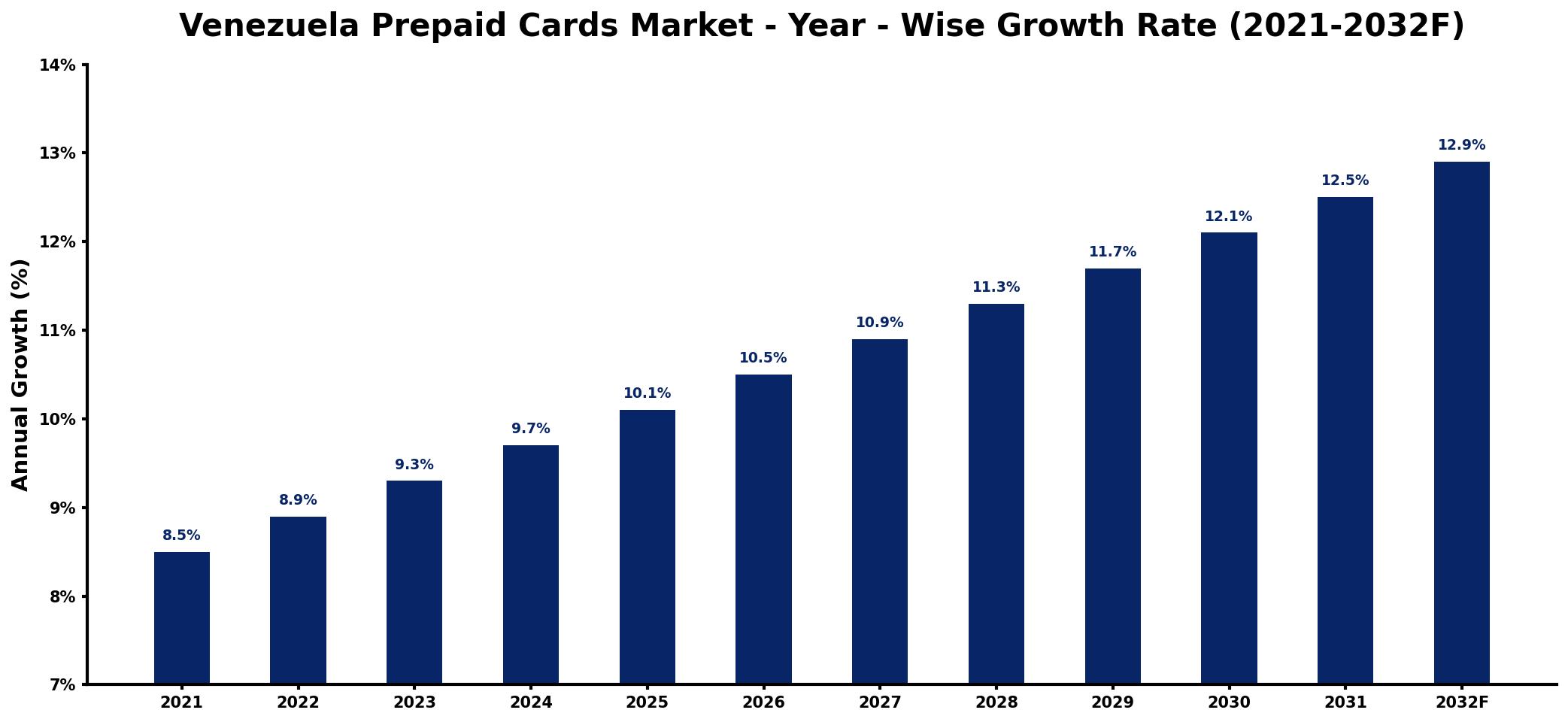
The table below presents the year‑wise growth rates along with the key drivers influencing the market
| Year | Growth Rate | Major Drivers |
| 2021 | 8.5% | Rising digital payment adoption |
| 2022 | 8.9% | Increased consumer confidence levels |
| 2023 | 9.3% | Expansion of financial technology services |
| 2024 | 9.7% | Growing e-commerce transaction volumes |
| 2025 | 10.1% | Enhanced mobile payment solutions |
| 2026 | 10.5% | Investment in financial infrastructure |
| 2027 | 10.9% | Strengthening regulatory frameworks established |
| 2028 | 11.3% | Wider acceptance at retail outlets |
| 2029 | 11.7% | Development of loyalty reward programs |
| 2030 | 12.1% | Emergence of innovative fintech startups |
| 2031 | 12.5% | Improvement in cross-border transactions |
| 2032 | 12.9% | Rising interest in digital wallets |
Note: Market size estimations and growth projections presented in this report are based on 6Wresearch's proprietary forecasting methodology, utilizing the latest available industry data, government publications, and primary research inputs.
Venezuela Prepaid Cards Market Synopsis
In recent years, the Venezuela prepaid cards market has witnessed a gradual momentum, bolstered by the rising demand for secure, cashless transactions. However, economic volatility and currency devaluation continue to pose challenges, potentially stalling progress in this evolving sector.
Looking ahead, the market is expected to navigate these hurdles while also tapping into growing consumer segments seeking digital payment solutions. Innovations in mobile and digital wallets are set to redefine consumer experience, catering specifically to the unique needs of Venezuelans.
Venezuela Prepaid Cards Market Key Takeaways
- Steady growth projected as consumer preferences shift towards cashless payment solutions.
- Diverse range of prepaid cards available to cater to varying consumer needs.
- Technological advancements driving the adoption of digital wallets and mobile-based payments.
- Government regulations affecting market accessibility and operational frameworks.
- Significant investment opportunities arise from a largely unbanked population seeking financial inclusion.
Evaluation of Restraints in Venezuela Prepaid Cards Market
Several factors limit the full potential of the Venezuela prepaid cards market. The pervasive economic instability, characterized by hyperinflation and currency devaluation, complicates pricing strategies for card providers. This volatility creates consumer uncertainty, which further stifles adoption. Moreover, stringent government regulations surrounding financial transactions impose additional operational constraints. The resulting lack of trust in financial institutions adds to the challenge, hindering widespread acceptance and use of prepaid cards.
Venezuela Prepaid Cards Market Trends
Current trends indicate a robust movement towards digital solutions within the Venezuela prepaid cards market. The rapid increase in smartphone adoption and internet accessibility is driving consumer preference for mobile wallets and virtual prepaid cards. Additionally, there is a noticeable demand for prepaid products that cater to specific use cases, such as remittances, online shopping, and utility payments. As the market continues to evolve, regulatory changes promoting financial inclusion are likely to enhance transparency and consumer protection, further shaping demand.
Venezuela Prepaid Cards Market Opportunities
The landscape for investment in the Venezuela prepaid cards market is encouraging. With a large unbanked population and increasing demand for secure payment methods, opportunities abound for partnerships with local financial institutions to issue innovative prepaid cards. Developing tailored solutions that resonate with the unique challenges faced by Venezuelans—such as remittance services and online shopping options—can yield significant dividends. Moreover, leveraging technology to improve user experience and enhance security features presents a valuable avenue for growth. Expanding distribution channels and collaborating with retailers could also capitalize on the rising demand for prepaid cards.
Government Initiatives in the Venezuela Prepaid Cards Market
Government policies concerning prepaid cards in Venezuela reflect a response to economic challenges and the need for enhanced financial oversight. Strict regulations aim to combat currency manipulation and illegal transactions, creating a structured environment for electronic money. Decrees from the government have sought to regulate electronic transactions, including the use of prepaid cards, thereby fostering a degree of control over financial flows. However, such regulations also impose limitations on the number of funds that can be loaded onto these cards, affecting market expansion.
Future Insights of the Venezuela Prepaid Cards Market
As we look toward the future, the Venezuela prepaid cards market is expected to encounter continued challenges stemming from ongoing economic and political instability. However, certain sectors, particularly digital payments and remittance services, are poised for potential growth. The need for accessible financial solutions is likely to spur innovation as businesses adapt to the changing landscape. Over the next few years, market players will need to embrace resilience and develop creative strategies to meet evolving consumer demands in this complex environment.
Venezuela Prepaid Cards Market Latest Developments (2025 - 2026)
Recent developments in the Venezuela prepaid cards market have highlighted a strong inclination towards mobile payment solutions. As technological advancements continue to emerge, there is a noticeable increase in partnerships aimed at enhancing digital wallet capabilities. Industry players are actively exploring innovative features that provide consumers with more flexible payment options, especially in a climate of economic uncertainty. As regulatory frameworks evolve, providers are also seeking ways to align their offerings with government initiatives that promote financial inclusion.
Venezuela Prepaid Cards Market - Key Attractiveness of the Report
- 10 Years of Market Numbers
- Historical Data Starting from 2022 to 2025
- Base Year: 2025
- Forecast Data until 2032
- Key Performance Indicators Impacting the Market
- Major Upcoming Developments and Projects
Key Highlights of the Report:
- Venezuela Prepaid Cards Market Outlook
- Market Size of Venezuela Prepaid Cards Market, 2025
- Forecast of Venezuela Prepaid Cards Market, 2032
- Historical Data and Forecast of Venezuela Prepaid Cards Revenues & Volume for the Period 2022-2032F
- Venezuela Prepaid Cards Market Trend Evolution
- Venezuela Prepaid Cards Market Drivers and Challenges
- Venezuela Prepaid Cards Price Trends
- Venezuela Prepaid Cards Porter's Five Forces
- Venezuela Prepaid Cards Industry Life Cycle
- Historical Data and Forecast of Venezuela Prepaid Cards Market Revenues & Volume By Offering for the Period 2022-2032F
- Historical Data and Forecast of Venezuela Prepaid Cards Market Revenues & Volume By General Purpose Card for the Period 2022-2032F
- Historical Data and Forecast of Venezuela Prepaid Cards Market Revenues & Volume By Gift Card for the Period 2022-2032F
- Historical Data and Forecast of Venezuela Prepaid Cards Market Revenues & Volume By Government Benefit/Disbursement Card for the Period 2022-2032F
- Historical Data and Forecast of Venezuela Prepaid Cards Market Revenues & Volume By Incentive/Payroll Card for the Period 2022-2032F
- Historical Data and Forecast of Venezuela Prepaid Cards Market Revenues & Volume By Others for the Period 2022-2032F
- Historical Data and Forecast of Venezuela Prepaid Cards Market Revenues & Volume By Card Type for the Period 2022-2032F
- Historical Data and Forecast of Venezuela Prepaid Cards Market Revenues & Volume By Closed Loop Card for the Period 2022-2032F
- Historical Data and Forecast of Venezuela Prepaid Cards Market Revenues & Volume By Open Loop Card for the Period 2022-2032F
- Historical Data and Forecast of Venezuela Prepaid Cards Market Revenues & Volume By End User for the Period 2022-2032F
- Historical Data and Forecast of Venezuela Prepaid Cards Market Revenues & Volume By Retail for the Period 2022-2032F
- Historical Data and Forecast of Venezuela Prepaid Cards Market Revenues & Volume By Corporate for the Period 2022-2032F
- Historical Data and Forecast of Venezuela Prepaid Cards Market Revenues & Volume By Government/Public Sector for the Period 2022-2032F
- Venezuela Prepaid Cards Import Export Trade Statistics
- Market Opportunity Assessment By Offering
- Market Opportunity Assessment By Card Type
- Market Opportunity Assessment By End User
- Venezuela Prepaid Cards Top Companies Market Share
- Venezuela Prepaid Cards Competitive Benchmarking By Technical and Operational Parameters
- Venezuela Prepaid Cards Company Profiles
- Venezuela Prepaid Cards Key Strategic Recommendations






































