Bahrain Artificial Intelligence (AI) Market Size & Growth Rate (2026-2032)
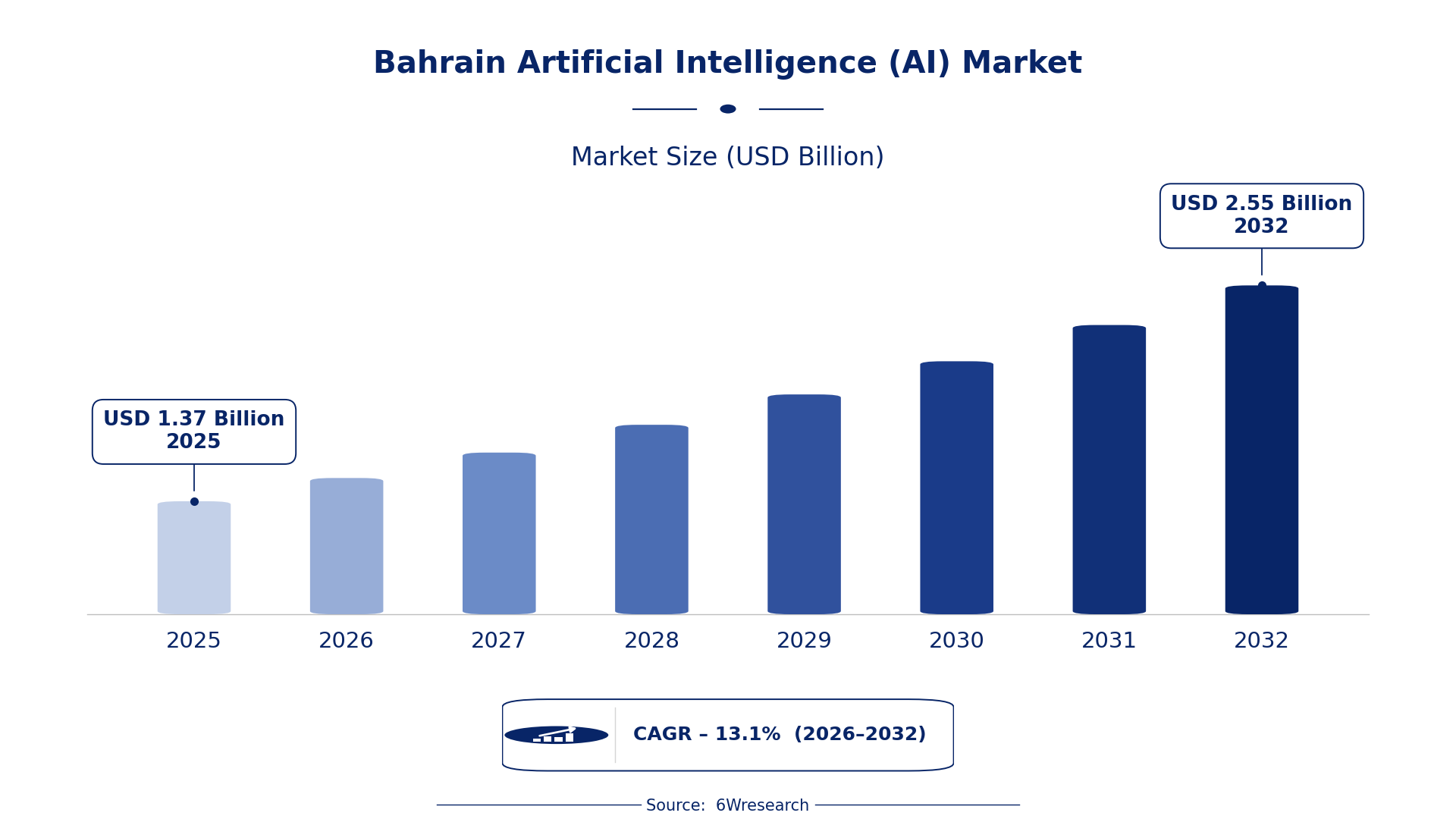
The Bahrain Artificial Intelligence (AI) Market was estimated at USD 1370 Million in 2025 and is projected to reach USD 2548 Million by 2032, growing at a CAGR of 13.1% from 2026 to 2032.
Bahrain Artificial Intelligence (AI) Market Synopsis
The Bahrain Artificial Intelligence (AI) Market is experiencing a remarkable surge, spurred by government initiatives aimed at digital transformation and a growing appetite for innovation across various sectors. From fintech to education, AI applications are becoming integral to operational efficiency and customer engagement in Bahrain.
Key industries, including healthcare and logistics, are increasingly adopting AI for automation, predictive analytics, and enhanced service delivery. With investments in machine learning and natural language processing, Bahrain is laying the groundwork for a more digitally adept economy, positioning itself as a regional leader in AI technology.
Bahrain Artificial Intelligence (AI) Market Year-wise Growth Rate and Key Drivers
This graph illustrates the annual growth rates of the Bahrain Artificial Intelligence (AI) Market from 2021 to 2032, highlighting a steady upward trajectory and projected expansion over the forecast period.
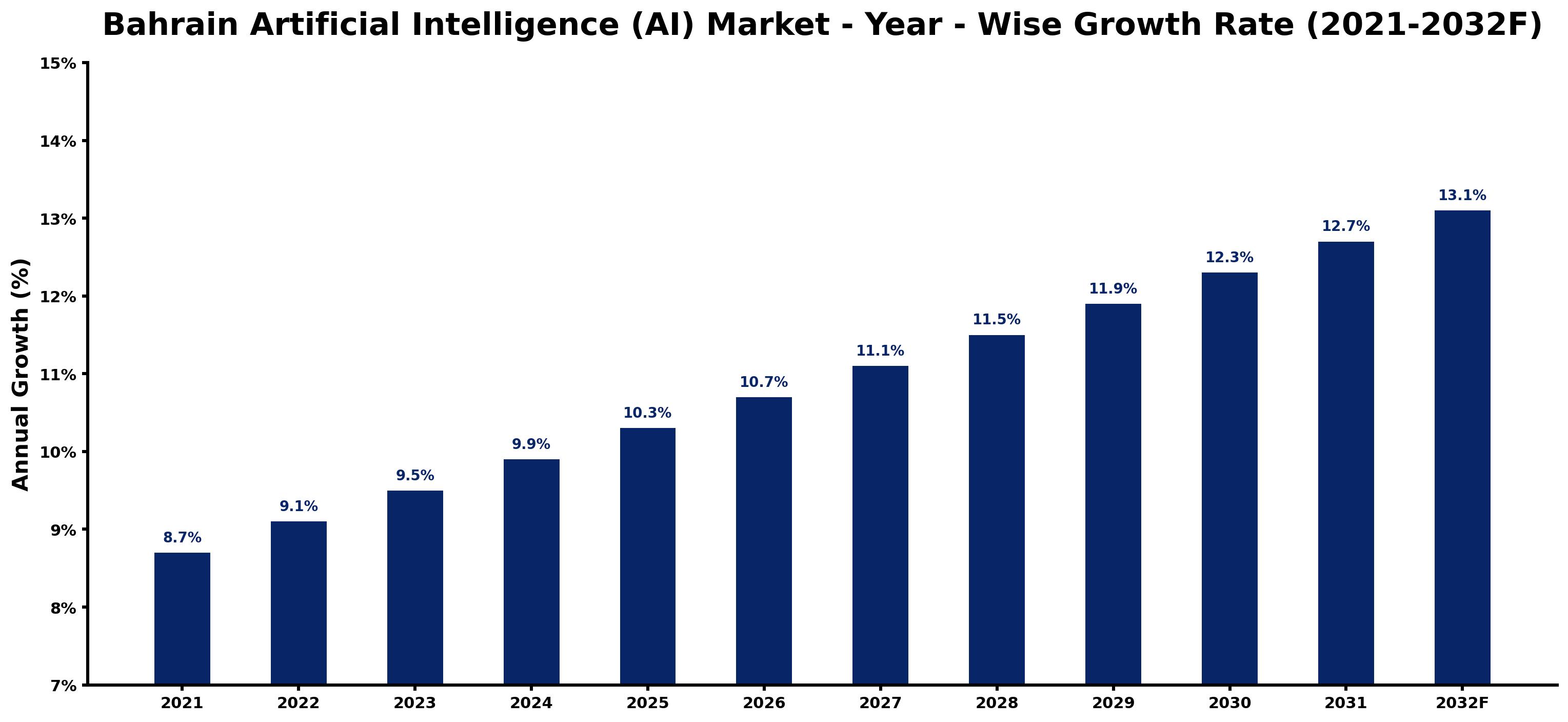
The table below presents the year‑wise growth rates along with the key drivers influencing the market
| Year | Growth Rate | Major Drivers |
| 2021 | 8.7% | National Artificial Intelligence Strategy implementation boosts investments. |
| 2022 | 9.1% | Government incentives for AI startups attract local talent. |
| 2023 | 9.5% | Increased adoption of AI in healthcare optimizes services. |
| 2024 | 9.9% | Bahrain’s financial sector exploring AI for risk management. |
| 2025 | 10.3% | Smart city initiatives drive demand for AI technologies. |
| 2026 | 10.7% | Local businesses adopting AI for enhanced customer experiences. |
| 2027 | 11.1% | Increased collaboration between government and AI researchers. |
| 2028 | 11.5% | AI-powered fintech solutions gaining popularity in Bahrain. |
| 2029 | 11.9% | Regulatory frameworks support ethical AI development practices. |
| 2030 | 12.3% | Emerging AI education programs increase skilled workforce availability. |
| 2031 | 12.7% | Public sector digitization initiatives require advanced AI solutions. |
| 2032 | 13.1% | International AI conferences in Bahrain boost sector visibility. |
Note: Market size estimations and growth projections presented in this report are based on 6Wresearch's proprietary forecasting methodology, utilizing the latest available industry data, government publications, and primary research inputs.
Bahrain Artificial Intelligence (AI) Market Key Takeaways
Below are some of the specific key takeaways from the market, including:
- The market is supported by a strong government commitment to digital innovation.
- Investment opportunities exist across multiple sectors, including healthcare, finance, and education.
- The need for skilled professionals remains a critical challenge hindering market growth.
- AI applications are increasingly utilized for customer engagement and fraud detection.
- Data availability and cloud infrastructure advancements are crucial for future AI integration.
Evaluation of Restraints in Bahrain Artificial Intelligence (AI) Market
Despite the optimistic outlook, the Bahrain AI market faces several constraints that could impede its rapid growth. A significant hurdle is the lack of robust regulatory frameworks tailored to AI applications, creating uncertainty for businesses operating in sensitive sectors like finance and healthcare. on top of that, the limited pool of skilled AI professionals and researchers makes it challenging for organizations to develop and implement AI solutions effectively.
Additionally, the high investment costs associated with computing infrastructure and data storage act as barriers for many small and medium-sized enterprises. The scarcity of large, annotated datasets further complicates AI training and deployment, ultimately affecting the market’s potential to fully realize its growth trajectory.
Bahrain Artificial Intelligence (AI) Market Trends
Current trends in the Bahrain AI market reflect a shift towards automation and enhanced customer experiences. Businesses are increasingly utilizing AI for predictive analytics, helping to forecast consumer behavior and improve decision-making processes. There's a noticeable rise in the deployment of virtual assistants and recommendation engines across retail and service sectors.
on top of that, the government’s initiatives are fostering an environment conducive to AI experimentation. Startups are actively exploring AI solutions tailored to the regional market, indicating a growing trend of localized innovation. As cloud infrastructure continues to improve, the integration of AI technologies is expected to become commonplace in various industries.
Bahrain Artificial Intelligence (AI) Market Opportunities
The Bahrain AI market presents numerous opportunities for growth and investment. With the government's focus on digital transformation, sectors like banking, healthcare, and public administration are ripe for AI-driven innovations. The increasing demand for AI-as-a-Service solutions opens up avenues for businesses to access cutting-edge technology without substantial upfront investments.
Opportunities also lie in developing predictive analytics tools, which can enhance operational efficiency and customer satisfaction. As the government encourages public-private partnerships, startups have the chance to play a pivotal role in driving sector-specific AI advancements.
Government Initiatives in the Bahrain Artificial Intelligence (AI) Market
Bahrain's government is taking proactive steps to shape the AI market, emphasizing ethical considerations and fostering a conducive environment for innovation. By integrating AI across key sectors such as healthcare and finance, the government is paving the way for a technologically advanced society. Current policies focus on regulatory frameworks that prioritize data privacy and non-discrimination, aligning with Bahrain's Vision 2030 for economic diversification.
- A recently launched initiative, the Artificial Intelligence Academy, focuses on upskilling the workforce in AI technologies.
- A national digital infrastructure upgrade programme is currently underway to enhance connectivity and data accessibility.
- The government has initiated pilot projects for AI procurement guidelines in collaboration with the World Economic Forum.
- Planned public-private partnerships aim to develop AI solutions specifically tailored to local market needs by 2027.
- Ongoing regulatory efforts are focused on establishing clear compliance protocols for AI applications in sensitive sectors.
Future Insights of the Bahrain Artificial Intelligence (AI) Market
Looking ahead to 2026-2032, the Bahrain AI market is set for transformative growth. As businesses increasingly recognize the value of AI in enhancing productivity and customer experiences, adoption rates are expected to surge. The government's continued investment in education and infrastructure will play a crucial role in addressing the current skills gap and fostering innovation.
With the rise of data-driven decision-making, AI applications will become indispensable across various industries. As regulatory frameworks mature, businesses will find themselves better equipped to navigate compliance challenges, thus unlocking further potential for growth. Bahrain is on a trajectory to solidify its status as a digital-first economy in the region.
Bahrain Artificial Intelligence (AI) Market Latest Developments
In the past year, the Bahrain AI market has witnessed several noteworthy developments. Companies have been increasingly focused on deploying AI technologies to enhance customer engagement and streamline operations. The government’s initiatives are fostering a vibrant ecosystem for startups and tech innovators, leading to a surge in AI-related projects.
- A major technology vendor announced the rollout of a new AI-driven platform aimed at improving customer service experiences, which began in early 2025.
- A collaborative initiative between local universities and the government to develop AI research capabilities is currently ongoing.
- A pilot project testing AI applications in healthcare settings is expected to commence by mid-2026.
- Several fintech companies are integrating AI for fraud detection solutions, with implementations ongoing since early 2025.
- An upcoming national AI conference planned for late 2026 will showcase local innovations and facilitate networking among industry stakeholders.
Bahrain Artificial Intelligence (AI) Market - Key Attractiveness of the Report
- 10 Years of Market Numbers
- Historical Data Starting from 2022 to 2025
- Base Year: 2025
- Forecast Data until 2032
- Key Performance Indicators Impacting the Market
- Major Upcoming Developments and Projects
Key Highlights of the Report:
- Bahrain Artificial Intelligence (AI) Market Outlook
- Market Size of Bahrain Artificial Intelligence (AI) Market, 2025
- Forecast of Bahrain Artificial Intelligence (AI) Market, 2032
- Historical Data and Forecast of Bahrain Artificial Intelligence (AI) Revenues & Volume for the Period 2022-2032F
- Bahrain Artificial Intelligence (AI) Market Trend Evolution
- Bahrain Artificial Intelligence (AI) Market Drivers and Challenges
- Bahrain Artificial Intelligence (AI) Price Trends
- Bahrain Artificial Intelligence (AI) Porter's Five Forces
- Bahrain Artificial Intelligence (AI) Industry Life Cycle
- Historical Data and Forecast of Bahrain Artificial Intelligence (AI) Market Revenues & Volume By Offering for the Period 2022-2032F
- Historical Data and Forecast of Bahrain Artificial Intelligence (AI) Market Revenues & Volume By Hardware for the Period 2022-2032F
- Historical Data and Forecast of Bahrain Artificial Intelligence (AI) Market Revenues & Volume By Software for the Period 2022-2032F
- Historical Data and Forecast of Bahrain Artificial Intelligence (AI) Market Revenues & Volume By Services for the Period 2022-2032F
- Historical Data and Forecast of Bahrain Artificial Intelligence (AI) Market Revenues & Volume By Technology for the Period 2022-2032F
- Historical Data and Forecast of Bahrain Artificial Intelligence (AI) Market Revenues & Volume By Machine Learning for the Period 2022-2032F
- Historical Data and Forecast of Bahrain Artificial Intelligence (AI) Market Revenues & Volume By Natural Language Processing for the Period 2022-2032F
- Historical Data and Forecast of Bahrain Artificial Intelligence (AI) Market Revenues & Volume By Context-Aware Computing for the Period 2022-2032F
- Historical Data and Forecast of Bahrain Artificial Intelligence (AI) Market Revenues & Volume By Computer Vision for the Period 2022-2032F
- Historical Data and Forecast of Bahrain Artificial Intelligence (AI) Market Revenues & Volume By Business Function for the Period 2022-2032F
- Historical Data and Forecast of Bahrain Artificial Intelligence (AI) Market Revenues & Volume By Finance for the Period 2022-2032F
- Historical Data and Forecast of Bahrain Artificial Intelligence (AI) Market Revenues & Volume By Security for the Period 2022-2032F
- Historical Data and Forecast of Bahrain Artificial Intelligence (AI) Market Revenues & Volume By Human Resources for the Period 2022-2032F
- Historical Data and Forecast of Bahrain Artificial Intelligence (AI) Market Revenues & Volume By Law for the Period 2022-2032F
- Historical Data and Forecast of Bahrain Artificial Intelligence (AI) Market Revenues & Volume By Marketing and Sales for the Period 2022-2032F
- Historical Data and Forecast of Bahrain Artificial Intelligence (AI) Market Revenues & Volume By Other Business Function (IT operations) for the Period 2022-2032F
- Historical Data and Forecast of Bahrain Artificial Intelligence (AI) Market Revenues & Volume By Deployment Mode for the Period 2022-2032F
- Historical Data and Forecast of Bahrain Artificial Intelligence (AI) Market Revenues & Volume By On-premises for the Period 2022-2032F
- Historical Data and Forecast of Bahrain Artificial Intelligence (AI) Market Revenues & Volume By Cloud for the Period 2022-2032F
- Historical Data and Forecast of Bahrain Artificial Intelligence (AI) Market Revenues & Volume By Organization Size for the Period 2022-2032F
- Historical Data and Forecast of Bahrain Artificial Intelligence (AI) Market Revenues & Volume By Large Enterprises for the Period 2022-2032F
- Historical Data and Forecast of Bahrain Artificial Intelligence (AI) Market Revenues & Volume By SMEs for the Period 2022-2032F
- Historical Data and Forecast of Bahrain Artificial Intelligence (AI) Market Revenues & Volume By Verticals for the Period 2022-2032F
- Historical Data and Forecast of Bahrain Artificial Intelligence (AI) Market Revenues & Volume By BFSI for the Period 2022-2032F
- Historical Data and Forecast of Bahrain Artificial Intelligence (AI) Market Revenues & Volume By IT/ ITES for the Period 2022-2032F
- Historical Data and Forecast of Bahrain Artificial Intelligence (AI) Market Revenues & Volume By Telecommunication for the Period 2022-2032F
- Historical Data and Forecast of Bahrain Artificial Intelligence (AI) Market Revenues & Volume By Government and Defense for the Period 2022-2032F
- Historical Data and Forecast of Bahrain Artificial Intelligence (AI) Market Revenues & Volume By Manufacturing for the Period 2022-2032F
- Historical Data and Forecast of Bahrain Artificial Intelligence (AI) Market Revenues & Volume By Healthcare and Lifesciences for the Period 2022-2032F
- Historical Data and Forecast of Bahrain Artificial Intelligence (AI) Market Revenues & Volume By Retail and Ecommerce for the Period 2022-2032F
- Historical Data and Forecast of Bahrain Artificial Intelligence (AI) Market Revenues & Volume By Automotive, Transportation & Logistics for the Period 2022-2032F
- Bahrain Artificial Intelligence (AI) Import Export Trade Statistics
- Market Opportunity Assessment By Offering
- Market Opportunity Assessment By Technology
- Market Opportunity Assessment By Business Function
- Market Opportunity Assessment By Deployment Mode
- Market Opportunity Assessment By Organization Size
- Market Opportunity Assessment By Verticals
- Bahrain Artificial Intelligence (AI) Top Companies Market Share
- Bahrain Artificial Intelligence (AI) Competitive Benchmarking By Technical and Operational Parameters
- Bahrain Artificial Intelligence (AI) Company Profiles
- Bahrain Artificial Intelligence (AI) Key Strategic Recommendations






































