Japan Automated Fare Collection System Market Size & Growth Rate
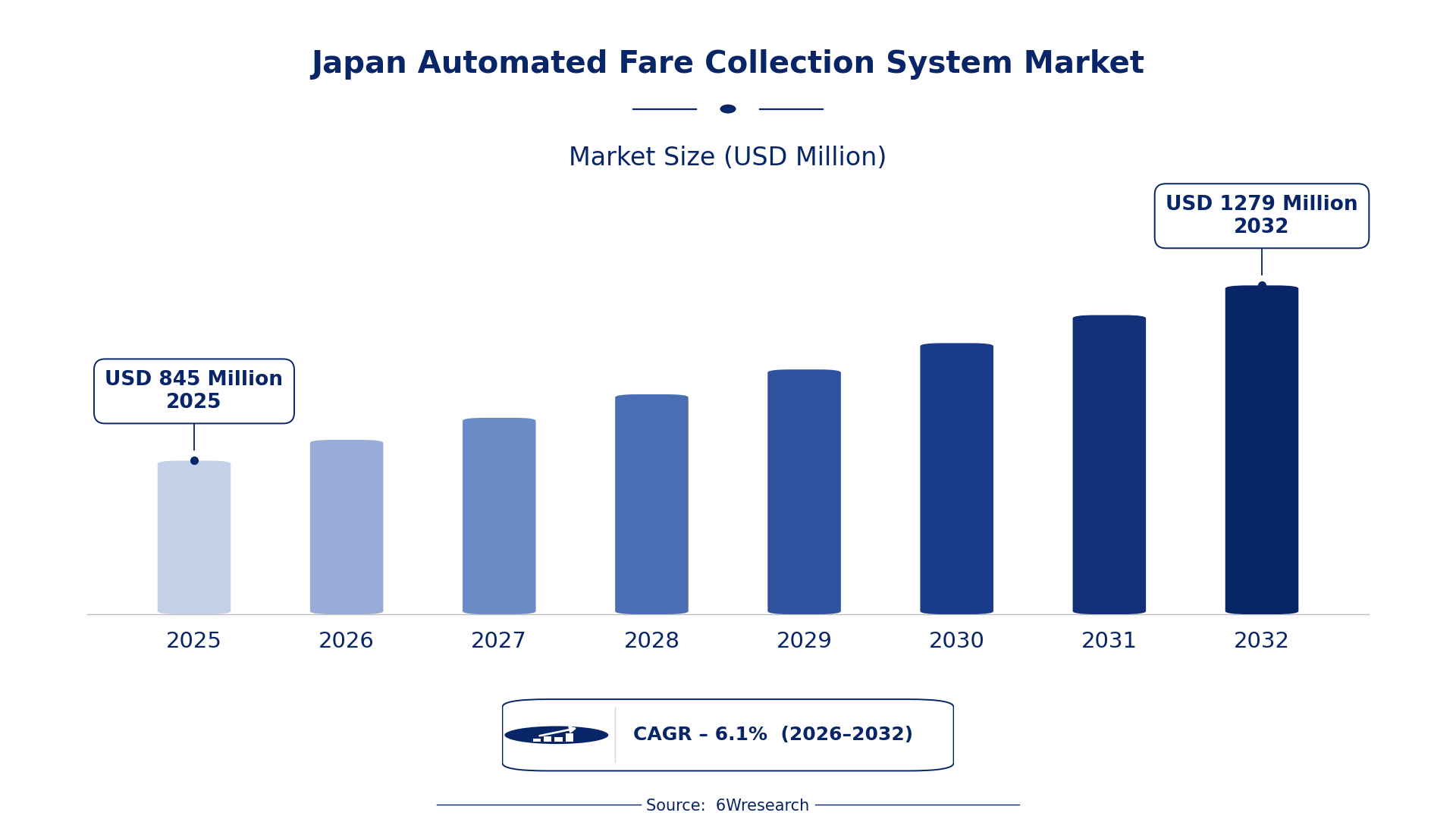
According to 6Wresearch internal database and industry insights, the Japan Automated Fare Collection System Market was valued at USD 845 Million in 2025 and is projected to reach USD 1,279 Million by 2032, growing at a CAGR of approximately 6.1% during 2026–2032.
Japan Automated Fare Collection System Market Highlights
| Report Metric | Details |
| Report Name | Japan Automated Fare Collection System Market (2026-2032) |
| Market Size 2025 | USD 845 Million |
| Market Size 2032 | USD 1,279 Million |
| Absolute Growth 2025–2032 | USD 434 Million |
| CAGR 2026–2032 | 6.1% |
| Peak Annual Growth | 7.2% in 2026 |
| Forecast Period | 2026–2032 |
| Historical Data | 2022–2025 |
| Base Year | 2025 |
| Leading Product Type, 2025 | Ticketing Systems (41% share) |
| Leading Application, 2025 | Transportation (60% share) |
| Leading End User, 2025 | Public Transport (55% share) |
| Leading Functionality, 2025 | Contactless Payment (45% share) |
| Fastest-Growing Product Type | Fare Collection Systems (8.6% CAGR) |
| Fastest-Growing Application | Urban Transport (7.8% CAGR) |
| Fastest-Growing End User | Metro Rail (7.5% CAGR) |
| Fastest-Growing Functionality | RFID Integration (8.0% CAGR) |
| Growing Sector | Public Transport |
| Key End Users | Public Transport Operators, Urban Transport Authorities, Commuters, Transport Technology Providers |
Japan Automated Fare Collection System Market Year-wise Growth Rate and Key Drivers (2022–2032)
This graph illustrates the annual growth rates of the market from 2022 to 2032, highlighting a steady upward trajectory and projected market expansion over the forecast period.
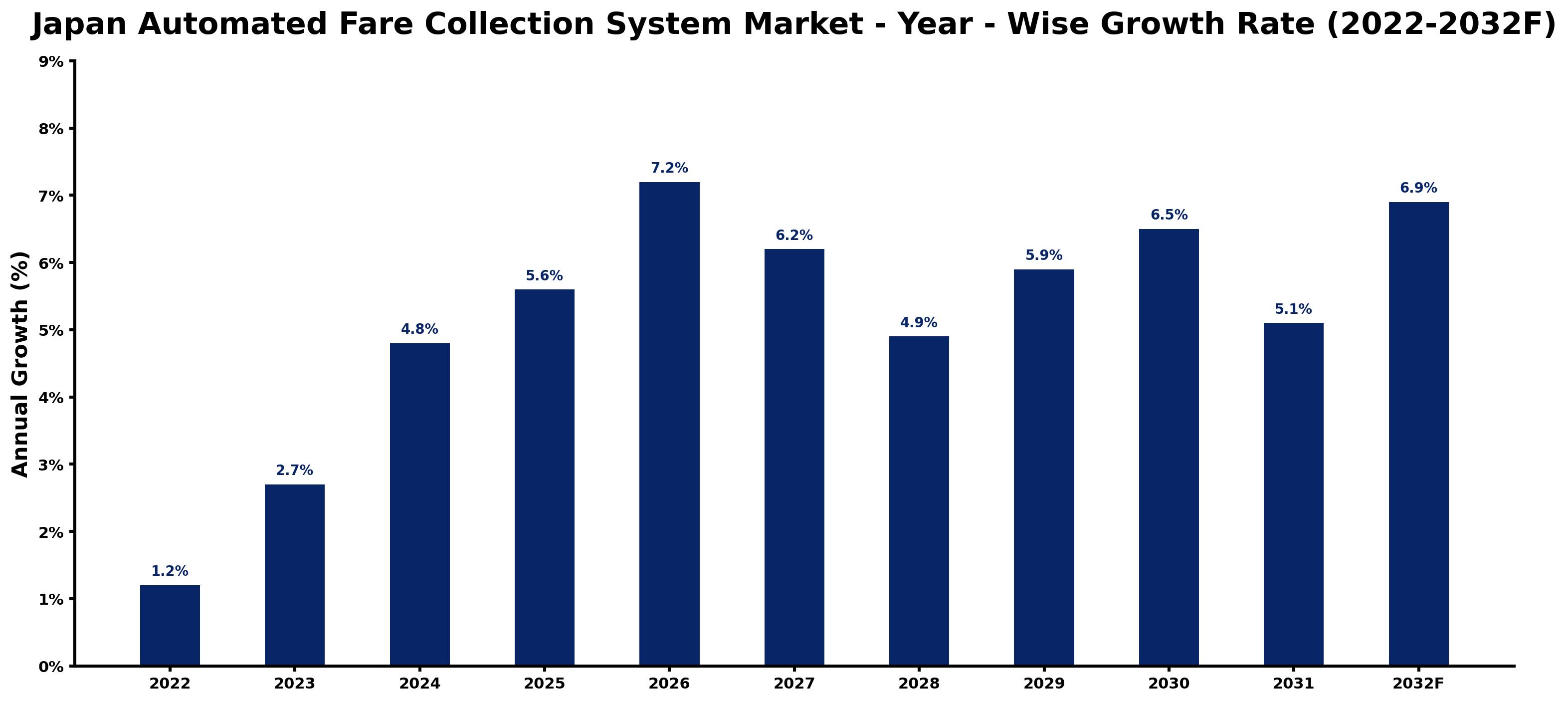
The yearly estimates that follow link every growth rate to its principal driver, so readers can see why the pace changed in each period.
| Year | Estimated Annual Growth (%) | Market Rationale |
| 2022 | 1.2 | The market showed steady demand from urban transport networks and domestic users. |
| 2023 | 2.7 | Growth accelerated as public transport systems upgraded their fare collection technologies. |
| 2024 | 4.8 | Investment in automated ticketing systems increased, boosting market performance. |
| 2025 | 5.6 | The introduction of new smart transport initiatives further enhanced user convenience. |
| 2026 | 7.2 | Demand peaked due to significant urban population growth and infrastructure investments. |
| 2027 | 6.2 | Market growth slowed as saturation in urban transport systems began to set in. |
| 2028 | 4.9 | Technological advancements continued, but growth rates normalised from previous highs. |
| 2029 | 5.9 | Increased adoption of contactless payments revitalised interest in fare collection systems. |
| 2030 | 6.5 | The ongoing push for sustainability in transport systems spurred further investments. |
| 2031 | 5.1 | Growth moderated as the market adjusted to established technologies and practices. |
| 2032 | 6.9 | A renewed focus on smart payment options is expected to drive growth again. |
Note: Market size estimations and growth projections presented in this report are based on 6Wresearch's proprietary forecasting methodology, utilizing the latest available industry data, government publications, and primary research inputs.
Japan Automated Fare Collection System Market Synopsis
Automated Fare Collection Systems streamline fare payment in public transportation, utilising advanced hardware and software components like ticketing machines and fare gates. The market in Japan is expanding due to rising urbanisation, with public transport systems serving approximately 7 million passengers daily in Tokyo. Demand is driven by initiatives such as the smart transport initiative launched in 2023 and the growing preference for contactless payment options, which over 30% of users now choose.
Market Dynamics Impact Analysis (2026–2032)
| Factor | Type | Impact | Primary Segment Affected |
| Urban population growth | Driver | High | Transportation |
| Investment in smart transport initiatives | Driver | High | Public Transport |
| Integration of RFID technology | Opportunity | Medium | Fare Collection Systems |
| Expansion of contactless payment systems | Opportunity | Medium | Contactless Payment |
| High initial investment costs | Restraint | High | Automated Ticket Machines |
| Regulatory compliance requirements | Restraint | Medium | Ticketing Systems |
| Competition from alternative payment solutions | Challenge | High | Smart Payment |
| Technological integration challenges | Challenge | Medium | RFID Integration |
Evaluation of Drivers in Japan Automated Fare Collection System Market (2026–2032)
Key forces behind demand, with the segment each one moves most, are listed below.
| Drivers | Primary Segment Affected | Why It Matters (Evidence) |
| Urbanisation | Transportation | Japan's urban population growth drives demand for efficient public transport systems, with Tokyo Metro serving about 7 million passengers daily. |
| Smart transport initiatives | Public Transport | The Tokyo Metropolitan Government's 2023 initiative encourages investments in automated fare collection systems, increasing user adoption. |
| RFID technology adoption | Fare Collection Systems | Osaka's integration of RFID technology improves fare collection efficiency, leading to increased purchases of automated systems. |
| Contactless payment preferences | Contactless Payment | With over 30% of users opting for contactless payments, demand for compatible fare collection systems rises. |
| Government subsidies | Automated Ticket Machines | Public transport in Japan benefits from government subsidies, promoting investment in automated ticketing solutions. |
Volumes grow on the back of urbanisation, with Tokyo's metro system serving approximately 7 million passengers daily. Adoption of RFID technology in Osaka improves efficiency, leading to higher purchases of automated systems. Over 30% of users prefer contactless payments, driving demand for compatible fare collection systems.
Evaluation of Restraints in Japan Automated Fare Collection System Market
These restraints slow adoption and weigh on supplier margins.
| Market Restraint | Primary Segment Affected | Why It Matters (Evidence) |
| High initial investment costs | Automated Ticket Machines | The upfront costs associated with implementing automated systems deter some public transport operators from upgrading. |
| Regulatory compliance requirements | Ticketing Systems | Compliance measures necessitate costly investments for fare collection systems. |
| Limited public awareness of new technologies | Contactless Payment | Some users remain hesitant to adopt contactless payment options, slowing market penetration for these systems. |
| Maintenance and operational challenges | Fare Collection Systems | Ongoing maintenance requirements can burden operators, affecting their willingness to invest in new technologies. |
| Competition from alternative payment solutions | Smart Payment | Emerging payment options may divert users away from traditional fare collection systems, impacting overall market growth. |
Japan Automated Fare Collection System Market Challenges
Tokyo's metro system faces a shortage of skilled technicians, delaying necessary maintenance and upgrades, which costs transport operators considerable downtime. Rising operational costs affect buyers, as Japan's national minimum wage rose to JPY 1,055 per hour, resulting in higher fare prices for commuters. Competition intensifies as cities like Osaka invest heavily in advanced automated systems, making it challenging for other regions to keep pace. Supply chain disruptions occur since components for automated fare collection systems often depend on imported parts, causing delays in installations and upgrades for public transport networks.
Trends in the Japan Automated Fare Collection System Market
The trends below show where the Japan Automated Fare Collection System Market is heading.
- Shift to Contactless Payment Solutions: Public transport is transitioning towards contactless payment solutions, with over 30% of users opting for this method. This shift is reshaping fare collection systems, making them more efficient and user-friendly.
- Integration of RFID Technology: Osaka's public transport system is integrating RFID technology to improve fare collection efficiency. This advancement is expected to enhance user experience and increase system adoption among commuters.
- Expansion of Smart Transport Initiatives: The Tokyo Metropolitan Government's smart transport initiative promotes the adoption of automated fare collection systems. This initiative aims to streamline operations and improve user convenience across the city's transport network.
- Growing Urban Transport Demand: Urban transport demand is increasing as cities expand. This growth is driving investments in automated fare collection systems, particularly in metropolitan areas like Tokyo.
Investment Opportunities in the Japan Automated Fare Collection System Market
Below are the investment opportunities with the strongest case in the Japan Automated Fare Collection System Market.
- Investment in Automated Ticket Machines: With Japan's public transport systems seeking to upgrade, the market for automated ticket machines is expanding. In 2023, Tokyo's smart transport initiative highlighted the need for modern solutions.
- Expansion of RFID Integration: The Kansai region's investment in RFID technology presents an opportunity for suppliers. Collaborating with local transport authorities can facilitate market entry.
- Growth in Contactless Payment Systems: As over 30% of users prefer contactless payments, there is a growing demand for compatible fare collection systems. Engaging with public transport operators can help meet this need.
- Government Support for Public Transport Upgrades: Japan's public transport sector benefits from substantial government subsidies, creating opportunities for investment in automated fare collection systems. Partnering with local authorities can enhance market access.
Government Initiatives in the Japan Automated Fare Collection System Market
The Railway Business Act governs Japan's public transport system, ensuring compliance with safety and operational standards. The act has shaped fare collection practices, requiring providers to maintain high-quality service and user convenience. ISO 9001 certification is commonly pursued by fare collection system providers to demonstrate their commitment to quality management. In 2023, the Tokyo Metropolitan Government allocated JPY 150 billion for smart transport initiatives, overseen by the Ministry of Land, Infrastructure, Transport and Tourism. This funding aims to improve public transport systems, encouraging the adoption of automated fare collection technologies.
In 2023, the Tokyo Metropolitan Government allocated JPY 150 billion for smart transport initiatives, overseen by the Ministry of Land, Infrastructure, Transport and Tourism. This funding aims to improve public transport systems, encouraging the adoption of automated fare collection technologies.
Future Insight of the Japan Automated Fare Collection System Market
Buyers will experience greater convenience as public transport operators increasingly adopt smart payment technologies by 2032. Japan's investment in decarbonisation will reach JPY 150 trillion, driving the development of sustainable transport solutions. The implementation of the JIS X 6321 standard will elevate the quality and reliability of fare collection systems. As contactless payment adoption exceeds 30%, suppliers must innovate to meet evolving consumer preferences.
Market Segmentation Analysis
Japan Automated Fare Collection System Market report covers a detailed analysis of the following market segments:
By Product Type – Ticketing Systems Lead, Fare Collection Systems Expected to Grow Fastest
According to Ravi Bhandari, Research Head at 6Wresearch, with 41% of product type revenue in 2025, Ticketing Systems was the largest category. Ticketing systems hold the largest share due to their critical role in managing fare processes across various transport networks. Their extensive deployment in Tokyo's metro system, which features over 1,000 automated ticket machines, illustrates the strong demand and established infrastructure supporting this segment. Fare Collection Systems are projected to grow fastest, at a CAGR of 8.6% during 2026–2032. Fare collection systems are experiencing rapid growth as they are vital for revenue generation, particularly with the increasing adoption of contactless payments. The fact that over 30% of users now prefer these payment methods indicates a shift towards more efficient fare collection solutions. Suppliers should focus on developing advanced fare collection technologies to align with the growing user preference for streamlined payment options.
By Application – Transportation Leads, Urban Transport Expected to Grow Fastest
Transportation took 60% of application revenue in 2025, more than any other category. Transportation is the leading application as it is essential for ensuring public mobility, facilitating travel for millions daily. The Tokyo Metro, serving approximately 7 million passengers each day, underscores the vital role of robust transportation systems in urban settings. Over 2026–2032, Urban Transport is expected to post the fastest growth, at a CAGR of 7.8%. Urban transport is the fastest-growing application, propelled by the rising demand for efficient transit systems in cities. The significant investments in automated fare systems in the Kansai region highlight the urgent need for improved urban transport solutions. Buyers in urban transport should prioritise investments in advanced fare collection systems to enhance operational efficiency and improve the passenger experience.
By End User – Public Transport Leads, Metro Rail Expected to Grow Fastest
Public Transport held 55% of the Japan Automated Fare Collection System Market by end user in 2025. Public transport is the dominant end user, being vital for commuter services across major cities in Japan. The extensive use of automated fare collection in systems like Tokyo Metro underscores its importance in daily commuting. The quickest growth will come from Metro Rail, forecast to expand at a CAGR of 7.5% between 2026 and 2032. Metro rail is the fastest-growing end user segment, as it is integral for urban rail services that cater to densely populated areas. The increasing passenger numbers in metro systems highlight the need for efficient fare collection solutions. Suppliers should tailor their offerings to meet the specific needs of metro rail operations to capture this growing market.
By Functionality – Contactless Payment Leads, RFID Integration Expected to Grow Fastest
The largest functionality category in 2025 was Contactless Payment, at 45% of revenue. Contactless payment functionality dominates the market as it is increasingly preferred by users for its convenience and efficiency. This growing preference aligns with broader trends towards digital payment solutions, making it a key feature in fare collection systems. RFID Integration is set to record the highest CAGR in this split, 8.0% over 2026–2032. RFID integration is the fastest-growing functionality, as it significantly enhances system efficiency and streamlines fare collection processes. The rising adoption of this technology is crucial for public transport systems aiming to modernise and elevate user experience. Suppliers must invest in RFID technologies to remain competitive and meet the evolving demands of contemporary public transport systems.
Key Attractiveness of the Report
- 10 Years of Market Numbers
- Historical Data Starting from 2022 to 2025
- Base Year 2025
- Forecast Data until 2032
- Key Performance Indicators Impacting the Market
- Major Upcoming Developments and Projects
Key Highlights of the Report:
- Japan Automated Fare Collection System Market Outlook
- Market Size of Japan Automated Fare Collection System Market, 2025
- Forecast of Japan Automated Fare Collection System Market, 2032
- Historical Data and Forecast of Japan Automated Fare Collection System Revenues & Volume for the Period 2022-2032
- Japan Automated Fare Collection System Market Trend Evolution
- Japan Automated Fare Collection System Market Drivers and Challenges
- Japan Automated Fare Collection System Price Trends
- Japan Automated Fare Collection System Porter's Five Forces
- Japan Automated Fare Collection System Industry Life Cycle
- Historical Data and Forecast of Japan Automated Fare Collection System Market Revenues & Volume By Product Type for the Period 2022-2032
- Historical Data and Forecast of Japan Automated Fare Collection System Market Revenues & Volume By Ticketing Systems for the Period 2022-2032
- Historical Data and Forecast of Japan Automated Fare Collection System Market Revenues & Volume By Fare Collection Systems for the Period 2022-2032
- Historical Data and Forecast of Japan Automated Fare Collection System Market Revenues & Volume By Automated Ticket Machines for the Period 2022-2032
- Historical Data and Forecast of Japan Automated Fare Collection System Market Revenues & Volume By Application for the Period 2022-2032
- Historical Data and Forecast of Japan Automated Fare Collection System Market Revenues & Volume By Transportation for the Period 2022-2032
- Historical Data and Forecast of Japan Automated Fare Collection System Market Revenues & Volume By Transportation for the Period 2022-2032
- Historical Data and Forecast of Japan Automated Fare Collection System Market Revenues & Volume By Urban Transport for the Period 2022-2032
- Historical Data and Forecast of Japan Automated Fare Collection System Market Revenues & Volume By End User for the Period 2022-2032
- Historical Data and Forecast of Japan Automated Fare Collection System Market Revenues & Volume By Public Transport for the Period 2022-2032
- Historical Data and Forecast of Japan Automated Fare Collection System Market Revenues & Volume By Metro Rail for the Period 2022-2032
- Historical Data and Forecast of Japan Automated Fare Collection System Market Revenues & Volume By Bus Systems for the Period 2022-2032
- Historical Data and Forecast of Japan Automated Fare Collection System Market Revenues & Volume By Functionality for the Period 2022-2032
- Historical Data and Forecast of Japan Automated Fare Collection System Market Revenues & Volume By Contactless Payment for the Period 2022-2032
- Historical Data and Forecast of Japan Automated Fare Collection System Market Revenues & Volume By RFID Integration for the Period 2022-2032
- Historical Data and Forecast of Japan Automated Fare Collection System Market Revenues & Volume By Smart Payment for the Period 2022-2032
- Japan Automated Fare Collection System Import Export Trade Statistics
- Market Opportunity Assessment By Product Type
- Market Opportunity Assessment By Application
- Market Opportunity Assessment By End User
- Market Opportunity Assessment By Functionality
- Japan Automated Fare Collection System Top Companies Market Share
- Japan Automated Fare Collection System Competitive Benchmarking By Technical and Operational Parameters
- Japan Automated Fare Collection System Company Profiles
- Japan Automated Fare Collection System Key Strategic Recommendations
Market Covered
This report examines the market across the segments below.
By Product Type
- Ticketing Systems
- Fare Collection Systems
- Automated Ticket Machines
By Application
- Transportation
- Urban Transport
By End User
- Public Transport
- Metro Rail
- Bus Systems
By Functionality
- Contactless Payment
- RFID Integration
- Smart Payment































