Japan Long Term Care Market Size & Growth Rate
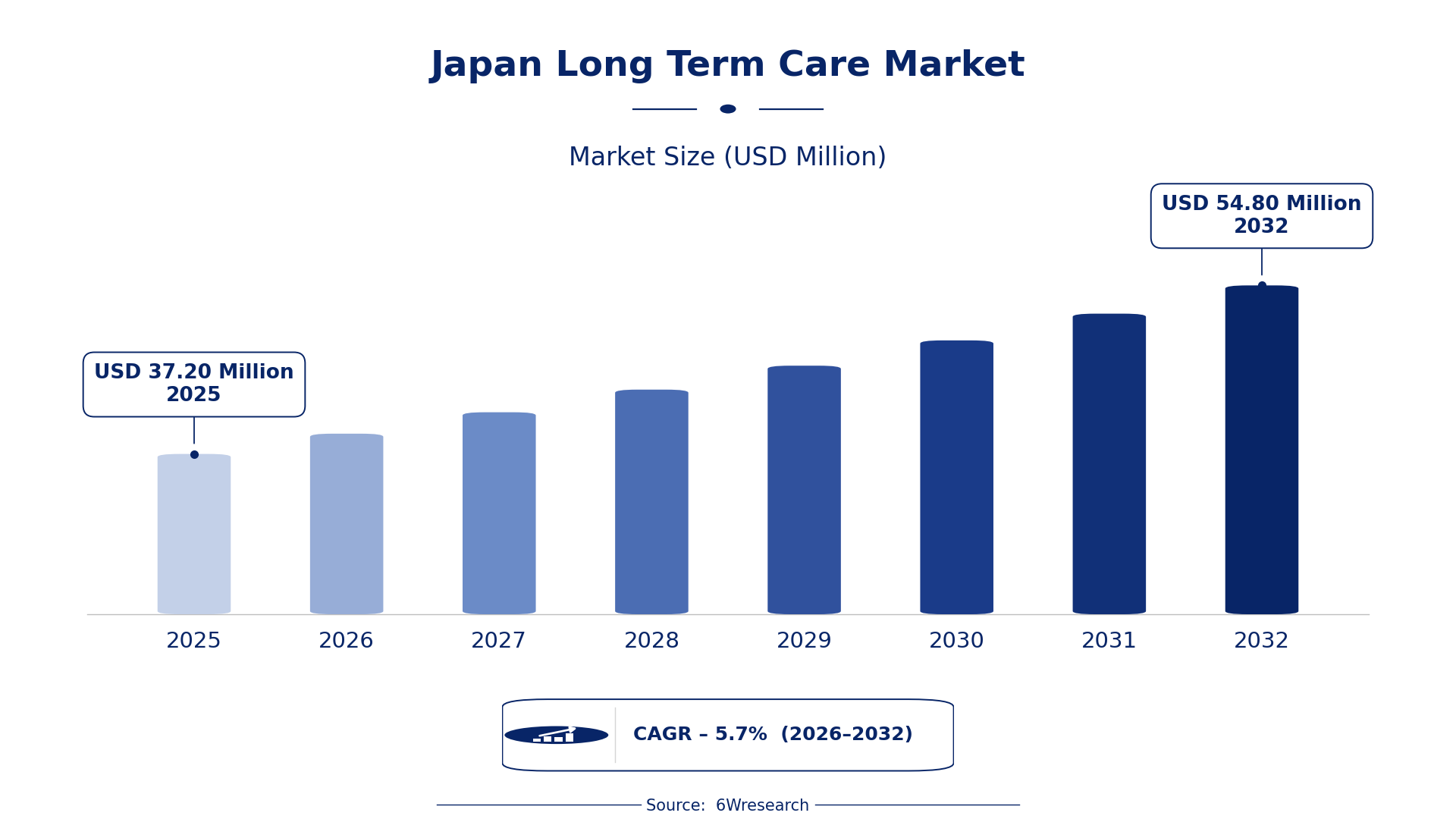
According to 6Wresearch internal database and industry insights, the Japan Long Term Care Market was valued at USD 37.20 Million in 2025 and is projected to reach USD 54.80 Million by 2032, growing at a CAGR of approximately 5.7% during 2026–2032.
Japan Long Term Care Market Highlights
| Report Metric | Details |
| Report Name | Japan Long Term Care Market (2026-2032) |
| Market Size 2025 | USD 37.20 Million |
| Market Size 2032 | USD 54.80 Million |
| Absolute Growth 2025–2032 | USD 17.60 Million |
| CAGR 2026–2032 | 5.7% |
| Peak Annual Growth | 6.4% in 2028 |
| Forecast Period | 2026–2032 |
| Historical Data | 2022–2025 |
| Base Year | 2025 |
| Leading Service, 2025 | Home Healthcare (36% share) |
| Leading Gender, 2025 | Female (68% share) |
| Leading Payer, 2025 | Public (54% share) |
| Fastest-Growing Gender | Male (7.1% CAGR) |
| Fastest-Growing Payer | Out-of-Pocket (7.2% CAGR) |
| Growing Sector | Out-of-Pocket |
| Key End Users | Public, Out-of-Pocket, Private |
Japan Long Term Care Market Year-wise Growth Rate and Key Drivers (2022–2032)
This graph illustrates the annual growth rates of the market from 2022 to 2032, highlighting a steady upward trajectory and projected market expansion over the forecast period.
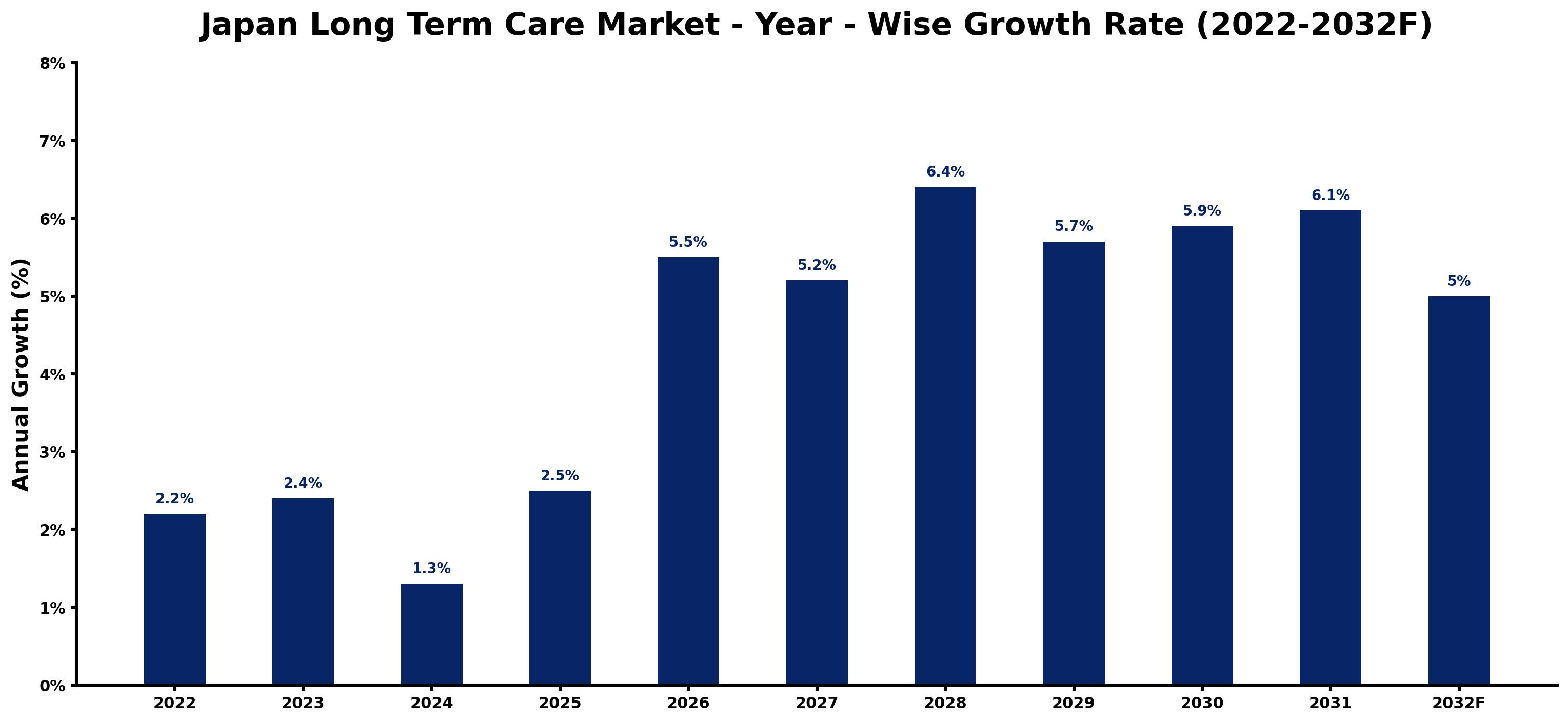
For each year, the table pairs the estimated growth rate with the leading influence on demand, showing how the drivers changed across the period.
| Year | Estimated Annual Growth (%) | Market Rationale |
| 2022 | 2.2 | The market experienced steady growth as demand for long-term care services increased due to an aging population. |
| 2023 | 2.4 | Growth accelerated as families became more aware of the need for elderly support services. |
| 2024 | 1.3 | A slowdown occurred as the market adjusted to evolving demographic trends and care requirements. |
| 2025 | 2.5 | Demand surged as the elderly population reached critical levels, necessitating expanded service offerings. |
| 2026 | 5.5 | Investment in home healthcare services is projected to rise, unlocking greater demand for care solutions. |
| 2027 | 5.2 | A slight slowdown is anticipated as the market stabilises following rapid growth in previous years. |
| 2028 | 6.4 | The market is expected to peak with significant investments in nursing care facilities and services. |
| 2029 | 5.7 | Growth is projected to decelerate as the market normalises after reaching peak demand levels. |
| 2030 | 5.9 | Demand is expected to rise again, driven by advancements in technology for care delivery. |
| 2031 | 6.1 | Continued growth will be fuelled by an expanding elderly population and enhanced service offerings. |
| 2032 | 5.0 | A slowdown is anticipated as the market stabilises, yet demand remains robust. |
Note: Market size estimations and growth projections presented in this report are based on 6Wresearch's proprietary forecasting methodology, utilizing the latest available industry data, government publications, and primary research inputs.
Japan Long Term Care Market Synopsis
Long term care encompasses a variety of services aimed at assisting individuals with aging, illness, or disability, primarily through home healthcare, nursing facilities, and assisted living environments. The Japan Long Term Care Market is expanding due to the increasing elderly population, with over 36 million individuals aged 65 and older as of 2023. Approximately 80% of these services are publicly funded, while the government aims to improve home healthcare through the 2023 Health and Welfare Policy, driving further demand in this sector.
Market Dynamics Impact Analysis (2026–2032)
| Factor | Type | Impact | Primary Segment Affected |
| Aging population driving demand for care services | Driver | High | Home Healthcare |
| Investment in nursing care facilities increasing service capacity | Driver | High | Nursing Care |
| Growing need for elderly care services | Opportunity | High | Assisted Living Facilities |
| Increase in home healthcare providers | Opportunity | Medium | Home Healthcare |
| Limited availability of skilled caregivers | Restraint | High | Nursing Care |
| High operational costs for long-term care facilities | Restraint | Medium | Assisted Living Facilities |
| Competition among service providers affecting pricing | Challenge | High | Nursing Care |
| Technological adoption lagging behind demand | Challenge | Medium | Home Healthcare |
Evaluation of Drivers in Japan Long Term Care Market (2026–2032)
The following drivers explain most of the expected growth.
| Drivers | Primary Segment Affected | Why It Matters (Evidence) |
| Increasing elderly population | Home Healthcare | The growing number of elderly individuals, exceeding 36 million, necessitates more home healthcare services to support aging in place. |
| Government funding for long-term care | Nursing Care | With approximately 80% of long-term care services funded publicly, facilities benefit from stable financial support, enabling them to expand services. |
| Rising demand for assisted living facilities | Assisted Living Facilities | The average length of stay in nursing homes is around 2.5 years, prompting families to seek more assisted living options for their elderly relatives. |
| Growth in telehealth services | Home Healthcare | The increase in telehealth consultations enhances access to care, allowing families to monitor health conditions remotely and seek timely assistance. |
| ISO 9001 certification adoption | Nursing Care | The prevalence of ISO 9001 certification among providers ensures higher service quality, attracting more clients seeking reliable long-term care. |
What keeps demand rising is the increasing elderly population, with over 36 million individuals aged 65 or older driving the need for home healthcare services. Families are increasingly seeking assisted living options, as evidenced by the growth in these facilities across Tokyo and Osaka. The rise in telehealth consultations indicates a growing need for technological solutions in long-term care.
Evaluation of Restraints in Japan Long Term Care Market
The table below lists the restraints and the evidence behind each.
| Market Restraint | Primary Segment Affected | Why It Matters (Evidence) |
| Skills shortage among long-term care providers | Nursing Care | The number of qualified professionals is insufficient to meet the needs of 6 million patients receiving services. |
| Intense competition among facilities | Assisted Living Facilities | This competition leads to price wars that can reduce service quality, ultimately costing patients who may receive inadequate support. |
| Regulatory compliance complexity | Home Healthcare | Providers must navigate the Long-Term Care Insurance Act, which can delay service approvals and increase operational costs. |
| Limited funding for private insurance | Private | Private insurance supplements public funding, but its limited availability restricts access to additional services for some individuals. |
| Aging infrastructure in facilities | Nursing Care | Many existing facilities require upgrades to meet current standards, impacting service delivery and patient satisfaction. |
Japan Long Term Care Market Challenges
Buyers face escalating costs due to a skills shortage, with only 3 million qualified professionals available for 6 million patients, resulting in longer wait times for care. Suppliers encounter fierce competition among facilities, which drives down prices but can compromise service quality, leading to increased expenses for patients needing reliable support. Regulatory complexities surrounding the Long-Term Care Insurance Act create delays in service approvals, raising operational costs for providers. The average monthly cost of ¥200,000 for assisted living facilities burdens families, making it challenging for them to secure necessary care services.
Trends in the Japan Long Term Care Market
The shifts below are changing how Japan Long Term Care Market products are bought and supplied.
- Shift towards Home Healthcare Services: Families are increasingly opting for home healthcare services to provide support for elderly relatives, driven by the need for personalised assistance. In 2023, the number of home healthcare providers rose by 15%, reflecting this trend.
- Growth of Assisted Living Facilities: The demand for assisted living facilities has surged as families seek supportive environments for aging relatives. In 2023, the total number of such facilities increased significantly in urban areas like Tokyo, highlighting this shift.
- Technological Integration in Long Term Care: The integration of technology in long-term care services has become a priority, with telehealth solutions gaining traction. In 2023, telehealth consultations increased by 20%, enhancing accessibility for patients and their families.
- Focus on Quality Standards: There is a growing emphasis on quality standards in long-term care, with many facilities pursuing ISO 9001 certification. This trend aims to improve service delivery and patient satisfaction across the sector.
Investment Opportunities in the Japan Long Term Care Market
The opportunities below stand out in the Japan Long Term Care Market for new entrants and existing suppliers.
- Investment in Home Healthcare: With over 36 million elderly individuals in Japan, there is a notable gap in home healthcare services. Investing in home healthcare providers can meet this demand, particularly in urban areas like Tokyo, where the need is acute.
- Expansion of Assisted Living Facilities: The increasing elderly population presents an opportunity to expand assisted living facilities. Investors can target regions with high concentrations of seniors, such as Osaka, to establish new facilities and meet rising demand.
- Technological Solutions for Care Delivery: The rise in telehealth consultations indicates a need for technological solutions in long-term care. Companies can develop platforms to facilitate remote monitoring and consultations for elderly patients, improving service delivery.
- Enhancing Nursing Care Facilities: The government allocated ¥1.2 trillion for long-term care, creating opportunities to enhance nursing facilities. Investors can partner with local governments to upgrade existing facilities and improve service delivery.
Government Initiatives in the Japan Long Term Care Market
The Long-Term Care Insurance Act, established in 1997 and in force since 2000, is vital for funding nursing care and support services for older individuals. This framework ensures that a significant portion of long-term care services is covered, allowing more individuals to access necessary support and assistance.
The Ministry of Health, Labour and Welfare oversees the long-term care insurance program, approving funding for various services. In 2023, the government allocated ¥1.2 trillion to support long-term care facilities, enhancing service delivery and capacity across the sector.
Future Insight of the Japan Long Term Care Market
Telehealth solutions will transform demand for long-term care services by 2032, enabling efficient remote monitoring and consultations. The government's 2023 Health and Welfare Policy will focus on expanding nursing facilities to meet the needs of an aging population. ISO 9001 certification will set new quality standards, prompting improvements in service delivery. With a projected increase in the number of home healthcare providers by 15% since 2020, buyers will gain access to more diverse options, while suppliers must elevate their service quality to meet growing expectations.
Market Segmentation Analysis
Japan Long Term Care Market report covers a detailed analysis of the following market segments:
By Service – Home Healthcare Leads and Records the Fastest Growth
According to Vasudha, AM at 6Wresearch, Home Healthcare took 36% of service revenue in 2025, more than any other category. Home healthcare holds the largest share due to its critical role in providing essential support for the elderly at home, catering to a significant portion of the 6 million patients receiving long-term care services. The government's focus on enhancing home healthcare services through the 2023 Health and Welfare Policy further solidifies its importance in the market. The same category is also set to grow fastest, at a CAGR of 7.5% during 2026–2032. The continuous growth of home healthcare is propelled by the increasing number of home healthcare providers, which has risen by 15% since 2020, reflecting a growing demand for these services. As home healthcare remains the leading segment, its growth will likely widen the gap with other service types. Suppliers should prioritise home healthcare solutions to align with the increasing demand from an ageing population.
By Gender – Female Leads, Male Expected to Grow Fastest
Female held 68% of the Japan Long Term Care Market by gender in 2025. Females dominate the long-term care sector, making up the majority of both caregivers and recipients, which is reflected in the high percentage of women utilising these services. This trend is driven by the fact that women generally live longer and require more care as they age, particularly in regions like Tokyo and Osaka. Male is projected to grow fastest, at a CAGR of 7.1% during 2026–2032. The male demographic is witnessing a faster growth rate in service utilisation, as more men are beginning to access long-term care services, albeit at a lower representation than women. This shift indicates a potential change in societal norms regarding elderly care and may lead to increased service offerings tailored for men. Providers must consider gender-specific needs and preferences to effectively cater to both male and female segments.
By Payer – Public Leads, Out-of-Pocket Expected to Grow Fastest
Public accounted for 54% of the market by payer in 2025. Public funding is the primary source for long-term care services, accounting for approximately 80% of the total funding, which underscores the government's commitment to supporting its ageing population. The long-term care insurance system established in 2000 has facilitated access to necessary services for millions of elderly citizens. The quickest growth will come from Out-of-Pocket, forecast to expand at a CAGR of 7.2% between 2026 and 2032. Out-of-pocket payments are increasing as some individuals seek services not fully covered by public insurance, reflecting a growing willingness to invest in personal care. This trend may lead to a diversification of service offerings that cater to those who are prepared to pay for additional support. Suppliers should explore options for out-of-pocket services to meet the needs of consumers seeking more personalised care.
Key Attractiveness of the Report
- 10 Years of Market Numbers
- Historical Data Starting from 2022 to 2025
- Base Year 2025
- Forecast Data until 2032
- Key Performance Indicators Impacting the Market
- Major Upcoming Developments and Projects
Key Highlights of the Report:
- Japan Long Term Care Market Outlook
- Market Size of Japan Long Term Care Market, 2025
- Forecast of Japan Long Term Care Market, 2032
- Historical Data and Forecast of Japan Long Term Care Revenues & Volume for the Period 2022-2032
- Japan Long Term Care Market Trend Evolution
- Japan Long Term Care Market Drivers and Challenges
- Japan Long Term Care Price Trends
- Japan Long Term Care Porter's Five Forces
- Japan Long Term Care Industry Life Cycle
- Historical Data and Forecast of Japan Long Term Care Market Revenues & Volume By Service for the Period 2022-2032
- Historical Data and Forecast of Japan Long Term Care Market Revenues & Volume By Home Healthcare for the Period 2022-2032
- Historical Data and Forecast of Japan Long Term Care Market Revenues & Volume By Hospice for the Period 2022-2032
- Historical Data and Forecast of Japan Long Term Care Market Revenues & Volume By Nursing Care for the Period 2022-2032
- Historical Data and Forecast of Japan Long Term Care Market Revenues & Volume By Assisted Living Facilities for the Period 2022-2032
- Historical Data and Forecast of Japan Long Term Care Market Revenues & Volume By Gender for the Period 2022-2032
- Historical Data and Forecast of Japan Long Term Care Market Revenues & Volume By Male for the Period 2022-2032
- Historical Data and Forecast of Japan Long Term Care Market Revenues & Volume By Female for the Period 2022-2032
- Historical Data and Forecast of Japan Long Term Care Market Revenues & Volume By Payer for the Period 2022-2032
- Historical Data and Forecast of Japan Long Term Care Market Revenues & Volume By Public for the Period 2022-2032
- Historical Data and Forecast of Japan Long Term Care Market Revenues & Volume By Private for the Period 2022-2032
- Historical Data and Forecast of Japan Long Term Care Market Revenues & Volume By Out-of-Pocket for the Period 2022-2032
- Japan Long Term Care Import Export Trade Statistics
- Market Opportunity Assessment By Service
- Market Opportunity Assessment By Gender
- Market Opportunity Assessment By Payer
- Japan Long Term Care Top Companies Market Share
- Japan Long Term Care Competitive Benchmarking By Technical and Operational Parameters
- Japan Long Term Care Company Profiles
- Japan Long Term Care Key Strategic Recommendations
Market Covered
Coverage by segment is as follows.
By Service
- Home Healthcare
- Hospice
- Nursing Care
- Assisted Living Facilities
By Gender
- Male
- Female
By Payer
- Public
- Private
- Out-of-Pocket































