Peru Sea Bass Market Size, Share & Growth Rate
The Peru Sea Bass Market was estimated at USD 352 Million in 2025 and is projected to reach USD 497 Million by 2032, growing at a CAGR of 5.1% from 2026 to 2032. This growth is primarily fueled by an escalating global demand for high-quality seafood, with consumers increasingly favoring the delicate flavor and versatile culinary applications of Peru Sea Bass. Moreover, the trend towards sustainable and responsibly sourced seafood is reshaping market dynamics and elevating the reputation of Peru's seafood offerings.
Peru Sea Bass Market Year-wise Growth Rate and Key Drivers
This graph highlights how the Peru Sea Bass Market has steadily grown over the years, supported by major growth factors.
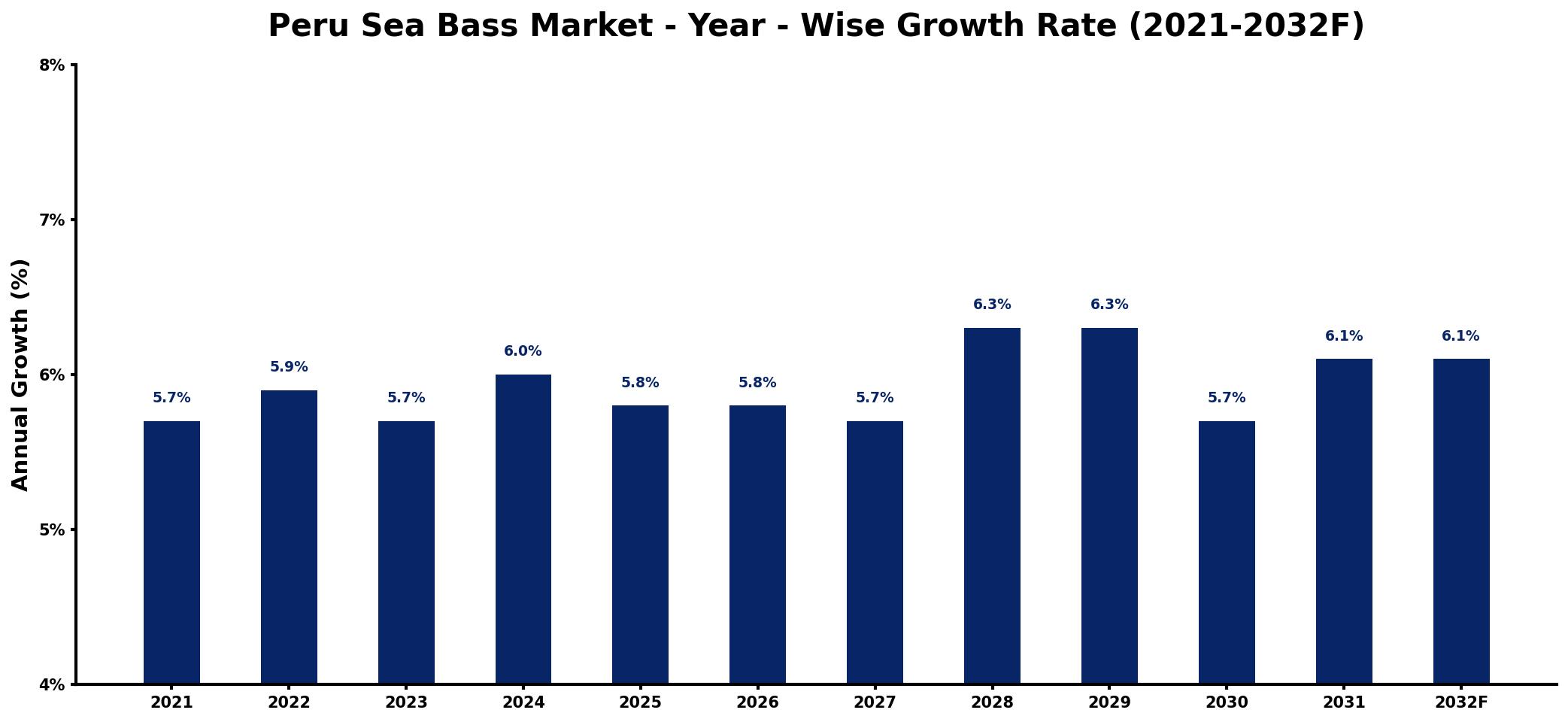
The table below presents the year‑wise growth rates along with the key drivers influencing the market
| Year | Growth Rate | Major Drivers |
| 2021 | 5.7% | Rising consumer health awareness |
| 2022 | 5.9% | Increased gourmet dining experiences |
| 2023 | 5.7% | increased domestic production output |
| 2024 | 6.0% | Expansion of aquaculture facilities |
| 2025 | 5.8% | rising end-use demand growth |
| 2026 | 5.8% | Strengthened international trade agreements |
| 2027 | 5.7% | Enhanced supply chain efficiencies |
| 2028 | 6.3% | Growing popularity of sustainable sourcing |
| 2029 | 6.3% | Increased restaurant menu diversification |
| 2030 | 5.7% | Higher disposable income trends |
| 2031 | 6.1% | Rise in culinary tourism |
| 2032 | 6.1% | growing emerging market penetration |
Note: Market size estimations and growth projections presented in this report are based on 6Wresearch's proprietary forecasting methodology, utilizing the latest available industry data, government publications, and primary research inputs.
Peru Sea Bass Market Synopsis
Peru Sea Bass, widely known as Corvina, is gaining traction not just locally but also in international markets, primarily due to its unique flavor profile and culinary versatility. The seafood is being marketed not only for its taste but also for its nutritional benefits, appealing to health-conscious consumers.
The commitment to sustainable fishing practices in Peru is further enhancing the market's appeal. As consumers grow more aware of sourcing ethics, businesses focusing on responsible fishing and certification processes are witnessing increased demand, which solidifies Peru's standing in the global seafood industry.
Peru Sea Bass Market Key Takeaways
- The market is driven by a rising global appetite for premium seafood, particularly among health-conscious consumers.
- Sustainability and ethical sourcing are emerging as significant factors influencing consumer purchasing decisions.
- Peru's reputation for high-quality seafood continues to enhance its market position in the global arena.
- Innovations in aquaculture and fishing technologies are crucial for maintaining product quality and extending shelf life.
- Government regulations focused on sustainability are instrumental in shaping the future landscape of the market.
Evaluation of Restraints in Peru Sea Bass Market
While the Peru Sea Bass market is poised for growth, it faces inherent challenges related to sustainability and the risk of overfishing. The increasing demand could potentially lead to the depletion of natural populations if not managed correctly. Regulatory frameworks are crucial in addressing these concerns, but non-compliance and illegal fishing activities still pose threats. Additionally, competition from other seafood products and evolving consumer preferences necessitate constant innovation and adaptation from businesses in the sector.
Peru Sea Bass Market Trends
The market is witnessing a significant shift towards transparency in the supply chain, driven by consumer demand for traceable and ethically sourced products. The influence of Peruvian cuisine on global culinary trends is also increasing the visibility and desirability of Peru Sea Bass. Furthermore, advancements in technology are enhancing the processing and packaging of seafood, allowing for improved quality, safety, and distribution.
Peru Sea Bass Market Opportunities
There are promising avenues for investment within the Peru Sea Bass market. With its rich marine resources and a focus on sustainable practices, Peru is well-positioned to cater to the increasing global demand for high-quality seafood. Expanding production facilities and enhancing aquaculture operations can be lucrative. Additionally, investment in technology that improves processing efficiency can significantly benefit both producers and consumers, thereby broadening market access.
Government Initiatives in the Peru Sea Bass Market
The Peruvian government actively promotes sustainable fishing practices through stringent regulations that establish fishing quotas, designate gear types, and regulate fishing seasons. Efforts to combat illegal fishing are complemented by penalties for violations, ensuring that resources are protected. Collaborating with industry stakeholders, the government aims to enhance sustainable practices while balancing economic growth and environmental conservation.
Future Insights of the Peru Sea Bass Market
Looking ahead to 2026-2032, the Peru Sea Bass market is expected to thrive, bolstered by increasing domestic consumption and expanding export opportunities. The focus on health benefits, combined with a growing preference for sustainably sourced seafood, will be pivotal in driving market growth. Technological advancements in aquaculture and transportation infrastructure will further enhance distribution capabilities, broadening market access for Peru Sea Bass.
Peru Sea Bass Market Latest Developments (2025 - 2026)
Recent developments in the Peru Sea Bass market highlight a growing emphasis on sustainable fishing practices and certifications. Companies are enhancing their traceability measures, responding to consumer demands for transparency. Innovations in processing technology have also been noted, aiming to extend product shelf life and improve overall quality. Additionally, there is an ongoing effort to educate consumers about the benefits of choosing responsibly sourced seafood.
Peru Sea Bass Market - Key Attractiveness of the Report
- 10 Years of Market Numbers
- Historical Data Starting from 2022 to 2025
- Base Year: 2025
- Forecast Data until 2032
- Key Performance Indicators Impacting the Market
- Major Upcoming Developments and Projects
Key Highlights of the Report:
- Peru Sea Bass Market Outlook
- Market Size of Peru Sea Bass Market, 2025
- Forecast of Peru Sea Bass Market, 2032
- Historical Data and Forecast of Peru Sea Bass Revenues & Volume for the Period 2022-2032F
- Peru Sea Bass Market Trend Evolution
- Peru Sea Bass Market Drivers and Challenges
- Peru Sea Bass Price Trends
- Peru Sea Bass Porter's Five Forces
- Peru Sea Bass Industry Life Cycle
- Historical Data and Forecast of Peru Sea Bass Market Revenues & Volume By Nature for the Period 2022-2032F
- Historical Data and Forecast of Peru Sea Bass Market Revenues & Volume By Wild for the Period 2022-2032F
- Historical Data and Forecast of Peru Sea Bass Market Revenues & Volume By Farmed for the Period 2022-2032F
- Historical Data and Forecast of Peru Sea Bass Market Revenues & Volume By Type for the Period 2022-2032F
- Historical Data and Forecast of Peru Sea Bass Market Revenues & Volume By Fresh for the Period 2022-2032F
- Historical Data and Forecast of Peru Sea Bass Market Revenues & Volume By Processed for the Period 2022-2032F
- Historical Data and Forecast of Peru Sea Bass Market Revenues & Volume By Sales Channel for the Period 2022-2032F
- Historical Data and Forecast of Peru Sea Bass Market Revenues & Volume By Food Service for the Period 2022-2032F
- Historical Data and Forecast of Peru Sea Bass Market Revenues & Volume By Hypermarket/Supermarket for the Period 2022-2032F
- Historical Data and Forecast of Peru Sea Bass Market Revenues & Volume By Specialty Stores for the Period 2022-2032F
- Historical Data and Forecast of Peru Sea Bass Market Revenues & Volume By Online Channels for the Period 2022-2032F
- Peru Sea Bass Import Export Trade Statistics
- Market Opportunity Assessment By Nature
- Market Opportunity Assessment By Type
- Market Opportunity Assessment By Sales Channel
- Peru Sea Bass Top Companies Market Share
- Peru Sea Bass Competitive Benchmarking By Technical and Operational Parameters
- Peru Sea Bass Company Profiles
- Peru Sea Bass Key Strategic Recommendations






































