South Korea Cloud ERP Market Size & Growth Rate (2026-2032)
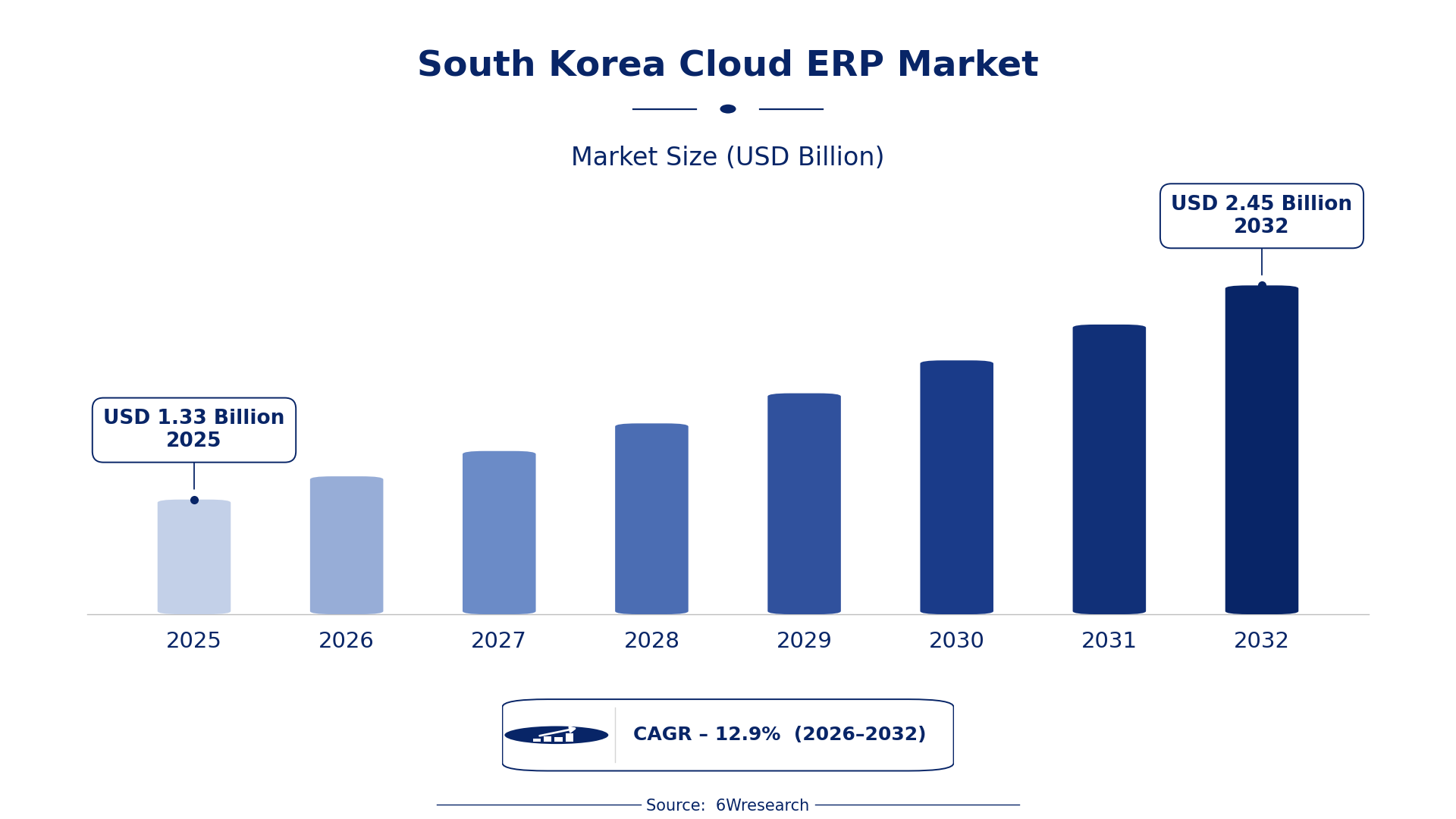
The South Korea Cloud ERP Market was estimated at USD 1331 Million in 2025 and is projected to reach USD 2449 Million by 2032, growing at a CAGR of 12.9% from 2026 to 2032.
South Korea Cloud ERP Market Synopsis
In South Korea, businesses are increasingly recognizing the advantages of cloud ERP systems for enhancing operational efficiency. These systems provide not just flexibility but also the ability to adapt to fluctuating market demands, making them essential for competitive enterprises.
The integration of real-time data analytics within cloud ERP solutions allows South Korean firms to make informed decisions swiftly. This capability drives demand as companies seek to streamline their processes and improve productivity across departments.
South Korea Cloud ERP Market Year-wise Growth Rate and Key Drivers
This graph illustrates the annual growth rates of the South Korea Cloud ERP Market from 2021 to 2032, highlighting a steady upward trajectory and projected expansion over the forecast period.
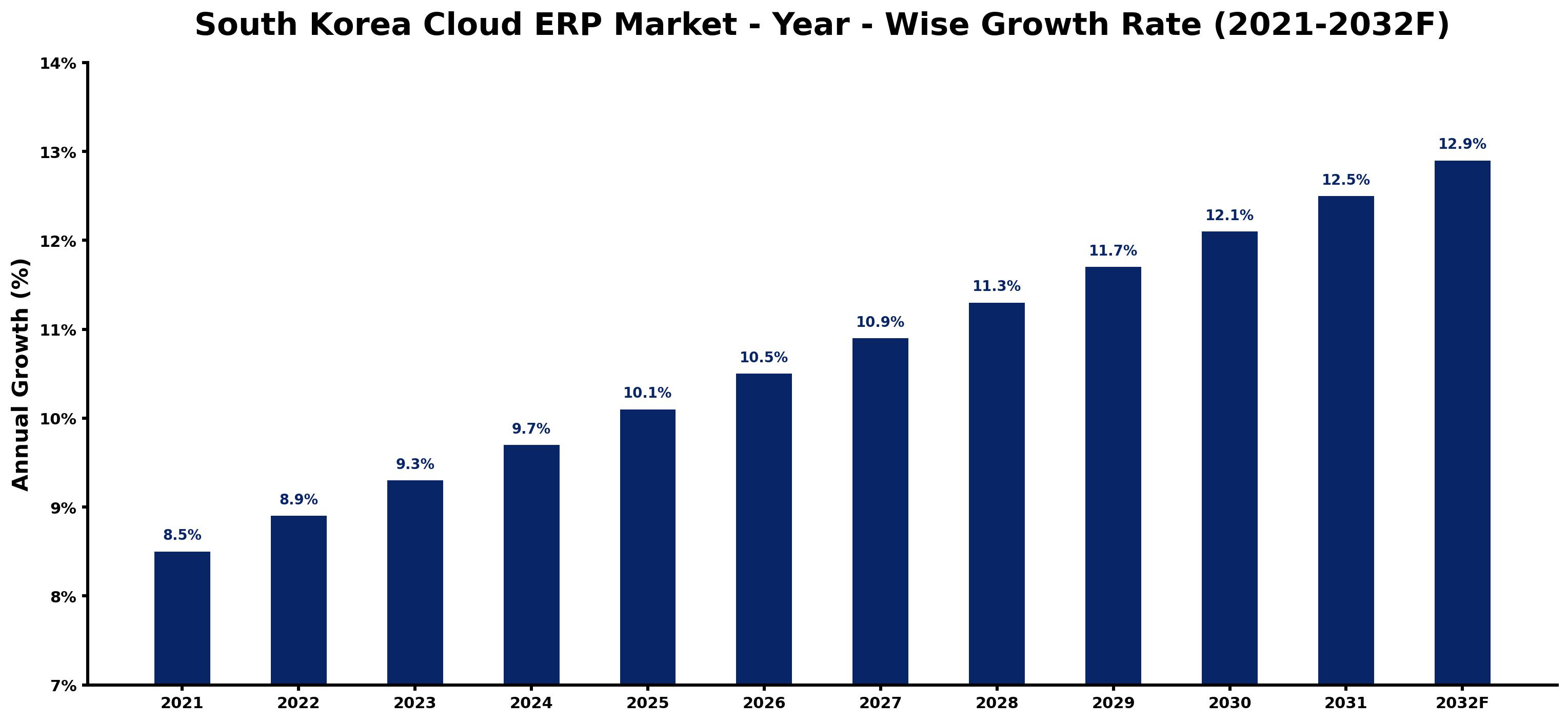
The table below presents the year‑wise growth rates along with the key drivers influencing the market
| Year | Growth Rate | Major Drivers |
| 2021 | 8.5% | Rising adoption of cloud solutions in manufacturing sector. |
| 2022 | 8.9% | Government support for smart factory initiatives enhances ERP usage. |
| 2023 | 9.3% | Increased need for supply chain integration post-pandemic. |
| 2024 | 9.7% | Growth of fintech driving ERP usage in financial services. |
| 2025 | 10.1% | Popularity of subscription models pushing cloud ERP adoption. |
| 2026 | 10.5% | Enhanced cybersecurity regulations prompting ERP migration to cloud. |
| 2027 | 10.9% | Local startups adopting ERP to scale operations efficiently. |
| 2028 | 11.3% | Growing focus on sustainability driving cloud ERP solutions. |
| 2029 | 11.7% | Rising e-commerce demand increasing cloud logistics ERP systems. |
| 2030 | 12.1% | Large enterprises optimizing operations through integrated cloud solutions. |
| 2031 | 12.5% | Expanding digital marketplace requiring agile ERP infrastructures. |
| 2032 | 12.9% | Increasing cross-border trade necessitating flexible ERP platforms. |
Note: Market size estimations and growth projections presented in this report are based on 6Wresearch's proprietary forecasting methodology, utilizing the latest available industry data, government publications, and primary research inputs.
South Korea Cloud ERP Market Key Takeaways
Below are some of the specific key takeaways from the market, including:
- Cloud ERP systems are rapidly replacing traditional on-premise solutions due to their cost-effectiveness and scalability.
- The South Korean government actively promotes cloud adoption through supportive policies and initiatives aimed at digital transformation.
- Growing demand for real-time insights is pushing companies to invest in advanced cloud ERP functionalities.
- Industry-specific compliance challenges are compelling businesses to select tailored cloud ERP solutions.
- Education and training programs are essential for overcoming migration complexities and maximizing ERP system benefits.
Evaluation of Restraints in South Korea Cloud ERP Market
The South Korea Cloud ERP market faces several restraints that could impede its growth trajectory. One major concern is the complexity involved in migrating from legacy systems to cloud-based solutions. Companies often grapple with data integration across various business functions, which can delay implementation timelines. Additionally, ensuring compliance with industry-specific regulations adds another layer of complexity. These challenges require substantial investment in user training and adaptation, diverting resources from core business activities.
South Korea Cloud ERP Market Trends
A noticeable trend in the South Korean cloud ERP market is the shift toward industry-specific solutions. Companies are increasingly looking for ERP systems that cater to their unique operational needs, especially in sectors such as manufacturing and retail. Another significant trend is the integration of artificial intelligence and machine learning technologies, which enhance predictive analytics capabilities. This focus on intelligent ERP systems is reshaping how businesses operate and make decisions.
South Korea Cloud ERP Market Opportunities
The push towards digital transformation presents substantial growth opportunities for cloud ERP providers in South Korea. Companies are eager to adopt ERP solutions that support their transition to automated processes and real-time data usage. There is also a growing market for cloud ERP systems tailored for small and medium enterprises, as these businesses seek affordable yet powerful solutions to enhance their operational efficiency. Public-private partnerships could foster innovation and drive further advancements in cloud technology.
Government Initiatives in the South Korea Cloud ERP Market
Government policy in South Korea is actively shaping the cloud ERP market. Focused on digital transformation and enhancing business process efficiency, current regulations encourage the adoption of cloud-based solutions. This policy framework is crucial as it not only fosters operational agility but also aims to improve overall productivity and competitiveness among businesses.
- A recently completed initiative included a nationwide digital infrastructure upgrade to support cloud adoption across industries.
- A currently ongoing program is aimed at providing digital skills training for employees in small and medium-sized enterprises to ensure smooth ERP transitions.
- A planned public-private partnership is expected to roll out in 2026, aimed at enhancing data interoperability standards for cloud ERP systems.
- The government has introduced regulations to streamline the integration of cloud ERP systems, set to be fully implemented by mid-2026.
- A new framework promoting compliance with ERP software standards is set to launch in early 2025.
Future Insights of the South Korea Cloud ERP Market
Looking ahead, the South Korea Cloud ERP market is expected to witness substantial advancements driven by technological innovations and increasing digital adoption. By 2032, we anticipate that cloud ERP solutions will become the norm across various sectors, enabling businesses to optimize their operations and decision-making processes. As organizations continue to seek agility and efficiency, those offering cutting-edge, customizable ERP solutions are likely to thrive.
South Korea Cloud ERP Market Latest Developments
Recent developments in the South Korea Cloud ERP market indicate a strong momentum towards modernization and enhanced functionality. The past year has seen a flurry of activity as companies strive to upgrade their systems to meet rising consumer expectations and regulatory requirements.
- A major technology vendor launched a new cloud ERP solution designed specifically for the manufacturing sector, which began rollout in Q1 2025.
- In late 2025, a leading regional operator completed a comprehensive upgrade of its cloud ERP infrastructure, improving system reliability and user experience.
- Currently ongoing is an initiative to integrate AI capabilities into existing cloud ERP solutions, enhancing analytics features for better business insights.
- Upcoming in early 2026 is a planned launch of a collaborative cloud platform aimed at fostering partnerships between SMEs and technology providers.
- A significant service upgrade to improve user interface and accessibility features is set to be completed by mid-2026.
South Korea Cloud ERP Market - Key Attractiveness of the Report
- 10 Years of Market Numbers
- Historical Data Starting from 2022 to 2025
- Base Year: 2025
- Forecast Data until 2032
- Key Performance Indicators Impacting the Market
- Major Upcoming Developments and Projects
Key Highlights of the Report:
- South Korea Cloud ERP Market Outlook
- Market Size of South Korea Cloud ERP Market, 2025
- Forecast of South Korea Cloud ERP Market, 2032
- Historical Data and Forecast of South Korea Cloud ERP Revenues & Volume for the Period 2022-2032F
- South Korea Cloud ERP Market Trend Evolution
- South Korea Cloud ERP Market Drivers and Challenges
- South Korea Cloud ERP Price Trends
- South Korea Cloud ERP Porter's Five Forces
- South Korea Cloud ERP Industry Life Cycle
- Historical Data and Forecast of South Korea Cloud ERP Market Revenues & Volume By Component for the Period 2022-2032F
- Historical Data and Forecast of South Korea Cloud ERP Market Revenues & Volume By Solution for the Period 2022-2032F
- Historical Data and Forecast of South Korea Cloud ERP Market Revenues & Volume By Services for the Period 2022-2032F
- Historical Data and Forecast of South Korea Cloud ERP Market Revenues & Volume By Vertical for the Period 2022-2032F
- Historical Data and Forecast of South Korea Cloud ERP Market Revenues & Volume By BFSI for the Period 2022-2032F
- Historical Data and Forecast of South Korea Cloud ERP Market Revenues & Volume By Manufacturing for the Period 2022-2032F
- Historical Data and Forecast of South Korea Cloud ERP Market Revenues & Volume By IT and Telecom for the Period 2022-2032F
- Historical Data and Forecast of South Korea Cloud ERP Market Revenues & Volume By Business Function for the Period 2022-2032F
- Historical Data and Forecast of South Korea Cloud ERP Market Revenues & Volume By Accounting and Finance for the Period 2022-2032F
- Historical Data and Forecast of South Korea Cloud ERP Market Revenues & Volume By Sales and Marketing for the Period 2022-2032F
- Historical Data and Forecast of South Korea Cloud ERP Market Revenues & Volume By Inventory and Order Management for the Period 2022-2032F
- Historical Data and Forecast of South Korea Cloud ERP Market Revenues & Volume By Organization Size for the Period 2022-2032F
- Historical Data and Forecast of South Korea Cloud ERP Market Revenues & Volume By SMEs for the Period 2022-2032F
- Historical Data and Forecast of South Korea Cloud ERP Market Revenues & Volume By Large Enterprises for the Period 2022-2032F
- South Korea Cloud ERP Import Export Trade Statistics
- Market Opportunity Assessment By Component
- Market Opportunity Assessment By Vertical
- Market Opportunity Assessment By Business Function
- Market Opportunity Assessment By Organization Size
- South Korea Cloud ERP Top Companies Market Share
- South Korea Cloud ERP Competitive Benchmarking By Technical and Operational Parameters
- South Korea Cloud ERP Company Profiles
- South Korea Cloud ERP Key Strategic Recommendations






































