Venezuela Physical Security Market Size & Growth Rate (2026-2032)
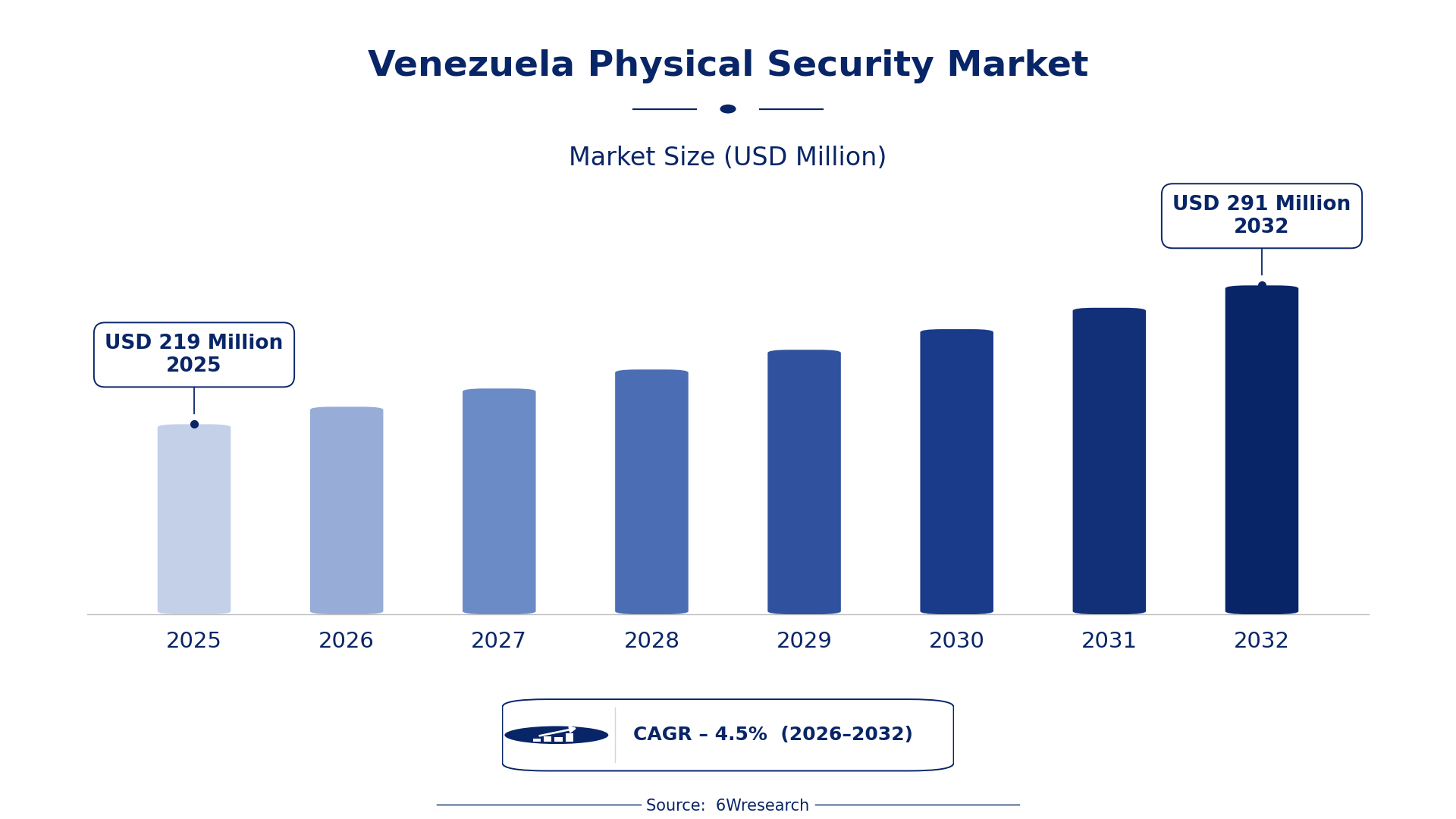
The Venezuela Physical Security Market was estimated at USD 219 Million in 2025 and is projected to reach USD 291 Million by 2032, growing at a CAGR of 4.5% from 2026 to 2032.
Venezuela Physical Security Market Synopsis
The demand for physical security solutions in Venezuela has surged as crime rates rise and political instability becomes a fixture of daily life. As businesses and individuals seek to safeguard their assets, a variety of sectors, including government, commercial, and residential, are investing in advanced security measures.
The Venezuelan market is seeing increased interest in technologies such as video surveillance and access control systems. Despite facing economic hurdles and a challenging investment climate, stakeholders recognize that prioritizing security is essential for protecting both people and property in these turbulent times.
Venezuela Physical Security Market Year-wise Growth Rate and Key Drivers
This graph illustrates the annual growth rates of the Venezuela Physical Security Market from 2021 to 2032, highlighting a steady upward trajectory and projected expansion over the forecast period.
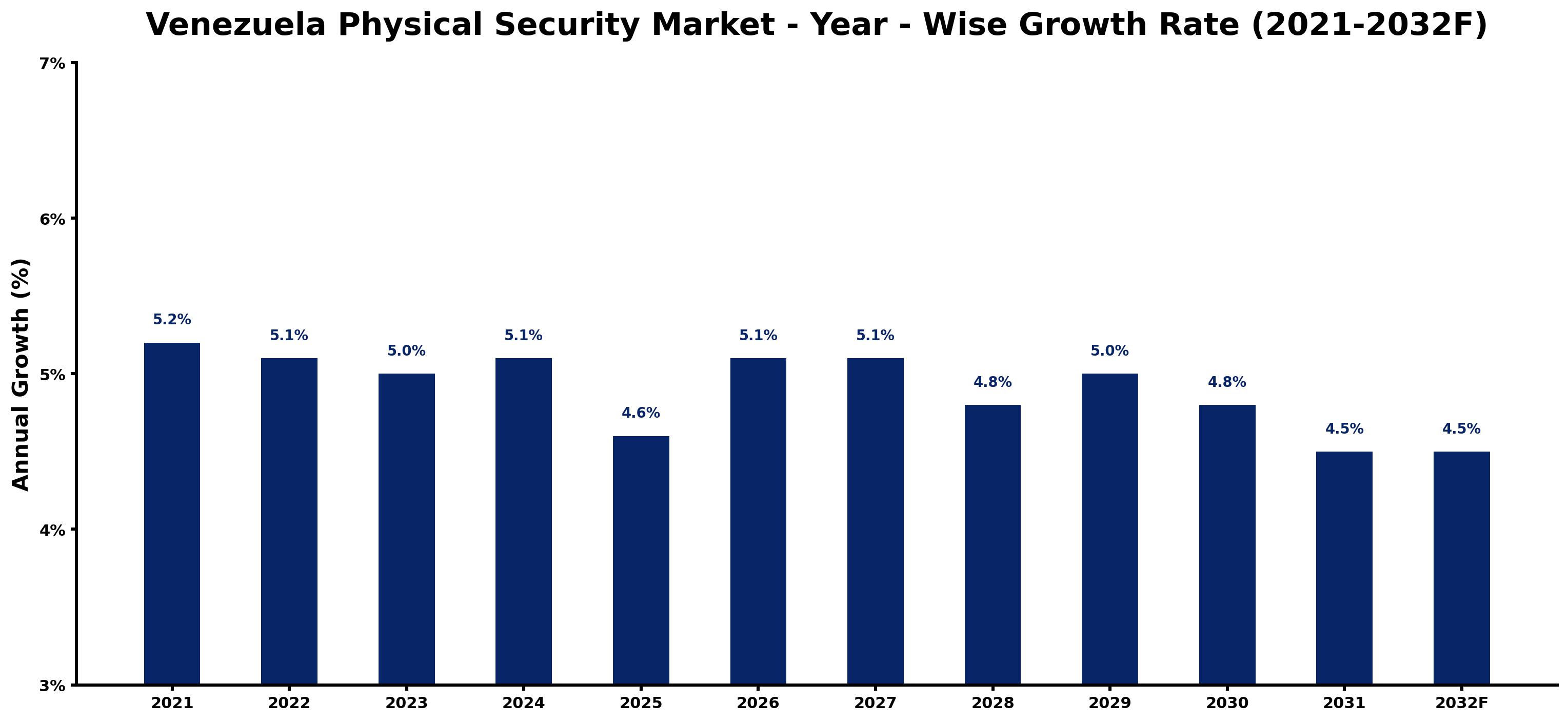
The table below presents the year‑wise growth rates along with the key drivers influencing the market
| Year | Growth Rate | Major Drivers |
| 2021 | 5.2% | Increased crime rates leading to higher security investments |
| 2022 | 5.1% | Growth in private security companies for personal protection |
| 2023 | 5.0% | Government initiatives promoting urban safety enhancements |
| 2024 | 5.1% | Surge in demand for video surveillance installations |
| 2025 | 4.6% | Rising consumer consciousness about safety and security |
| 2026 | 5.1% | Local tech innovations improving security system efficacy |
| 2027 | 5.1% | Migration crisis driving demand for security infrastructure |
| 2028 | 4.8% | Public-private partnerships enhancing security services availability |
| 2029 | 5.0% | Increased foreign investment requiring robust security measures |
| 2030 | 4.8% | Demand for cybersecurity in physical security integration |
| 2031 | 4.5% | Focus on residential security solutions amid urban challenges |
| 2032 | 4.5% | Community programs promoting neighborhood watch initiatives |
Note: Market size estimations and growth projections presented in this report are based on 6Wresearch's proprietary forecasting methodology, utilizing the latest available industry data, government publications, and primary research inputs.
Venezuela Physical Security Market Key Takeaways
Below are some of the specific key takeaways from the market, including:
- The physical security market is diversifying, with increasing demand across sectors.
- Integration of AI in surveillance technologies is enhancing security measures.
- The market is currently influenced by economic challenges and political unrest.
- Investment in security systems is recognized as vital for asset protection.
- Collaborations with international players may be key for future growth.
Evaluation of Restraints in Venezuela Physical Security Market
The primary constraints in the Venezuela Physical Security Market stem from ongoing economic crises and political volatility. High crime rates compound the challenges, as businesses struggle to find the necessary resources and infrastructure to implement effective security solutions. Limited investment due to market uncertainty further complicates matters, hampering the capabilities of security providers and reducing the overall efficacy of proposed security measures.
Venezuela Physical Security Market Trends
Currently, there is a notable trend towards advanced surveillance systems that employ artificial intelligence for better threat detection. Security providers are increasingly offering integrated solutions that combine multiple security layers, enhancing control and monitoring capabilities. on top of that, the growing emphasis on cybersecurity within physical security systems highlights a shift towards protecting both physical assets and data integrity, ensuring comprehensive security solutions in a country facing numerous threats.
Venezuela Physical Security Market Opportunities
There is substantial potential for growth in the Venezuelan Physical Security Market, particularly in sectors like oil and gas, banking, and retail. The urgent need for robust security systems, driven by rising crime rates, presents opportunities for firms specializing in innovative security technologies. Customized solutions that address local needs and conditions can pave the way for new market entrants and help establish a competitive advantage amid economic uncertainty.
Government Initiatives in the Venezuela Physical Security Market
Government involvement is crucial in shaping the Venezuela Physical Security Market, as public safety remains a top priority amid rising crime. Various regulations are being implemented to mandate the installation of security systems in key sectors, aiming to enhance overall safety. However, the overarching political and economic instability complicates the execution of these initiatives, emphasizing the need for coherence and effectiveness in government policies.
- A recently completed initiative mandated the installation of security cameras in public transport facilities to curb crime.
- A current program is underway to increase public-private partnerships aimed at strengthening urban surveillance systems.
- A regulatory framework introduced in late 2025 requires all new businesses to implement basic security measures upon establishment.
- Planned initiatives include a public awareness campaign to educate citizens about personal security practices expected to launch in mid-2026.
- Future proposals aim to integrate cybersecurity measures with physical security regulations, addressing vulnerabilities across sectors.
Future Insights of the Venezuela Physical Security Market
Looking ahead to 2026-2032, the Venezuela Physical Security Market is likely to see steady demand growth driven by ongoing security concerns. Increased investments in technology and infrastructure, albeit limited by economic constraints, could lead to the adoption of more advanced systems. Collaboration with international security experts may also unlock innovative solutions tailored to the unique challenges faced in Venezuela.
Venezuela Physical Security Market Latest Developments
In recent months, the Venezuela Physical Security Market has witnessed significant activity as stakeholders adapt to current challenges. Companies are focusing on upgrading technologies and forming strategic alliances to enhance their offerings and better meet consumer needs.
- A leading regional operator launched a new line of AI-powered surveillance cameras in early 2025, aimed at increasing detection rates in urban areas.
- An initiative that began in late 2025 and remains underway focuses on developing community-based security programs to improve local engagement and vigilance.
- A major technology vendor is planning a rollout of a cloud-based security management system expected to begin in Q3 2026.
- Last month, a consortium of local firms announced a partnership to create a comprehensive security training program for professionals, enhancing workforce capabilities.
- An upcoming conference scheduled for early 2026 will showcase the latest advancements in physical security technologies, attracting both local and international participants.
Venezuela Physical Security Market - Key Attractiveness of the Report
- 10 Years of Market Numbers
- Historical Data Starting from 2022 to 2025
- Base Year: 2025
- Forecast Data until 2032
- Key Performance Indicators Impacting the Market
- Major Upcoming Developments and Projects
Key Highlights of the Report:
- Venezuela Physical Security Market Outlook
- Market Size of Venezuela Physical Security Market, 2025
- Forecast of Venezuela Physical Security Market, 2032
- Historical Data and Forecast of Venezuela Physical Security Revenues & Volume for the Period 2022-2032F
- Venezuela Physical Security Market Trend Evolution
- Venezuela Physical Security Market Drivers and Challenges
- Venezuela Physical Security Price Trends
- Venezuela Physical Security Porter's Five Forces
- Venezuela Physical Security Industry Life Cycle
- Historical Data and Forecast of Venezuela Physical Security Market Revenues & Volume By Component for the Period 2022-2032F
- Historical Data and Forecast of Venezuela Physical Security Market Revenues & Volume By Systems (PACS, PSIM, PIAM, Video Surveillance, Fire and Life Safety) for the Period 2022-2032F
- Historical Data and Forecast of Venezuela Physical Security Market Revenues & Volume By Services for the Period 2022-2032F
- Historical Data and Forecast of Venezuela Physical Security Market Revenues & Volume By Vertical for the Period 2022-2032F
- Historical Data and Forecast of Venezuela Physical Security Market Revenues & Volume By BFSI for the Period 2022-2032F
- Historical Data and Forecast of Venezuela Physical Security Market Revenues & Volume By Government for the Period 2022-2032F
- Historical Data and Forecast of Venezuela Physical Security Market Revenues & Volume By Retail for the Period 2022-2032F
- Historical Data and Forecast of Venezuela Physical Security Market Revenues & Volume By Transportation for the Period 2022-2032F
- Historical Data and Forecast of Venezuela Physical Security Market Revenues & Volume By Residential for the Period 2022-2032F
- Historical Data and Forecast of Venezuela Physical Security Market Revenues & Volume By Telecom and IT for the Period 2022-2032F
- Historical Data and Forecast of Venezuela Physical Security Market Revenues & Volume By Other Verticals (Healthcare, Manufacturing, Energy and Utilities, and Education). for the Period 2022-2032F
- Historical Data and Forecast of Venezuela Physical Security Market Revenues & Volume By Organization Size for the Period 2022-2032F
- Historical Data and Forecast of Venezuela Physical Security Market Revenues & Volume By SMEs for the Period 2022-2032F
- Historical Data and Forecast of Venezuela Physical Security Market Revenues & Volume By Large Enterprises for the Period 2022-2032F
- Venezuela Physical Security Import Export Trade Statistics
- Market Opportunity Assessment By Component
- Market Opportunity Assessment By Vertical
- Market Opportunity Assessment By Organization Size
- Venezuela Physical Security Top Companies Market Share
- Venezuela Physical Security Competitive Benchmarking By Technical and Operational Parameters
- Venezuela Physical Security Company Profiles
- Venezuela Physical Security Key Strategic Recommendations






































