Qatar Television Market Summary
The qatar television market was estimated at USD 477 Million in 2025 and is projected to reach USD 826 Million by 2032, growing at a CAGR of 9.4% from 2026 to 2032.
Qatar Television Market Year-wise Growth Rate and Key Drivers
This graph highlights how the Qatar Television Market has steadily grown over the past five years, supported by major growth factors.
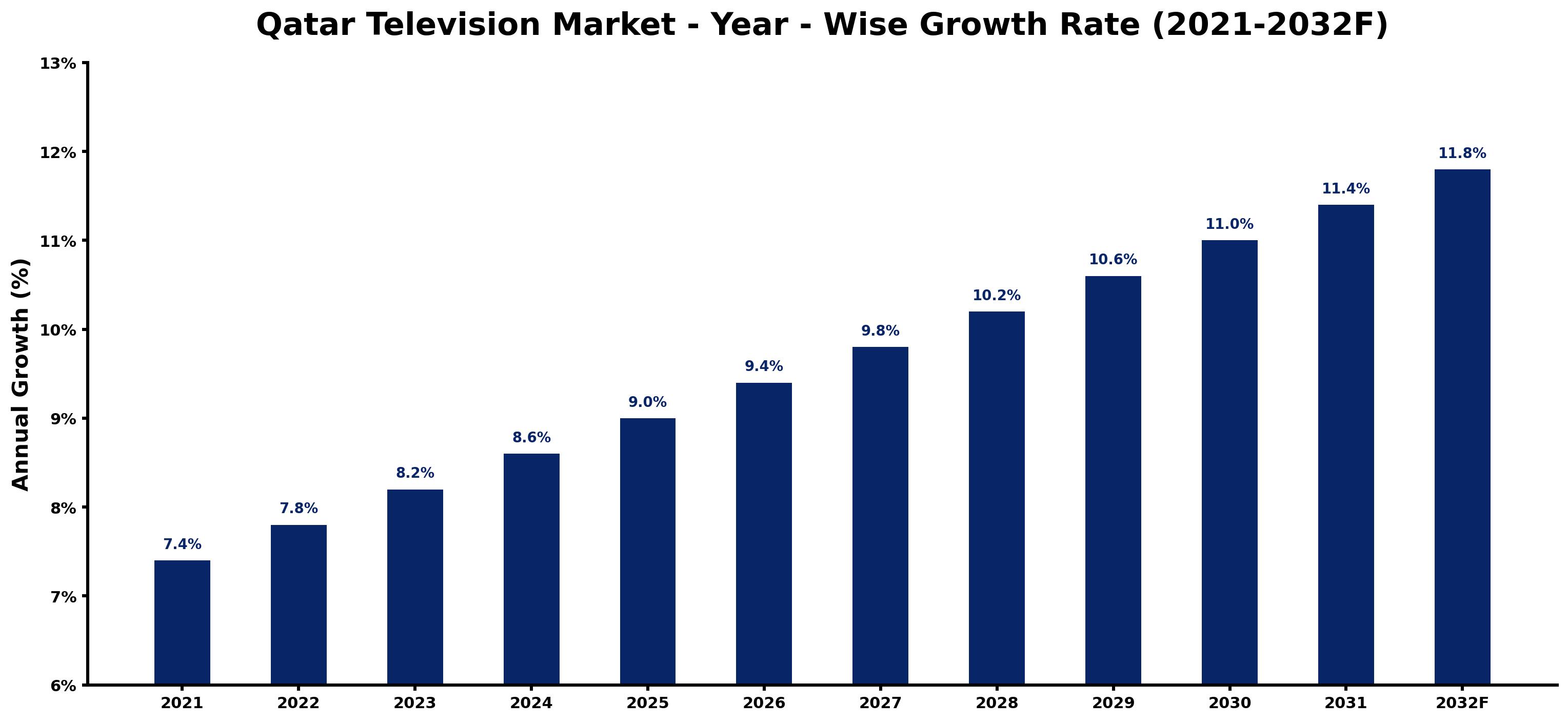
The table below presents the year wise growth rates along with the key drivers influencing the market
| Year | Growth Rate | Major Drivers |
| 2021 | 7.4% | Viewership patterns shifted towards digital streaming and on-demand content preferences. |
| 2022 | 7.8% | Major sporting events sparked increased investment in broadcast technology and infrastructure. |
| 2023 | 8.2% | International content partnerships emerged, enhancing local programming diversity and quality. |
| 2024 | 8.6% | Smart TV penetration expanded, leading to higher adoption of interactive viewing experiences. |
| 2025 | 9.0% | Local production studios gained traction, creating original content tailored to Qatari culture. |
| 2026 | 9.4% | Mobile viewing habits transformed, prompting broadcasters to optimize content for smaller screens. |
| 2027 | 9.8% | Advertising revenue streams diversified, capturing the attention of niche market segments effectively. |
| 2028 | 10.2% | Content personalization algorithms advanced, improving user engagement with tailored viewing options. |
| 2029 | 10.6% | Qatar's media landscape evolved, with notable growth in youth-targeted programming and formats. |
| 2030 | 11.0% | Emerging technologies like AR and VR began enhancing viewer experiences significantly. |
| 2031 | 11.4% | Corporate sponsorships became integral, driving partnerships between brands and media outlets. |
| 2032 | 11.8% | Sustainability initiatives influenced content creation, reflecting broader regional environmental priorities. |
Note - Market size estimations and growth projections presented in this report are based on 6Wresearch's advanced forecasting approach, validated with industry datasets as of June 2026.
Qatar Television Market Synopsis
The Qatar Television Market is projected to reach 9.4% and witness significant growth during the forecast period (2026-2032). This growth can be attributed to several factors, including the rapid economic expansion of Qatar, the increasing consumer demand for diverse television services, and robust technological advancements in broadcasting and display technologies. As the market develops, the infrastructure of Qatar facilitates innovations such as IPTV and enhanced satellite TV services, positioning the country as a significant player in the regional television landscape.
Qatar Television Market Growth Drivers
The growth of the Qatar Television Market is largely driven by several key factors:
- The rise in disposable income among consumers is enhancing the purchasing power for premium television sets and subscription services, leading to an increase in market demand.
- A growing number of households equipped with digital television infrastructure is encouraging the adoption of advanced TV services, significantly boosting the market.
- Technological innovations, including the introduction of OLED, QLED, UHDTV, and 8K resolution TVs, are captivating consumers and enhancing viewing experiences.
- The expansion of internet connectivity and mobile services is facilitating the growth of IPTV, creating additional revenue streams and enhancing content consumption opportunities.
- Increased interest in localized and diverse content is prompting more investments in production, thereby expanding the content offerings available to consumers.
Qatar Television Market Challenges and Restraints
Despite its growth prospects, the Qatar Television Market faces several challenges:
- The high costs associated with content production can deter new entrants and restrict the growth of local productions, impacting the diversity of available programming.
- Limited advertising revenues pose a challenge for broadcasters in maintaining profitability and investing in better infrastructure and technology.
- Stringent censorship laws in Qatar may impact the programming choices available to broadcasters, limiting content creativity and viewer engagement.
- The competitive nature of the media landscape means that traditional broadcasters must continuously innovate to retain audience attention in the face of rising digital and online platforms.
- The lingering effects of the Covid-19 pandemic have disrupted supply chains, leading to potential delays in new product releases and content acquisitions.
Qatar Television Market Government Investment and Initiatives
The Qatari government has been proactive in fostering the development of the television market. Significant investments are being made in public broadcasting initiatives and technological advancements to elevate the quality of local television. Policies that encourage partnerships between public and private entities are also being implemented to stimulate content creation and distribution. Furthermore, with Qatar's focus on diversifying its economy, investments in digital infrastructure are prioritized, allowing for the integration of modern television technologies that align with global best practices.
Qatar Television Market Latest Developments (May 2025 - June 2026)
In the recent period from May 2025 to June 2026, the Qatar Television Market has experienced various developments. There has been a noted increase in strategic collaborations aimed at enhancing content variety and quality, fostering an environment for innovative programming. Additionally, efforts to streamline content distribution channels, including digital and traditional platforms, have been gaining traction, reflecting the shift in viewer preferences. Enhanced investment in high-definition broadcasting capabilities, including 8K technology, is also shaping the competitive landscape as broadcasters seek to capture consumer interest. Moreover, regulatory discussions aimed at addressing censorship laws are underway, which may influence future programming decisions and market dynamics.
Qatar Television Market - Key Attractiveness of the Report
- 10 Years of Market Numbers
- Historical Data Starting from 2022 to 2025
- Base Year: 2025
- Forecast Data until 2032
- Key Performance Indicators Impacting the Market
- Major Upcoming Developments and Projects
Key Highlights of the Report:
- Qatar Television Market Outlook
- Market Size of Qatar Television Market, 2025
- Forecast of Qatar Television Market, 2032
- Historical Data and Forecast of Qatar Television Revenues & Volume for the Period 2022-2032F
- Qatar Television Market Trend Evolution
- Qatar Television Market Drivers and Challenges
- Qatar Television Price Trends
- Qatar Television Porter's Five Forces
- Qatar Television Industry Life Cycle
- Historical Data and Forecast of Qatar Television Market Revenues & Volume By Resolution for the Period 2022-2032F
- Historical Data and Forecast of Qatar Television Market Revenues & Volume By LCD TVs for the Period 2022-2032F
- Historical Data and Forecast of Qatar Television Market Revenues & Volume By OLED TVs for the Period 2022-2032F
- Historical Data and Forecast of Qatar Television Market Revenues & Volume By Types for the Period 2022-2032F
- Historical Data and Forecast of Qatar Television Market Revenues & Volume By 2D TVs for the Period 2022-2032F
- Historical Data and Forecast of Qatar Television Market Revenues & Volume By 3D TVs for the Period 2022-2032F
- Qatar Television Import Export Trade Statistics
- Market Opportunity Assessment By Resolution
- Market Opportunity Assessment By Types
- Qatar Television Top Companies Market Share
- Qatar Television Competitive Benchmarking By Technical and Operational Parameters
- Qatar Television Company Profiles
- Qatar Television Key Strategic Recommendations






































