United Arab Emirates (UAE) Fashion Belt Market Size, Share & Growth Rate
The United Arab Emirates (UAE) Fashion Belt Market was estimated at USD 339 Million in 2025 and is projected to reach USD 466 Million by 2032, growing at a CAGR of 4.7% from 2026 to 2032. This upward trajectory is primarily driven by an expanding consumer base that is increasingly fashion-conscious and willing to invest in high-quality, trendy accessories. As disposable incomes rise in the UAE, more consumers are looking to elevate their personal style with fashionable belts that add flair and versatility to their wardrobes.
United Arab Emirates (UAE) Fashion Belt Market Year-wise Growth Rate and Key Drivers
This graph highlights how the United Arab Emirates (UAE) Fashion Belt Market has steadily grown over the years, supported by major growth factors.
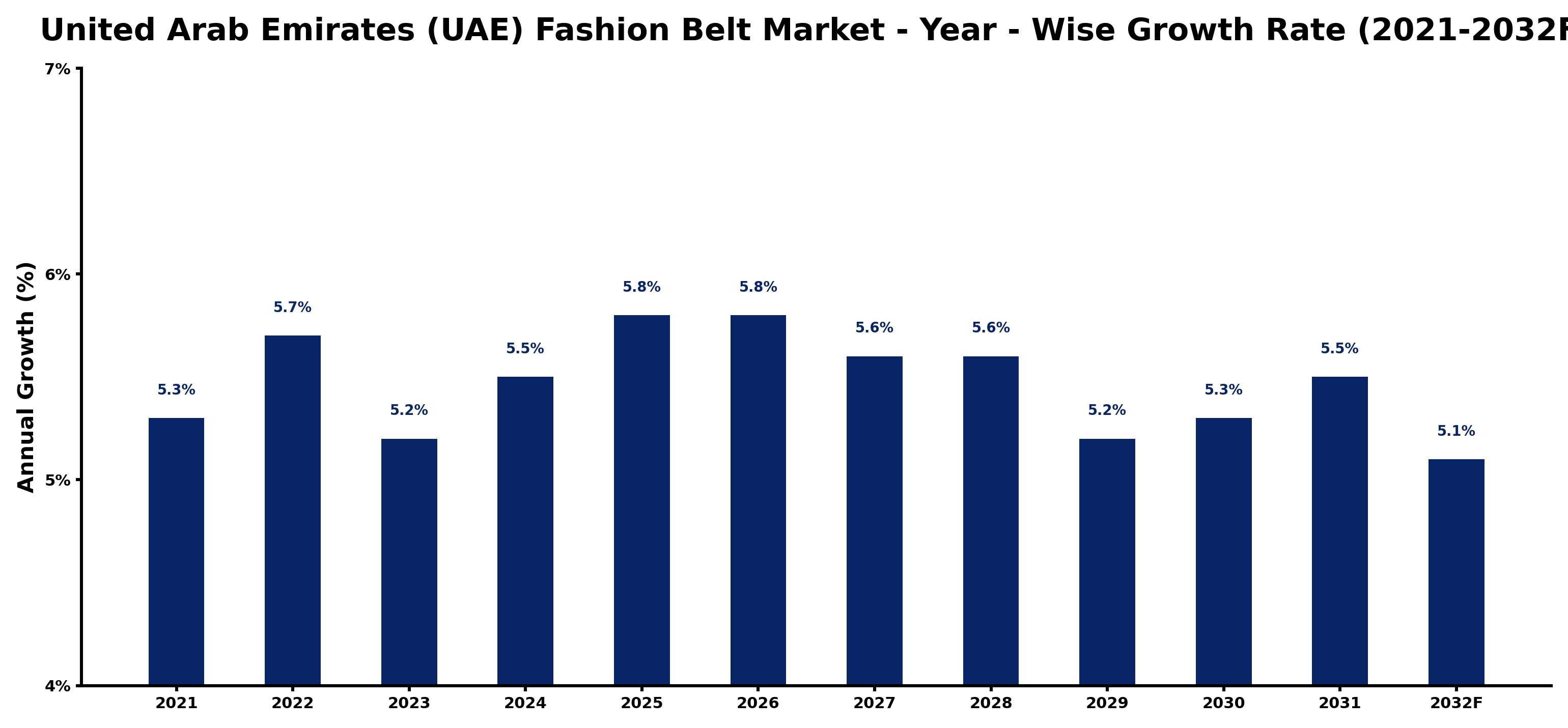
The table below presents the year‑wise growth rates along with the key drivers influencing the market
| Year | Growth Rate | Major Drivers |
| 2021 | 5.3% | Smart manufacturing adoption drives advanced textile machinery investments |
| 2022 | 5.7% | Smart factories optimize fabric cutting efficiency across UAE textile sector |
| 2023 | 5.2% | Smart manufacturing upgrades drive fashion belt production efficiency |
| 2024 | 5.5% | Logistics upgrades boost fashion belt distribution efficiency in UAE |
| 2025 | 5.8% | Smart textile machinery investments boost production capacity in fashion sector |
| 2026 | 5.8% | Domestic textile manufacturing expansion fueled demand for high tech machinery |
| 2027 | 5.6% | Local textile manufacturers expand capacity to meet export demands |
| 2028 | 5.6% | Smart manufacturing adoption boosted textile machinery investment in UAE |
| 2029 | 5.2% | E commerce logistics improvements boosted local fashion production capacities |
| 2030 | 5.3% | Smart logistics investments boosted textile distribution network efficiency |
| 2031 | 5.5% | Optimized logistics infrastructure bolstered fashion supply chain efficiency |
| 2032 | 5.1% | Local fashion brands invest in advanced textile production technologies |
Note - Market size estimations and growth projections presented in this report are based on 6Wresearch’s advanced forecasting approach, validated with industry datasets as of June 2026.
United Arab Emirates (UAE) Fashion Belt Market Synopsis
The UAE Fashion Belt market is currently witnessing a vibrant surge, becoming an essential accessory for the style-savvy. With its diverse climate and cosmopolitan culture, the UAE presents a unique landscape for fashion, where belts are not merely functional but also an embodiment of personal style and status.
In this market, fashion belts come in an array of designs, materials, and price ranges, appealing to both men and women. From luxurious designer options to more affordable styles, the sector has flourished, adapting to the dynamic tastes of a culturally diverse population that values both individuality and trends.
United Arab Emirates (UAE) Fashion Belt Market Key Takeaways
- Fashion belts are increasingly recognized as essential style accessories among UAE consumers.
- The market is characterized by a strong demand for designer and luxury belts, fueled by rising disposable incomes.
- Counterfeit products present a significant challenge, necessitating a focus on brand authenticity.
- The shift towards online shopping post-COVID-19 has altered consumer purchasing behaviors.
- The diverse offerings cater to a wide range of fashion preferences and occasions, ensuring a robust market landscape.
Evaluation of Restraints in United Arab Emirates (UAE) Fashion Belt Market
Despite the market's potential, several restraints hinder its full growth. One primary concern is the pervasive presence of counterfeit products that undermine the integrity of established brands. Consumers may find it challenging to distinguish between genuine and fake items, leading to mistrust and potential declines in sales for reputable manufacturers. Additionally, fluctuations in raw material costs and currency exchange rates can create volatility in pricing, impacting both manufacturers and retailers significantly. This dynamic necessitates a strategic approach to mitigate risks and protect brand value.
United Arab Emirates (UAE) Fashion Belt Market Trends
Current trends in the UAE Fashion Belt market highlight a growing preference for sustainable materials and ethical production practices. Consumers are increasingly concerned about the environmental impact of their purchases, prompting brands to innovate and incorporate eco-friendly materials into their collections. Moreover, technology integration, such as smart belts with wearable tech features, is on the rise, appealing to a younger demographic seeking functionality alongside style. Social media influence remains a driving force, with fashion influencers shaping consumer preferences and encouraging a rapid turnover of styles.
United Arab Emirates (UAE) Fashion Belt Market Opportunities
The opportunities within the UAE Fashion Belt market are substantial. Firstly, expanding e-commerce platforms present avenues for brands to reach wider audiences, particularly post-pandemic. Additionally, collaborations between local designers and international brands can create exclusive collections that resonate with consumers looking for unique offerings. There is also room for growth in the premium segment, as affluent consumers continue to seek high-end belts that reflect their lifestyle and status. Investment in consumer education about authentic brands can further strengthen market trust and loyalty.
Government Initiatives in the United Arab Emirates (UAE) Fashion Belt Market
The UAE government has been proactive in promoting the fashion industry through initiatives that encourage creativity and innovation. Programs aimed at supporting local fashion designers and businesses enhance the appeal of homegrown brands. Furthermore, regulations aimed at combating counterfeit goods are gaining traction, aiming to protect both consumers and genuine brands within the market. This supportive environment is vital for nurturing growth in the fashion belt sector, as it fosters an ecosystem where authenticity and quality are prioritized.
Future Insights of the United Arab Emirates (UAE) Fashion Belt Market
Looking ahead to 2026-2032, the UAE Fashion Belt market is poised for continued growth driven by evolving consumer tastes and preferences. The blend of traditional styles with contemporary designs is likely to dominate, catering to a diverse population. The anticipated growth of the luxury market, coupled with increased awareness of brand authenticity, will pave the way for premium offerings. Digital transformation in marketing and sales will remain crucial, enabling brands to connect with younger consumers through innovative campaigns and a strong online presence.
United Arab Emirates (UAE) Fashion Belt Market Latest Developments (May 2025 - June 2026)
In recent months, the UAE Fashion Belt market has seen increased activity, particularly in online sales channels as brands pivot to meet changing consumer behaviors post-pandemic. Additionally, collaborations between local designers and international luxury houses have gained traction, producing limited edition collections that appeal to style enthusiasts. The push for sustainable fashion is also becoming more pronounced, with several brands launching eco-friendly belt lines, reflecting a growing consumer demand for responsible shopping choices.
United Arab Emirates (UAE) Fashion Belt Market - Key Attractiveness of the Report
- 10 Years of Market Numbers
- Historical Data Starting from 2022 to 2025
- Base Year: 2025
- Forecast Data until 2032
- Key Performance Indicators Impacting the Market
- Major Upcoming Developments and Projects
Key Highlights of the Report:
- United Arab Emirates (UAE) Fashion Belt Market Outlook
- Market Size of United Arab Emirates (UAE) Fashion Belt Market, 2025
- Forecast of United Arab Emirates (UAE) Fashion Belt Market, 2032
- Historical Data and Forecast of United Arab Emirates (UAE) Fashion Belt Revenues & Volume for the Period 2022-2032F
- United Arab Emirates (UAE) Fashion Belt Market Trend Evolution
- United Arab Emirates (UAE) Fashion Belt Market Drivers and Challenges
- United Arab Emirates (UAE) Fashion Belt Price Trends
- United Arab Emirates (UAE) Fashion Belt Porter's Five Forces
- United Arab Emirates (UAE) Fashion Belt Industry Life Cycle
- Historical Data and Forecast of United Arab Emirates (UAE) Fashion Belt Market Revenues & Volume By Types for the Period 2022-2032F
- Historical Data and Forecast of United Arab Emirates (UAE) Fashion Belt Market Revenues & Volume By Grommet Belt for the Period 2022-2032F
- Historical Data and Forecast of United Arab Emirates (UAE) Fashion Belt Market Revenues & Volume By Chain Belt for the Period 2022-2032F
- Historical Data and Forecast of United Arab Emirates (UAE) Fashion Belt Market Revenues & Volume By Leather Belt for the Period 2022-2032F
- Historical Data and Forecast of United Arab Emirates (UAE) Fashion Belt Market Revenues & Volume By Others for the Period 2022-2032F
- Historical Data and Forecast of United Arab Emirates (UAE) Fashion Belt Market Revenues & Volume By Industry for the Period 2022-2032F
- Historical Data and Forecast of United Arab Emirates (UAE) Fashion Belt Market Revenues & Volume By Online Sales for the Period 2022-2032F
- Historical Data and Forecast of United Arab Emirates (UAE) Fashion Belt Market Revenues & Volume By Offline Sales for the Period 2022-2032F
- United Arab Emirates (UAE) Fashion Belt Import Export Trade Statistics
- Market Opportunity Assessment By Types
- Market Opportunity Assessment By Industry
- United Arab Emirates (UAE) Fashion Belt Top Companies Market Share
- United Arab Emirates (UAE) Fashion Belt Competitive Benchmarking By Technical and Operational Parameters
- United Arab Emirates (UAE) Fashion Belt Company Profiles
- United Arab Emirates (UAE) Fashion Belt Key Strategic Recommendations






































