United Kingdom (UK) Mineral Oil Market Size, Share & Growth Rate
The United Kingdom (UK) Mineral Oil Market was estimated at USD 464 Million in 2025 and is projected to reach USD 575 Million by 2032, growing at a CAGR of 3.1% from 2026 to 2032. This growth trajectory can largely be attributed to the increasing applications of mineral oils in pharmaceuticals and cosmetics, where their stability and non-reactivity are paramount. Additionally, rising demand for environmentally-friendly alternatives is propelling innovation, as companies seek to create bio-based formulations to meet both consumer preferences and regulatory requirements.
United Kingdom (UK) Mineral Oil Market Year-wise Growth Rate and Key Drivers
This graph highlights how the United Kingdom (UK) Mineral Oil Market has steadily grown over the years, supported by major growth factors.
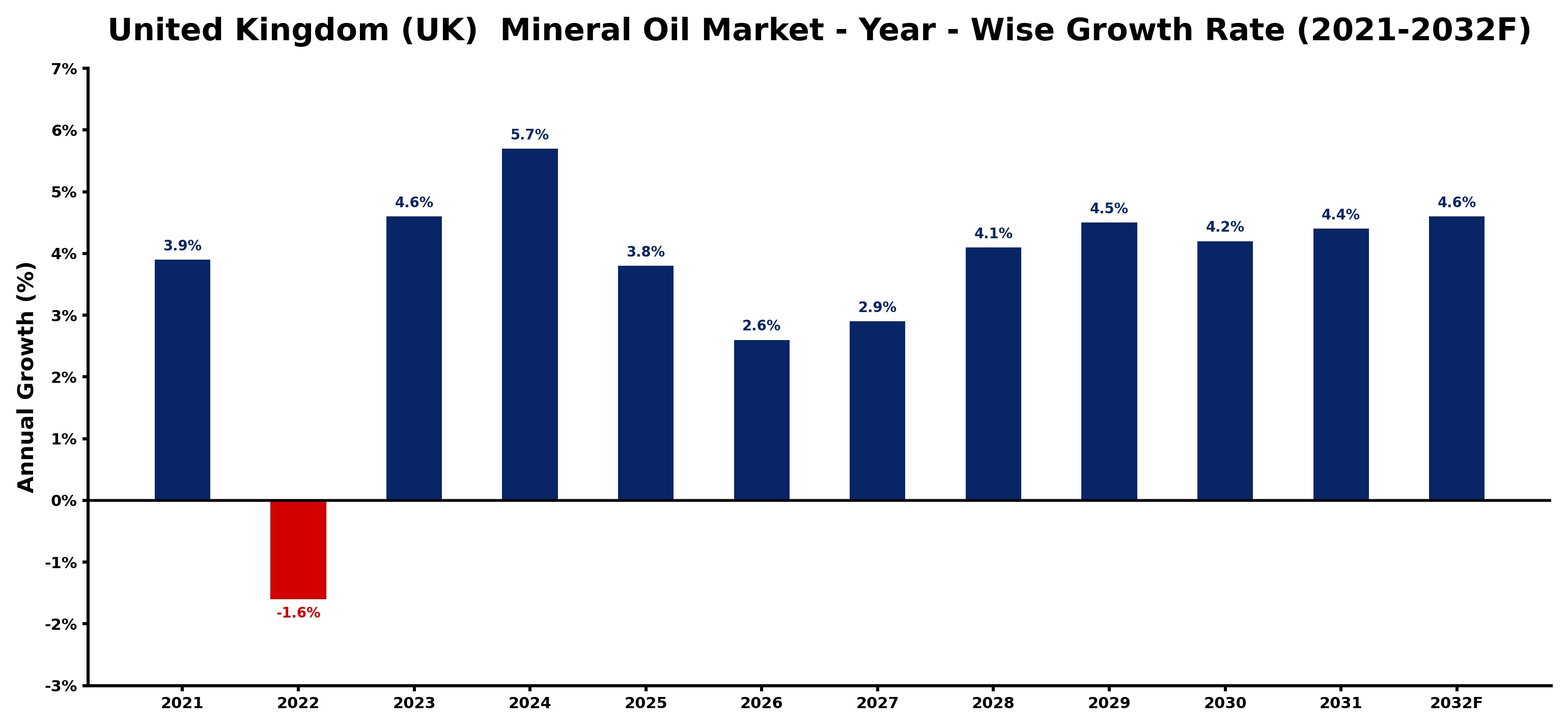
The table below presents the year‑wise growth rates along with the key drivers influencing the market
| Year | Growth Rate | Major Drivers |
| 2021 | 3.9% | Increasing adoption of advanced technologies |
| 2022 | -1.6% | Increasing industrial infrastructure investments |
| 2023 | 4.6% | Growing renewable energy integration projects |
| 2024 | 5.7% | Increasing smart city development projects |
| 2025 | 3.8% | Increasing smart city development projects |
| 2026 | 2.6% | Expansion of transportation and logistics networks |
| 2027 | 2.9% | Growing renewable energy integration projects |
| 2028 | 4.1% | Increasing industrial infrastructure investments |
| 2029 | 4.5% | Rapid growth in telecom and data center sectors |
| 2030 | 4.2% | Expansion of transportation and logistics networks |
| 2031 | 4.4% | Increasing smart city development projects |
| 2032 | 4.6% | Increasing industrial infrastructure investments |
Note - Market size estimations and growth projections presented in this report are based on 6Wresearch’s advanced forecasting approach, validated with industry datasets as of June 2026.
United Kingdom (UK) Mineral Oil Market Synopsis
A pivotal force currently shaping the UK mineral oil market is the stringent regulatory landscape governing product purity and environmental safety. As regulations evolve, manufacturers are prompted to innovate, focusing on sustainability while ensuring compliance with quality standards. These regulations not only ensure safety for consumers but also foster market differentiation among suppliers.
Furthermore, the demand from various sectors, particularly in industrial lubrication and cosmetic applications, continues to rise, creating a competitive landscape. The push for energy efficiency and eco-friendly solutions means that companies must adapt quickly, which influences product development strategies and investment in new technologies.
United Kingdom (UK) Mineral Oil Market Key Takeaways
- The market is projected to grow steadily, driven by diverse applications in pharmaceuticals, cosmetics, and lubrication.
- Regulatory frameworks are enhancing product safety and environmental standards, influencing market dynamics.
- Innovation in bio-based and sustainable formulations is becoming increasingly critical for market players.
- Demand for mineral oils continues to expand across various industrial sectors, creating opportunities for growth.
- Technological advancements in extraction and processing are set to redefine product offerings in the market.
Evaluation of Restraints in United Kingdom (UK) Mineral Oil Market
Despite its growth potential, the UK mineral oil market faces notable restraints that could hinder progress. Primarily, the pressure to meet stringent environmental standards limits traditional extraction and production processes. The industry must continuously adapt, focusing on achieving optimal performance and sustainability in lubricants, particularly within automotive and pharmaceutical applications. Furthermore, the challenge of balancing cost-effectiveness with innovative solutions poses a significant hurdle for companies aiming to stay competitive in a rapidly evolving landscape.
United Kingdom (UK) Mineral Oil Market Trends
Several key trends are emerging within the UK mineral oil market that are reshaping demand and technological approaches. A significant trend is the growing adoption of bio-based alternatives, driven by consumer preference for environmentally-friendly products. Additionally, advancements in extraction technology are enhancing the efficiency of mineral oil production, allowing for lower costs and improved product quality. There is also a marked increase in research focusing on the biodegradability of lubricants, highlighting a shift toward eco-conscious production methods.
United Kingdom (UK) Mineral Oil Market Opportunities
Opportunities for growth in the UK mineral oil market are promising, particularly in sectors demanding sustainable and high-performance solutions. The pharmaceutical industry remains a key area for investment, as the need for reliable laxatives and ointments drives demand for high-quality mineral oils. Moreover, the cosmetics sector is increasingly leaning towards products with natural and bio-based ingredients, creating a fertile ground for innovation. Companies that prioritize R&D and align their offerings with environmental standards are well-positioned to capture market share in this evolving landscape.
Government Initiatives in the United Kingdom (UK) Mineral Oil Market
The UK government has implemented various policies aimed at promoting sustainability and ensuring the quality of mineral oil products. Regulatory frameworks are focused on product safety, environmental protection, and adherence to quality standards, helping to safeguard consumer health while minimizing ecological impacts. Moreover, public spending initiatives are encouraging investment in innovative technologies that enhance the sustainability of mineral oil extraction and production processes.
Future Insights of the United Kingdom (UK) Mineral Oil Market
Looking ahead to 2026-2032, the UK mineral oil market is poised for sustained growth, driven by evolving consumer preferences and regulatory pressures. Companies that successfully navigate the challenges of sustainability while delivering high-quality products will emerge as leaders. Moreover, as the market shifts towards bio-based alternatives, firms that invest in research and development will likely capture new opportunities and maintain competitive advantages in an increasingly discerning consumer environment.
United Kingdom (UK) Mineral Oil Market Latest Developments (May 2025 - June 2026)
Recent developments within the UK mineral oil market reflect a concerted effort to enhance sustainability and comply with regulatory requirements. Companies are ramping up R&D efforts aimed at developing bio-based formulations, responding to market demands for eco-friendly alternatives. Additionally, ongoing investments in extraction technologies are poised to improve operational efficiencies, with many players focusing on lifecycle management strategies to optimize product offerings and minimize environmental impact.
United Kingdom (UK) Mineral Oil Market - Key Attractiveness of the Report
- 10 Years of Market Numbers
- Historical Data Starting from 2022 to 2025
- Base Year: 2025
- Forecast Data until 2032
- Key Performance Indicators Impacting the Market
- Major Upcoming Developments and Projects
Key Highlights of the Report:
- United Kingdom (UK) Mineral Oil Market Outlook
- Market Size of United Kingdom (UK) Mineral Oil Market, 2025
- Forecast of United Kingdom (UK) Mineral Oil Market, 2032
- Historical Data and Forecast of United Kingdom (UK) Mineral Oil Revenues & Volume for the Period 2022-2032F
- United Kingdom (UK) Mineral Oil Market Trend Evolution
- United Kingdom (UK) Mineral Oil Market Drivers and Challenges
- United Kingdom (UK) Mineral Oil Price Trends
- United Kingdom (UK) Mineral Oil Porter's Five Forces
- United Kingdom (UK) Mineral Oil Industry Life Cycle
- Historical Data and Forecast of United Kingdom (UK) Mineral Oil Market Revenues & Volume By Grade for the Period 2022-2032F
- Historical Data and Forecast of United Kingdom (UK) Mineral Oil Market Revenues & Volume By Technical Oil for the Period 2022-2032F
- Historical Data and Forecast of United Kingdom (UK) Mineral Oil Market Revenues & Volume By White Oil for the Period 2022-2032F
- Historical Data and Forecast of United Kingdom (UK) Mineral Oil Market Revenues & Volume By Application for the Period 2022-2032F
- Historical Data and Forecast of United Kingdom (UK) Mineral Oil Market Revenues & Volume By Baby Oil for the Period 2022-2032F
- Historical Data and Forecast of United Kingdom (UK) Mineral Oil Market Revenues & Volume By Cosmetics for the Period 2022-2032F
- Historical Data and Forecast of United Kingdom (UK) Mineral Oil Market Revenues & Volume By Skin Care Products for the Period 2022-2032F
- Historical Data and Forecast of United Kingdom (UK) Mineral Oil Market Revenues & Volume By Hair Care Products for the Period 2022-2032F
- Historical Data and Forecast of United Kingdom (UK) Mineral Oil Market Revenues & Volume By Consumer Goods for the Period 2022-2032F
- Historical Data and Forecast of United Kingdom (UK) Mineral Oil Market Revenues & Volume By Others for the Period 2022-2032F
- United Kingdom (UK) Mineral Oil Import Export Trade Statistics
- Market Opportunity Assessment By Grade
- Market Opportunity Assessment By Application
- United Kingdom (UK) Mineral Oil Top Companies Market Share
- United Kingdom (UK) Mineral Oil Competitive Benchmarking By Technical and Operational Parameters
- United Kingdom (UK) Mineral Oil Company Profiles
- United Kingdom (UK) Mineral Oil Key Strategic Recommendations






































