United States (US) Orphan Drugs Market Size, Share & Growth Rate
The United States (US) Orphan Drugs Market was estimated at USD 80 Million in 2025 and is projected to reach USD 94 Million by 2032, growing at a CAGR of 2.3% from 2026 to 2032. This growth is primarily driven by the increasing prevalence of rare diseases, which affects over 30 million Americans. The Orphan Drug Act continues to incentivize pharmaceutical innovation, while advancements in biotechnology enhance the development of targeted therapies.
United States (US) Orphan Drugs Market Year-wise Growth Rate and Key Drivers
This graph highlights how the United States (US) Orphan Drugs Market has steadily grown over the years, supported by major growth factors.
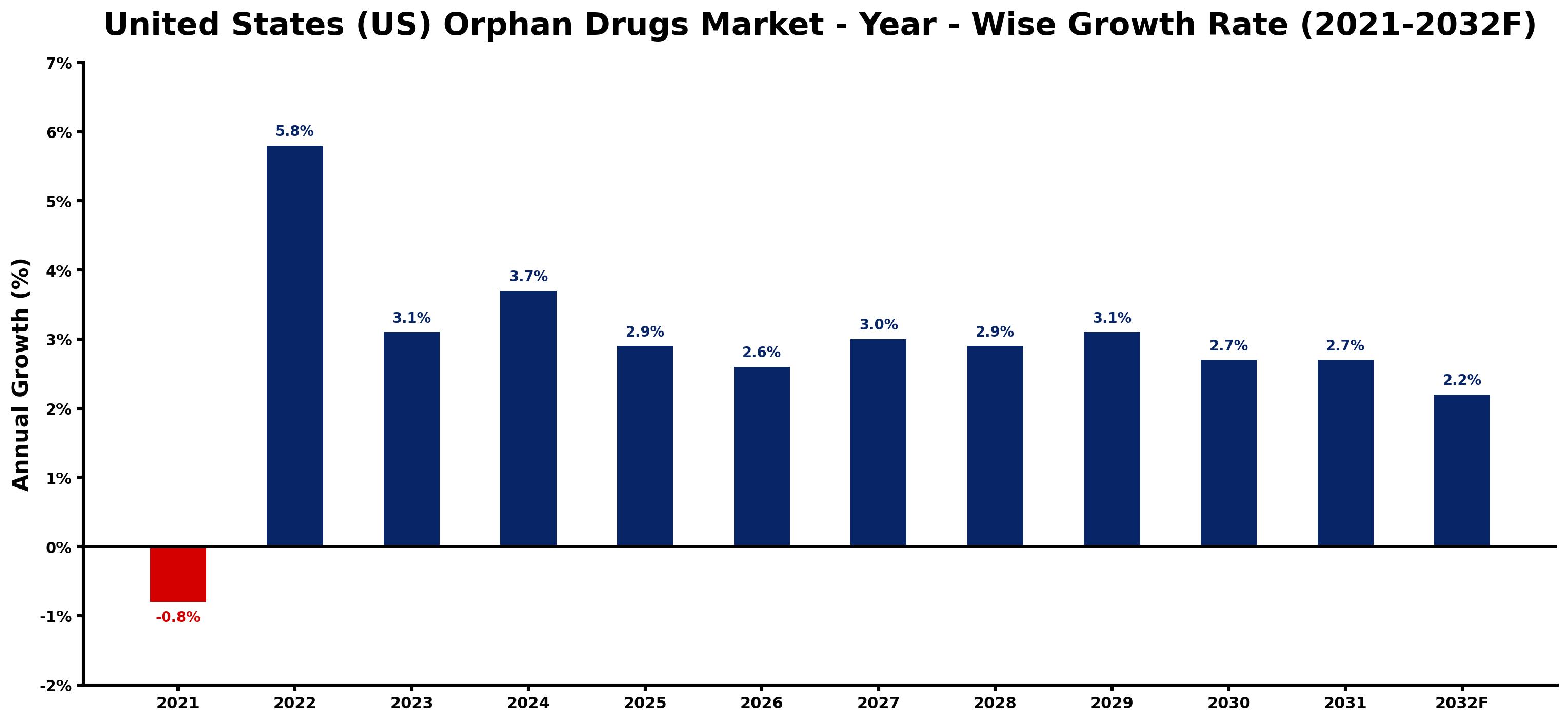
The table below presents the year‑wise growth rates along with the key drivers influencing the market
| Year | Growth Rate | Major Drivers |
| 2021 | -0.8% | Increasing adoption of advanced technologies |
| 2022 | 5.8% | Rapid growth in telecom and data center sectors |
| 2023 | 3.1% | Growing urbanization and commercial development |
| 2024 | 3.7% | Increasing industrial automation investments |
| 2025 | 2.9% | Expansion of manufacturing activities |
| 2026 | 2.6% | Increasing smart city development projects |
| 2027 | 3.0% | Growing urbanization and commercial development |
| 2028 | 2.9% | Expansion of transportation and logistics networks |
| 2029 | 3.1% | Expansion of commercial construction activities |
| 2030 | 2.7% | Rapid growth in telecom and data center sectors |
| 2031 | 2.7% | Increasing smart city development projects |
| 2032 | 2.2% | Increasing smart city development projects |
Note - Market size estimations and growth projections presented in this report are based on 6Wresearch's advanced forecasting approach, validated with industry datasets as of June 2026.
United States (US) Orphan Drugs Market Synopsis
In recent years, the United States Orphan Drugs Market has gained momentum, spurred by the urgent need for effective treatments for numerous rare diseases. As the landscape evolves, it is crucial to examine the dynamics that are guiding this market towards substantial growth.
Looking ahead, the market is on a trajectory shaped by advancements in precision medicine and targeted therapy development. Collaboration between pharmaceutical companies and regulatory bodies is expected to streamline the approval processes, thereby fostering a more robust market environment.
United States (US) Orphan Drugs Market Key Takeaways
- Significant unmet medical needs exist, with over 7,000 rare diseases identified in the United States.
- The Orphan Drug Act provides vital incentives that encourage pharmaceutical companies to invest in rare disease treatments.
- High drug prices reflect the extensive R&D costs, but the potential for profitability remains strong.
- Recent advancements in biotechnology are paving the way for innovative therapies, including gene and cell-based treatments.
- Strategic partnerships are becoming increasingly important in expediting drug development and market entry.
Evaluation of Restraints in United States (US) Orphan Drugs Market
The high costs associated with developing orphan drugs create significant barriers for companies in this market. Limited patient populations challenge the ability to recoup investments, leading to elevated pricing strategies that can hinder access for patients in need. Regulatory complexities further complicate the landscape, requiring a well-defined strategy to navigate the approval processes effectively. Additionally, reimbursement issues from payers pose challenges, as they often hesitate to cover the high costs associated with these niche treatments.
United States (US) Orphan Drugs Market Trends
A notable trend within the United States Orphan Drugs Market is the increasing emphasis on precision medicine and targeted therapies. Pharmaceutical companies are now focusing more on developing drugs that cater to specific genetic markers associated with rare diseases. Furthermore, collaboration between industry stakeholders—including research institutions and regulatory agencies—is expected to facilitate faster approval processes, thereby accelerating the availability of orphan drugs. Innovations in gene therapy and cell-based therapies are also gaining traction, enhancing the prospects for effective treatment options.
United States (US) Orphan Drugs Market Opportunities
Investment opportunities in the United States Orphan Drugs Market are abundant, particularly given the substantial unmet demand for treatments in this sector. The backing of the Orphan Drug Act, which offers tax incentives and market exclusivity, further enhances the appeal for investors. As the industry shifts towards personalized medicine, companies focusing on these innovative approaches are likely to reap significant rewards. Additionally, leveraging collaborations with research entities can accelerate the development of promising therapies, maximizing the potential for market success.
Government Initiatives in the United States (US) Orphan Drugs Market
The Orphan Drug Act of 1983 remains a cornerstone of government policy supporting the development of treatments for rare diseases. It offers tax credits, grants for clinical trials, and periods of market exclusivity to incentivize pharmaceutical companies. The FDA also plays a critical role by streamlining regulatory processes for orphan drugs, ensuring safety and efficacy while expediting approvals. These initiatives collectively foster a conducive environment for innovation and investment in the orphan drugs landscape.
Future Insights of the United States (US) Orphan Drugs Market
The future of the United States Orphan Drugs Market is bright, buoyed by an increasing understanding of rare diseases and a favorable regulatory environment. The sustained growth of this market will be driven by ongoing advancements in biotechnology and an emphasis on personalized medicine. Moreover, growing collaborations among pharmaceutical companies, academic institutions, and government entities will likely enhance research and development efforts, propelling the introduction of new orphan therapies. Ultimately, the market is poised for dynamic growth and transformative innovations in the coming years.
United States (US) Orphan Drugs Market Latest Developments (May 2025 - June 2026)
Recent developments in the United States Orphan Drugs Market indicate a strengthening focus on collaborative efforts to expedite the approval of new therapies. Industry players are increasingly engaging in partnerships with academic research institutions to enhance their R&D capabilities. Additionally, there has been a notable uptick in clinical trials focused on gene therapies, aiming to address a wider range of rare diseases. These trends are reflective of the market's evolution towards more innovative and effective treatment solutions.
United States (US) Orphan Drugs Market - Key Attractiveness of the Report
- 10 Years of Market Numbers
- Historical Data Starting from 2022 to 2025
- Base Year: 2025
- Forecast Data until 2032
- Key Performance Indicators Impacting the Market
- Major Upcoming Developments and Projects
Key Highlights of the Report:
- United States (US) Orphan Drugs Market Outlook
- Market Size of United States (US) Orphan Drugs Market, 2025
- Forecast of United States (US) Orphan Drugs Market, 2032
- Historical Data and Forecast of United States (US) Orphan Drugs Revenues & Volume for the Period 2022-2032F
- United States (US) Orphan Drugs Market Trend Evolution
- United States (US) Orphan Drugs Market Drivers and Challenges
- United States (US) Orphan Drugs Price Trends
- United States (US) Orphan Drugs Porter's Five Forces
- United States (US) Orphan Drugs Industry Life Cycle
- Historical Data and Forecast of United States (US) Orphan Drugs Market Revenues & Volume By Drugs for the Period 2022-2032F
- Historical Data and Forecast of United States (US) Orphan Drugs Market Revenues & Volume By Revlimid for the Period 2022-2032F
- Historical Data and Forecast of United States (US) Orphan Drugs Market Revenues & Volume By Rituxan for the Period 2022-2032F
- Historical Data and Forecast of United States (US) Orphan Drugs Market Revenues & Volume By Opdivo for the Period 2022-2032F
- Historical Data and Forecast of United States (US) Orphan Drugs Market Revenues & Volume By Keytruda for the Period 2022-2032F
- Historical Data and Forecast of United States (US) Orphan Drugs Market Revenues & Volume By Imbruvica for the Period 2022-2032F
- Historical Data and Forecast of United States (US) Orphan Drugs Market Revenues & Volume By Soliris for the Period 2022-2032F
- Historical Data and Forecast of United States (US) Orphan Drugs Market Revenues & Volume By Other Orphan Drugs for the Period 2022-2032F
- Historical Data and Forecast of United States (US) Orphan Drugs Market Revenues & Volume By Drug Type for the Period 2022-2032F
- Historical Data and Forecast of United States (US) Orphan Drugs Market Revenues & Volume By Biologics for the Period 2022-2032F
- Historical Data and Forecast of United States (US) Orphan Drugs Market Revenues & Volume By Non-Biologics for the Period 2022-2032F
- Historical Data and Forecast of United States (US) Orphan Drugs Market Revenues & Volume By Therapy Class for the Period 2022-2032F
- Historical Data and Forecast of United States (US) Orphan Drugs Market Revenues & Volume By Oncology for the Period 2022-2032F
- Historical Data and Forecast of United States (US) Orphan Drugs Market Revenues & Volume By Blood for the Period 2022-2032F
- Historical Data and Forecast of United States (US) Orphan Drugs Market Revenues & Volume By Endocrine for the Period 2022-2032F
- Historical Data and Forecast of United States (US) Orphan Drugs Market Revenues & Volume By Central Nervous Systems for the Period 2022-2032F
- Historical Data and Forecast of United States (US) Orphan Drugs Market Revenues & Volume By Cardiovascular for the Period 2022-2032F
- Historical Data and Forecast of United States (US) Orphan Drugs Market Revenues & Volume By Respiratory for the Period 2022-2032F
- United States (US) Orphan Drugs Import Export Trade Statistics
- Market Opportunity Assessment By Drugs
- Market Opportunity Assessment By Drug Type
- Market Opportunity Assessment By Therapy Class
- United States (US) Orphan Drugs Top Companies Market Share
- United States (US) Orphan Drugs Competitive Benchmarking By Technical and Operational Parameters
- United States (US) Orphan Drugs Company Profiles
- United States (US) Orphan Drugs Key Strategic Recommendations






































