Venezuela Apiculture Market Size, Share & Growth Rate
The Venezuela Apiculture Market was estimated at USD 366 Million in 2025 and is projected to reach USD 493 Million by 2032, growing at a CAGR of 4.3% from 2026 to 2032. This growth trajectory is propelled by a burgeoning interest in sustainable beekeeping practices and an increasing consumer preference for natural honey products. Furthermore, the adaptation of innovative farming techniques and diversification into specialty honey varieties are enhancing the market's resilience amidst economic challenges.
Venezuela Apiculture Market Year-wise Growth Rate and Key Drivers
This graph highlights how the Venezuela Apiculture Market has steadily grown over the years, supported by major growth factors.
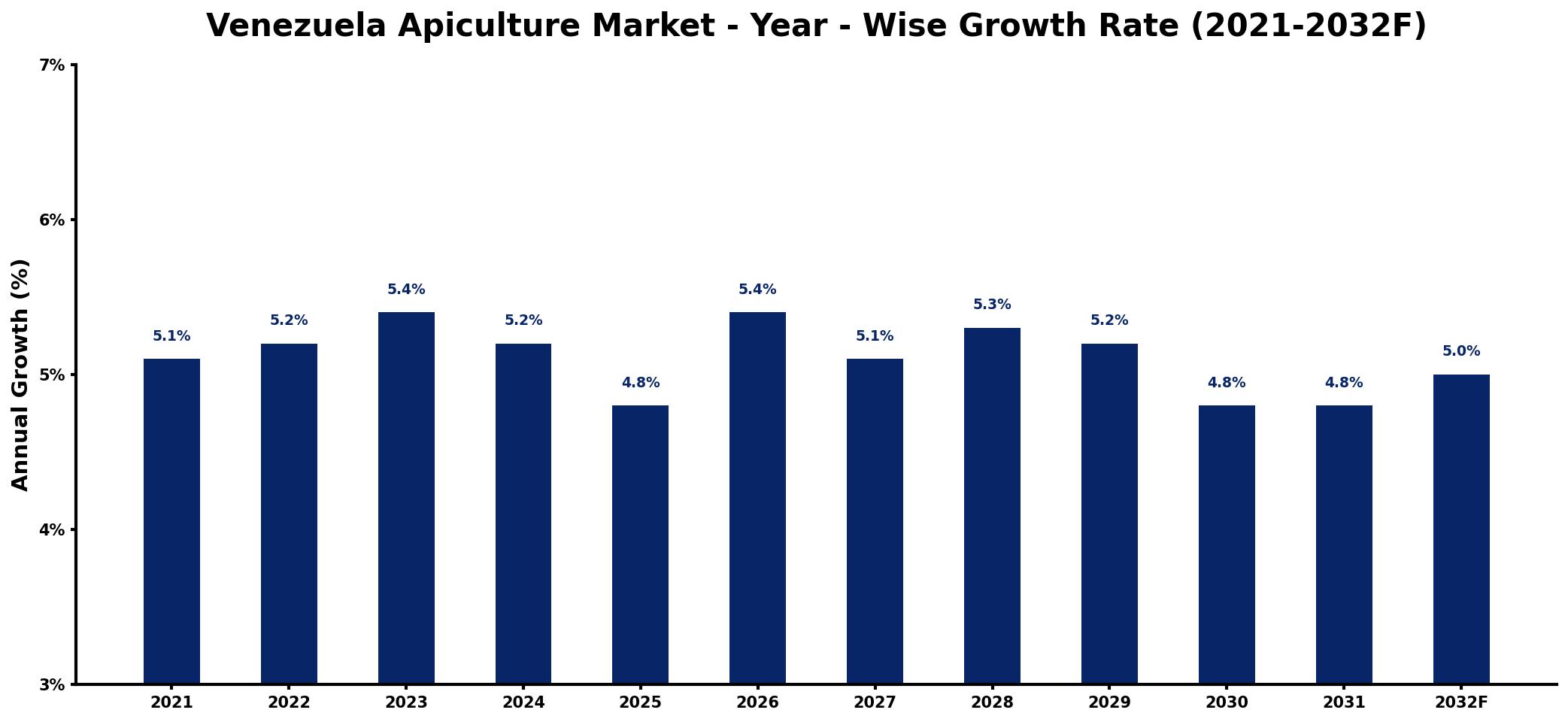
The table below presents the year‑wise growth rates along with the key drivers influencing the market
| Year | Growth Rate | Major Drivers |
| 2021 | 5.1% | Rising consumer health awareness |
| 2022 | 5.2% | Increased export market opportunities |
| 2023 | 5.4% | Growing popularity of organic products |
| 2024 | 5.2% | Expansion of local production facilities |
| 2025 | 4.8% | Emergence of niche market segments |
| 2026 | 5.4% | Higher investments in technology |
| 2027 | 5.1% | Strengthening of local cooperatives |
| 2028 | 5.3% | Increased focus on sustainability practices |
| 2029 | 5.2% | Growing demand for natural sweeteners |
| 2030 | 4.8% | Development of innovative processing methods |
| 2031 | 4.8% | Enhanced distribution network efficiency |
| 2032 | 5.0% | Rising interest in artisanal products |
Note: Market size estimations and growth projections presented in this report are based on 6Wresearch's proprietary forecasting methodology, utilizing the latest available industry data, government publications, and primary research inputs.
Venezuela Apiculture Market Synopsis
In recent years, the Venezuela Apiculture Market has gained momentum with a rising number of small-scale farmers and hobbyists engaging in beekeeping activities. This growing enthusiasm reflects a broader recognition of the vital ecological role bees play in agriculture and the need for sustainable practices within the industry.
As beekeepers strive to produce high-quality honey and value-added bee products, they face significant challenges, including political instability and a lack of infrastructure. Nonetheless, the shift towards organic and ethically sourced products positions the market for potential growth, even amidst adversity.
Venezuela Apiculture Market Key Takeaways
- The apiculture sector in Venezuela is largely characterized by small-scale operations and hobbyist practices.
- Consumer demand for organic and ethically sourced honey products is driving innovation in beekeeping practices.
- Despite economic instability, there is resilience in the market as beekeepers adapt to challenges through sustainable practices.
- Investment opportunities are emerging in value-added products and beekeeping technology to enhance production efficiency.
- The Venezuelan government is focusing on policies aimed at promoting the growth and sustainability of the apiculture sector.
Evaluation of Restraints in Venezuela Apiculture Market
The Venezuela Apiculture Market is constrained by several key factors that impede its full potential. Economic instability has led to fluctuating currency values, complicating access to essential beekeeping supplies and equipment. In addition, ongoing political unrest creates an uncertain environment that hampers the development and scaling of apiculture operations. Environmental issues such as pesticide use and deforestation further threaten bee populations, impacting honey production capabilities. These challenges collectively hinder beekeepers' ability to sustain operations and compete effectively on both national and international fronts.
Venezuela Apiculture Market Trends
There is a notable trend towards sustainable and organic beekeeping practices as consumers increasingly seek natural and ethically produced honey. Beekeepers are focusing on improving hive management techniques and utilizing organic treatments for pest control. The interest in specialty honey varieties, such as organic and raw options, is on the rise, appealing to the premium market segment. Moreover, the exploration of new distribution channels, including e-commerce and specialty retail, is helping beekeepers reach a broader audience.
Venezuela Apiculture Market Opportunities
There are promising investment opportunities within the Venezuela Apiculture Market, particularly in technology that enhances productivity and efficiency in beekeeping practices. Investors can explore avenues in value-added products such as honey-based cosmetics and health items, tapping into the growing consumer interest in natural products. Additionally, leveraging Venezuela's unique and diverse floral resources presents an avenue for producing high-quality honey varieties that can appeal to both local and international markets.
Government Initiatives in the Venezuela Apiculture Market
The Venezuelan government has recognized the importance of the apiculture sector in promoting economic development and food security. Policies are being implemented to provide training and technical assistance to beekeepers, alongside financial incentives to bolster industry growth. Research and innovation in sustainable apiculture practices are being prioritized, reflecting a commitment to enhancing the market's competitiveness and ensuring the safety and quality of bee products.
Future Insights of the Venezuela Apiculture Market
Looking ahead to the period from 2026 to 2032, the Venezuela Apiculture Market faces a landscape filled with both challenges and opportunities. While economic and political uncertainties loom, there is a significant potential for growth driven by consumer demand for organic honey products. Beekeepers will need to innovate and adapt to the economic climate, possibly focusing more on sustainable practices and product differentiation. The market's future will depend largely on the ability to foster partnerships and government support to navigate existing hurdles effectively.
Venezuela Apiculture Market Latest Developments (2025 - 2026)
Recent industry developments indicate a continued focus on sustainable beekeeping practices, with various initiatives aimed at improving the health of bee populations. There is growing collaboration between local producers and international organizations, fostering knowledge exchange and best practices in apiculture. Additionally, efforts to promote online sales channels for honey products are gaining traction, allowing beekeepers to reach a larger audience despite logistical challenges.
Venezuela Apiculture Market - Key Attractiveness of the Report
- 10 Years of Market Numbers
- Historical Data Starting from 2022 to 2025
- Base Year: 2025
- Forecast Data until 2032
- Key Performance Indicators Impacting the Market
- Major Upcoming Developments and Projects
Key Highlights of the Report:
- Venezuela Apiculture Market Outlook
- Market Size of Venezuela Apiculture Market, 2025
- Forecast of Venezuela Apiculture Market, 2032
- Historical Data and Forecast of Venezuela Apiculture Revenues & Volume for the Period 2022-2032F
- Venezuela Apiculture Market Trend Evolution
- Venezuela Apiculture Market Drivers and Challenges
- Venezuela Apiculture Price Trends
- Venezuela Apiculture Porter's Five Forces
- Venezuela Apiculture Industry Life Cycle
- Historical Data and Forecast of Venezuela Apiculture Market Revenues & Volume By Product Type for the Period 2022-2032F
- Historical Data and Forecast of Venezuela Apiculture Market Revenues & Volume By Honey for the Period 2022-2032F
- Historical Data and Forecast of Venezuela Apiculture Market Revenues & Volume By Beeswax for the Period 2022-2032F
- Historical Data and Forecast of Venezuela Apiculture Market Revenues & Volume By Live-bees for the Period 2022-2032F
- Historical Data and Forecast of Venezuela Apiculture Market Revenues & Volume By Others for the Period 2022-2032F
- Historical Data and Forecast of Venezuela Apiculture Market Revenues & Volume By Application for the Period 2022-2032F
- Historical Data and Forecast of Venezuela Apiculture Market Revenues & Volume By Medical for the Period 2022-2032F
- Historical Data and Forecast of Venezuela Apiculture Market Revenues & Volume By Food Beverages for the Period 2022-2032F
- Historical Data and Forecast of Venezuela Apiculture Market Revenues & Volume By Cosmetics for the Period 2022-2032F
- Historical Data and Forecast of Venezuela Apiculture Market Revenues & Volume By Others for the Period 2022-2032F
- Venezuela Apiculture Import Export Trade Statistics
- Market Opportunity Assessment By Product Type
- Market Opportunity Assessment By Application
- Venezuela Apiculture Top Companies Market Share
- Venezuela Apiculture Competitive Benchmarking By Technical and Operational Parameters
- Venezuela Apiculture Company Profiles
- Venezuela Apiculture Key Strategic Recommendations






































