Venezuela Whiskey Market Size, Share & Growth Rate
The Venezuela Whiskey Market was estimated at USD 1215 Million in 2025 and is projected to reach USD 1759 Million by 2032, growing at a CAGR of 5.4% from 2026 to 2032. This growth trajectory is driven by a burgeoning interest in premium whiskey offerings among consumers who seek authenticity and quality. The market is being shaped by innovative production methods and a focus on unique flavor profiles that appeal to both local and international audiences.
Venezuela Whiskey Market Year-wise Growth Rate and Key Drivers
This graph highlights how the Venezuela Whiskey Market has steadily grown over the years, supported by major growth factors.
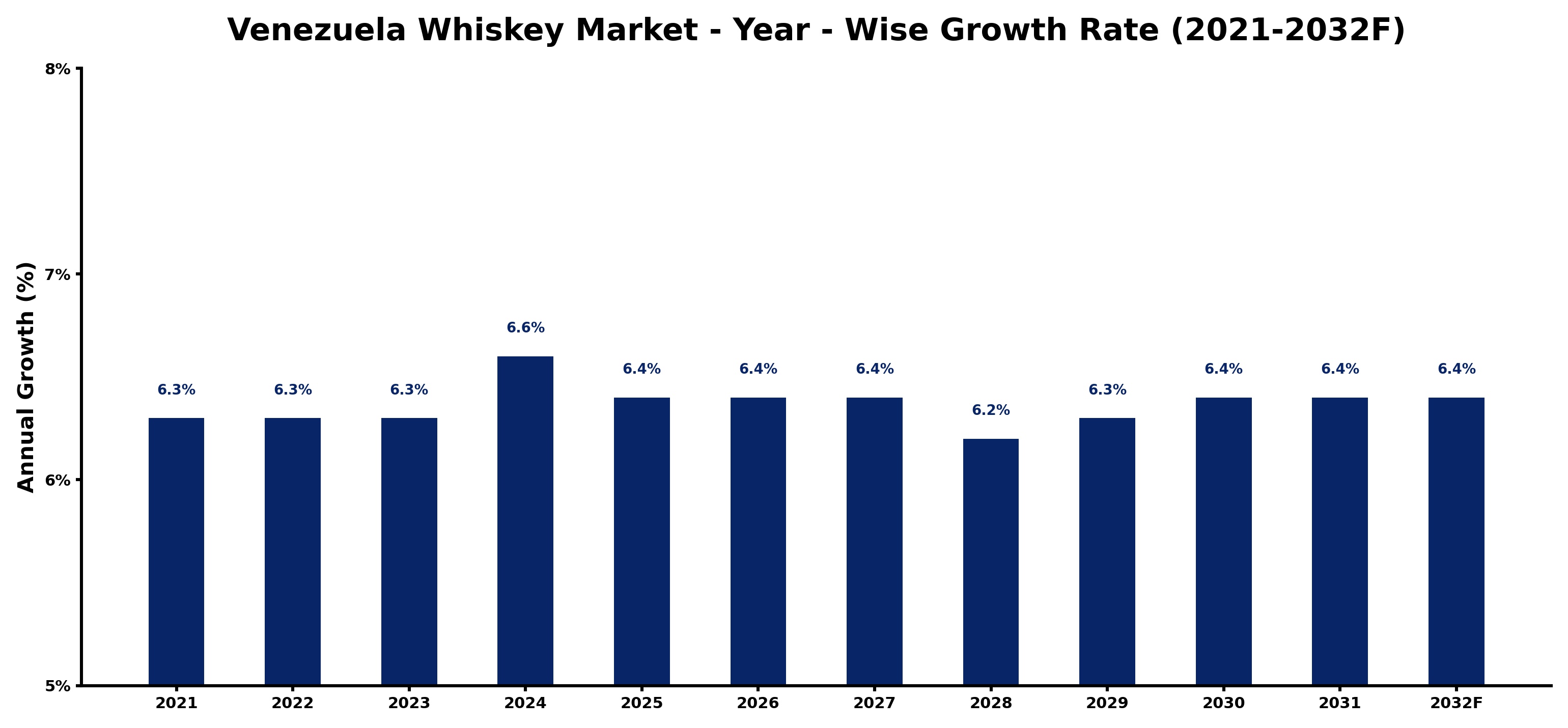
The table below presents the year‑wise growth rates along with the key drivers influencing the market
| Year | Growth Rate | Major Drivers |
| 2021 | 6.3% | Increased local production capacity |
| 2022 | 6.3% | Growing consumer interest in whiskey |
| 2023 | 6.3% | Expansion of whiskey tasting events |
| 2024 | 6.6% | Rise in premium whiskey segments |
| 2025 | 6.4% | Emergence of craft distilleries trend |
| 2026 | 6.4% | Enhanced marketing strategies implemented |
| 2027 | 6.4% | Collaboration with local influencers increased |
| 2028 | 6.2% | Diverse flavor profiles attracted consumers |
| 2029 | 6.3% | Whiskey tourism initiatives gained popularity |
| 2030 | 6.4% | Online sales channels expanded rapidly |
| 2031 | 6.4% | Increased investment in whiskey brands |
| 2032 | 6.4% | Social media campaigns drove engagement |
Note - Market size estimations and growth projections presented in this report are based on 6Wresearch’s advanced forecasting approach, validated with industry datasets as of June 2026.
Venezuela Whiskey Market Synopsis
Recent trends indicate a marked increase in consumer enthusiasm for whiskey, juxtaposed against the backdrop of Venezuela's storied rum production history. As whiskey brands emerge, they are carving out a niche that not only honors traditional techniques but also introduces contemporary twists, appealing to a more discerning customer base.
However, the market faces significant challenges due to the country's ongoing economic and political turbulence. While current momentum is promising, the future will demand agile adaptations to navigate external pressures while capitalizing on the rising demand for quality spirits.
Venezuela Whiskey Market Key Takeaways
- The Venezuela Whiskey Market is on a growth path, supported by the rising interest in premium and artisanal products.
- Innovative aging techniques and unique flavor profiles are gaining traction among consumers.
- The market remains impacted by economic challenges, necessitating strategic navigation by producers.
- Whiskey appreciation events are fostering consumer engagement and education, enhancing market penetration.
- Investment opportunities exist, particularly for partnerships focused on international market expansion.
Evaluation of Restraints in Venezuela Whiskey Market
The Venezuela Whiskey Market is significantly constrained by economic instability, which manifests through hyperinflation and currency devaluation. These factors have diminished consumer purchasing power, particularly for luxury goods such as whiskey. Additionally, stringent government regulations governing imports have created a scarcity of key raw materials, hindering production capabilities. The challenging financial landscape requires companies to innovate continually, but many still grapple with the operational realities that limit market expansion and consumer access.
Venezuela Whiskey Market Trends
A noticeable shift towards premiumization defines the current landscape of the Venezuela Whiskey Market. Consumers are increasingly inclined to explore unique offerings that highlight local craftsmanship, including diverse aging techniques such as cask finishes. Moreover, there is a rising interest in whiskey tasting events and educational experiences that not only enhance appreciation but also reinforce the cultural significance of whiskey production in the region. As consumers evolve, so too do their expectations for quality and authenticity.
Venezuela Whiskey Market Opportunities
The Venezuela Whiskey Market holds promising investment avenues, particularly for brands looking to leverage local expertise in spirit production. Strategic partnerships with distilleries can open doors to international markets, allowing Venezuelan whiskey to reach a broader audience. Furthermore, capitalizing on the growing interest in high-quality whiskey domestically presents an opportunity to build brand loyalty among consumers who seek authentic experiences. Navigating the complexities of the market will require innovative marketing strategies that resonate with a diverse consumer base.
Government Initiatives in the Venezuela Whiskey Market
Government policies in Venezuela significantly shape the whiskey market, particularly concerning import regulations and pricing structures. Stricter regulations have resulted in high barriers for importation, affecting product availability and affordability. Additionally, currency fluctuations and inflation pose challenges for industry players as they strive to comply with licensing and tax requirements. Overall, the policy environment remains critical in influencing market dynamics, necessitating that producers remain adaptive to evolving regulations.
Future Insights of the Venezuela Whiskey Market
The outlook for the Venezuela Whiskey Market through 2026-2032 is one of cautious optimism. Despite prevailing economic hardships, a segment of consumers is poised to prioritize premium whiskey as a sought-after luxury. As brands continue to differentiate themselves through innovation and quality, the potential for growth exists, especially within the craft whiskey segment. However, continued monitoring of government policy and market conditions will be essential for stakeholders aiming to capitalize on emerging opportunities.
Venezuela Whiskey Market Latest Developments (May 2025 - June 2026)
Recent developments in the Venezuela Whiskey Market indicate a surge in promotional efforts aimed at educating consumers about local offerings. Distilleries are increasingly participating in tasting events and community engagements to bolster their brand presence. Additionally, there is a noticeable push towards refining production techniques to enhance the quality and appeal of Venezuelan whiskey on both domestic and international fronts. These initiatives aim to establish a stronger foothold amid ongoing challenges and foster greater appreciation for the craft.
Venezuela Whiskey Market - Key Attractiveness of the Report
- 10 Years of Market Numbers
- Historical Data Starting from 2022 to 2025
- Base Year: 2025
- Forecast Data until 2032
- Key Performance Indicators Impacting the Market
- Major Upcoming Developments and Projects
Key Highlights of the Report:
- Venezuela Whiskey Market Outlook
- Market Size of Venezuela Whiskey Market, 2025
- Forecast of Venezuela Whiskey Market, 2032
- Historical Data and Forecast of Venezuela Whiskey Revenues & Volume for the Period 2022-2032F
- Venezuela Whiskey Market Trend Evolution
- Venezuela Whiskey Market Drivers and Challenges
- Venezuela Whiskey Price Trends
- Venezuela Whiskey Porter's Five Forces
- Venezuela Whiskey Industry Life Cycle
- Historical Data and Forecast of Venezuela Whiskey Market Revenues & Volume By Product Type for the Period 2022-2032F
- Historical Data and Forecast of Venezuela Whiskey Market Revenues & Volume By American Whisky for the Period 2022-2032F
- Historical Data and Forecast of Venezuela Whiskey Market Revenues & Volume By Irish Whisky for the Period 2022-2032F
- Historical Data and Forecast of Venezuela Whiskey Market Revenues & Volume By Scotch Whisky for the Period 2022-2032F
- Historical Data and Forecast of Venezuela Whiskey Market Revenues & Volume By Canadian Whisky for the Period 2022-2032F
- Historical Data and Forecast of Venezuela Whiskey Market Revenues & Volume By Others for the Period 2022-2032F
- Historical Data and Forecast of Venezuela Whiskey Market Revenues & Volume By Distribution Channel for the Period 2022-2032F
- Historical Data and Forecast of Venezuela Whiskey Market Revenues & Volume By On-trade for the Period 2022-2032F
- Historical Data and Forecast of Venezuela Whiskey Market Revenues & Volume By Off-trade for the Period 2022-2032F
- Venezuela Whiskey Import Export Trade Statistics
- Market Opportunity Assessment By Product Type
- Market Opportunity Assessment By Distribution Channel
- Venezuela Whiskey Top Companies Market Share
- Venezuela Whiskey Competitive Benchmarking By Technical and Operational Parameters
- Venezuela Whiskey Company Profiles
- Venezuela Whiskey Key Strategic Recommendations






































