Jordan Apiculture Market Size, Share & Growth Rate
The Jordan Apiculture Market was estimated at USD 790 Million in 2025 and is projected to reach USD 1125 Million by 2032, growing at a CAGR of 5.2% from 2026 to 2032. This growth trajectory is primarily fueled by increasing consumer awareness regarding the health benefits of honey and a rising trend towards organic and sustainable products. The unique biodiversity and favorable climatic conditions in Jordan further bolster honey production, positioning the country as a vital player in the regional apiculture market.
Jordan Apiculture Market Year-wise Growth Rate and Key Drivers
This graph highlights how the Jordan Apiculture Market has steadily grown over the years, supported by major growth factors.
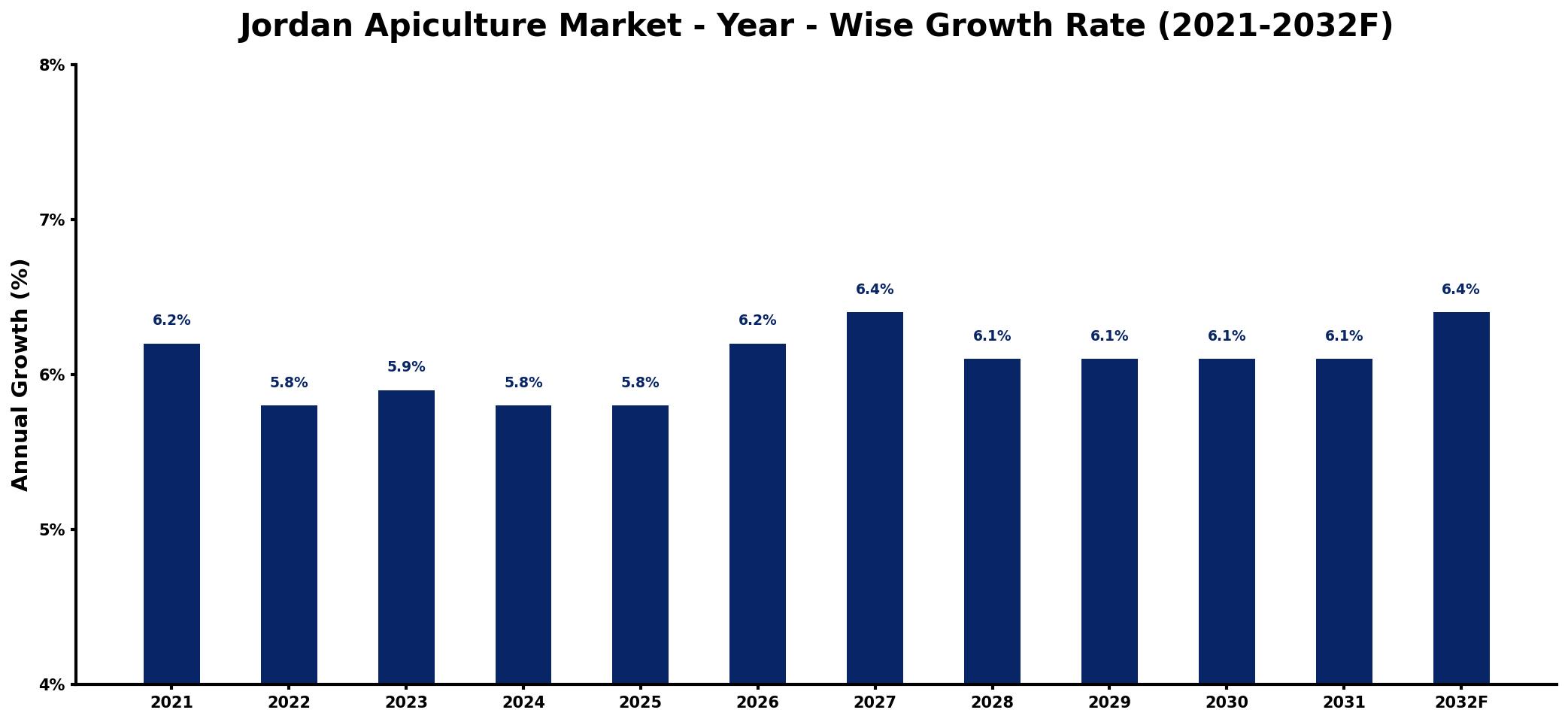
The table below presents the year‑wise growth rates along with the key drivers influencing the market
| Year | Growth Rate | Major Drivers |
| 2021 | 6.2% | Rising interest in organic products |
| 2022 | 5.8% | Growing health awareness among consumers |
| 2023 | 5.9% | Increased demand for natural sweeteners |
| 2024 | 5.8% | Expansion of export markets |
| 2025 | 5.8% | Investment in sustainable farming practices |
| 2026 | 6.2% | Surge in local production capabilities |
| 2027 | 6.4% | Enhanced research and development efforts |
| 2028 | 6.1% | Strengthening of farmer cooperatives |
| 2029 | 6.1% | Diversification into new product lines |
| 2030 | 6.1% | Development of eco-friendly packaging |
| 2031 | 6.1% | Collaboration with international markets |
| 2032 | 6.4% | Rising popularity of wellness trends |
Note: Market size estimations and growth projections presented in this report are based on 6Wresearch's proprietary forecasting methodology, utilizing the latest available industry data, government publications, and primary research inputs.
Jordan Apiculture Market Synopsis
The Jordanian apiculture market is currently on an upward trend, driven by the dual forces of consumer demand for natural honey and supportive government initiatives for beekeepers. Traditional apiculture practices, combined with a rich variety of floral sources, allow Jordan to produce high-quality honey products that resonate with both local and international markets.
Jordans unique geographical advantages and a commitment to sustainable agricultural practices lay the groundwork for future industry expansion. Despite challenges such as climate change and pest management, the focus on improving beekeeping techniques bodes well for the industrys longevity and market competitiveness.
Jordan Apiculture Market Key Takeaways
- Rising consumer preference for organic and sustainable bee products is reshaping production practices.
- The government's support, including training and financial assistance for beekeepers, is crucial for market growth.
- Diverse flora contributes to the production of high-quality honey, enhancing export potential.
- Challenges such as climate change and pest management must be addressed to sustain productivity.
- Investment opportunities abound, particularly in organic beekeeping and value-added product development.
Evaluation of Restraints in Jordan Apiculture Market
The Jordanian apiculture market faces significant constraints that could impede its growth. Limited access to modern beekeeping technology hampers efficiency and productivity, resulting in lower honey quality. Additionally, unpredictable climate patterns, such as droughts, can disrupt bee foraging, threatening hive health. The absence of standardized regulations further complicates the landscape, making it difficult for local producers to compete in international markets. Addressing these constraints through targeted strategies will be essential for the market to fully realize its potential.
Jordan Apiculture Market Trends
A notable trend in the Jordanian apiculture sector is the shift towards sustainable and eco-friendly practices. Beekeepers are increasingly adopting organic methods, driven by consumer demand for natural products devoid of harmful chemicals. This focus on environmental responsibility is further complemented by rising awareness of the health benefits associated with honey consumption, propelling interest in locally sourced products. As the market evolves, there is a clear push for innovations in beekeeping techniques that prioritize bee welfare and honey quality.
Jordan Apiculture Market Opportunities
The Jordan apiculture market holds numerous investment opportunities for those looking to capitalize on the growing demand for bee products. With a robust local environment conducive to beekeeping, potential investors can establish commercial bee farms or honey processing facilities. The interest in organic and sustainably sourced honey opens avenues for value-added products, such as propolis skincare or beeswax candles. Furthermore, the potential for exporting high-quality Jordanian honey to international markets presents a lucrative opportunity for growth.
Government Initiatives in the Jordan Apiculture Market
The Jordanian government actively supports the apiculture sector through various initiatives aimed at enhancing productivity and sustainability. Programs include financial support and subsidies for beekeepers, along with training schemes focused on best practices in beekeeping. The establishment of quality standards for honey production ensures that Jordanian products meet both local and international market demands. Furthermore, regulations to limit harmful pesticide use contribute to the protection and health of bee populations, which is vital for the industry's success.
Future Insights of the Jordan Apiculture Market
Looking ahead to the 2026-2032 period, the Jordan apiculture market is poised for continued growth, driven by escalating consumer interest in health and sustainability. The governments commitment to supporting small-scale farmers and promoting sustainable agriculture is expected to catalyze industry advancements. As Jordan enhances its presence in the global apiculture market, addressing ongoing challenges will be critical to sustaining growth. The convergence of consumer trends and policy support indicates a favorable outlook for the sector.
Jordan Apiculture Market Latest Developments (2025 - 2026)
Recent developments in the Jordan apiculture market signal a positive shift towards sustainable practices. Beekeepers are increasingly participating in organic certification programs, aligning with growing consumer preferences for eco-friendly products. Additionally, training initiatives launched by the government have garnered attention, enhancing beekeeping techniques and encouraging higher quality honey production. The sector is also witnessing collaborations aimed at research and development, focusing on pest management and hive health.
Jordan Apiculture Market - Key Attractiveness of the Report
- 10 Years of Market Numbers
- Historical Data Starting from 2022 to 2025
- Base Year: 2025
- Forecast Data until 2032
- Key Performance Indicators Impacting the Market
- Major Upcoming Developments and Projects
Key Highlights of the Report:
- Jordan Apiculture Market Outlook
- Market Size of Jordan Apiculture Market, 2025
- Forecast of Jordan Apiculture Market, 2032
- Historical Data and Forecast of Jordan Apiculture Revenues & Volume for the Period 2022-2032F
- Jordan Apiculture Market Trend Evolution
- Jordan Apiculture Market Drivers and Challenges
- Jordan Apiculture Price Trends
- Jordan Apiculture Porter's Five Forces
- Jordan Apiculture Industry Life Cycle
- Historical Data and Forecast of Jordan Apiculture Market Revenues & Volume By Product Type for the Period 2022-2032F
- Historical Data and Forecast of Jordan Apiculture Market Revenues & Volume By Honey for the Period 2022-2032F
- Historical Data and Forecast of Jordan Apiculture Market Revenues & Volume By Beeswax for the Period 2022-2032F
- Historical Data and Forecast of Jordan Apiculture Market Revenues & Volume By Live-bees for the Period 2022-2032F
- Historical Data and Forecast of Jordan Apiculture Market Revenues & Volume By Others for the Period 2022-2032F
- Historical Data and Forecast of Jordan Apiculture Market Revenues & Volume By Application for the Period 2022-2032F
- Historical Data and Forecast of Jordan Apiculture Market Revenues & Volume By Medical for the Period 2022-2032F
- Historical Data and Forecast of Jordan Apiculture Market Revenues & Volume By Food Beverages for the Period 2022-2032F
- Historical Data and Forecast of Jordan Apiculture Market Revenues & Volume By Cosmetics for the Period 2022-2032F
- Historical Data and Forecast of Jordan Apiculture Market Revenues & Volume By Others for the Period 2022-2032F
- Jordan Apiculture Import Export Trade Statistics
- Market Opportunity Assessment By Product Type
- Market Opportunity Assessment By Application
- Jordan Apiculture Top Companies Market Share
- Jordan Apiculture Competitive Benchmarking By Technical and Operational Parameters
- Jordan Apiculture Company Profiles
- Jordan Apiculture Key Strategic Recommendations






































